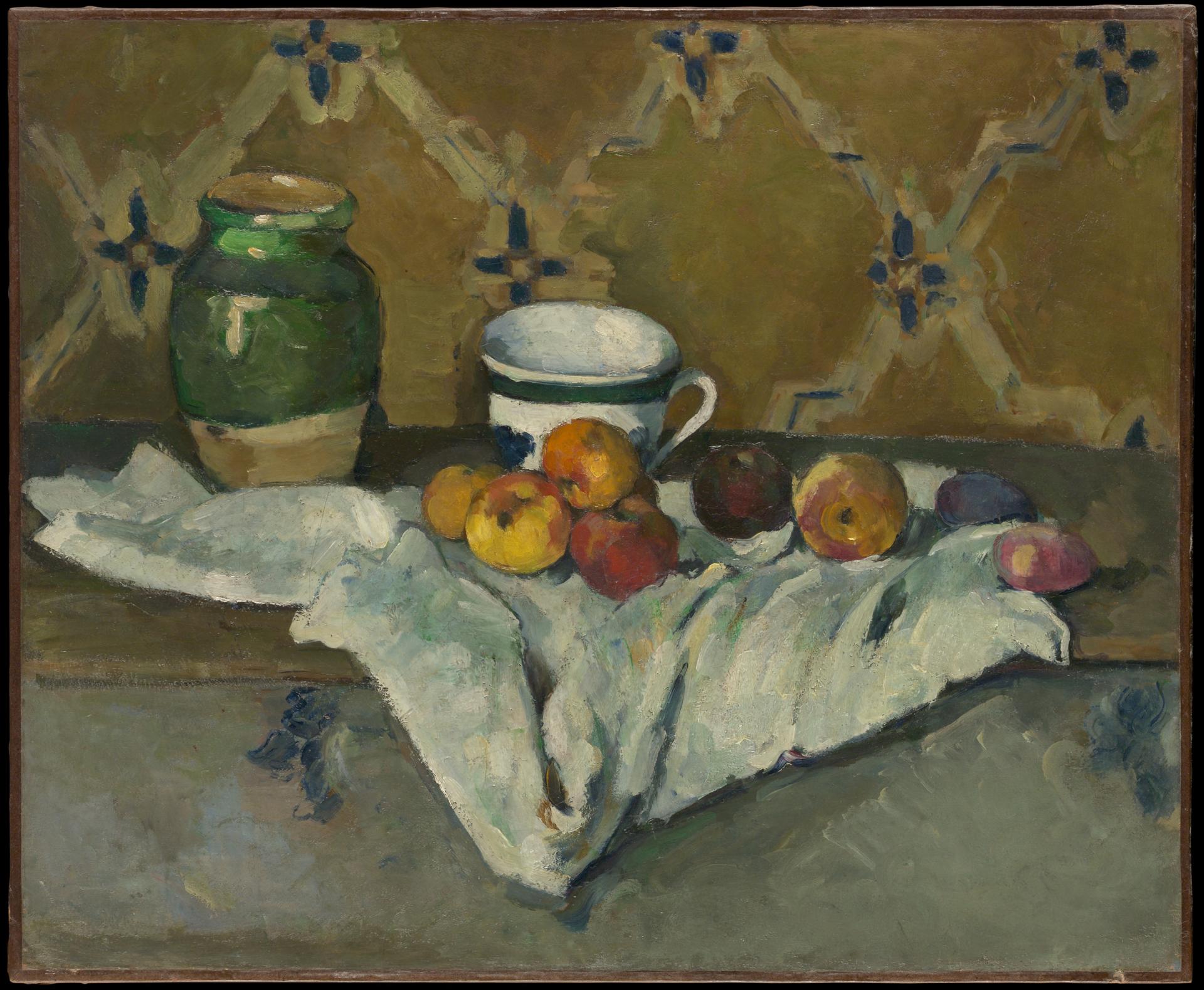
Still Life with Jar, Cup, and Apples
Original title: Still Life with Jar, Cup, and Apples
kurzbeschreibung
A green glass vessel, a white cup with a green rim, a bowl, and several apples sit on a cloth-covered table. Paul Cézanne painted this arrangement around 1877 in oil on canvas. It belongs to his many still lifes, with which he continually reexamined the genre.
Description
A green glass vessel, a white cup with a green rim, a bowl, and apples of varying colors and sizes are spread across a cloth over a tabletop. Behind them, a wall displays a pattern of crosses and flowers. The colors are muted, and the light is soft. The Impressionist style relies on color and texture.
Context
During the 1870s, Cézanne engaged deeply with Impressionist methods, yet he was already forging his own path. Still life served as a central motif for him to study form, light, and pictorial structure. The painting was made while Cézanne was working near Paris and in contact with Impressionists such as Pissarro—hence the loose brushwork. It joins many still lifes in which he investigated the relationship between objects and their surroundings.
Impact
The muted colors and soft light evoke a calm, contemplative mood. The arrangement of objects appears balanced but not rigid, giving the picture a natural liveliness. The Impressionist surface invites close viewing of the painting.
Technique
Oil on canvas, a technique typical of the period. The brushwork is loose and visible, characteristic of Impressionism, and emphasizes the texture of the paint layers. Cézanne used oil paint to model subtle gradations of light and shadow.
AI-generated description text
Source: Metropolitan Museum of Art · Public Domain (CC0 1.0)