Satyrical Poetry
Original title: Satyrical Poetry
kurzbeschreibung
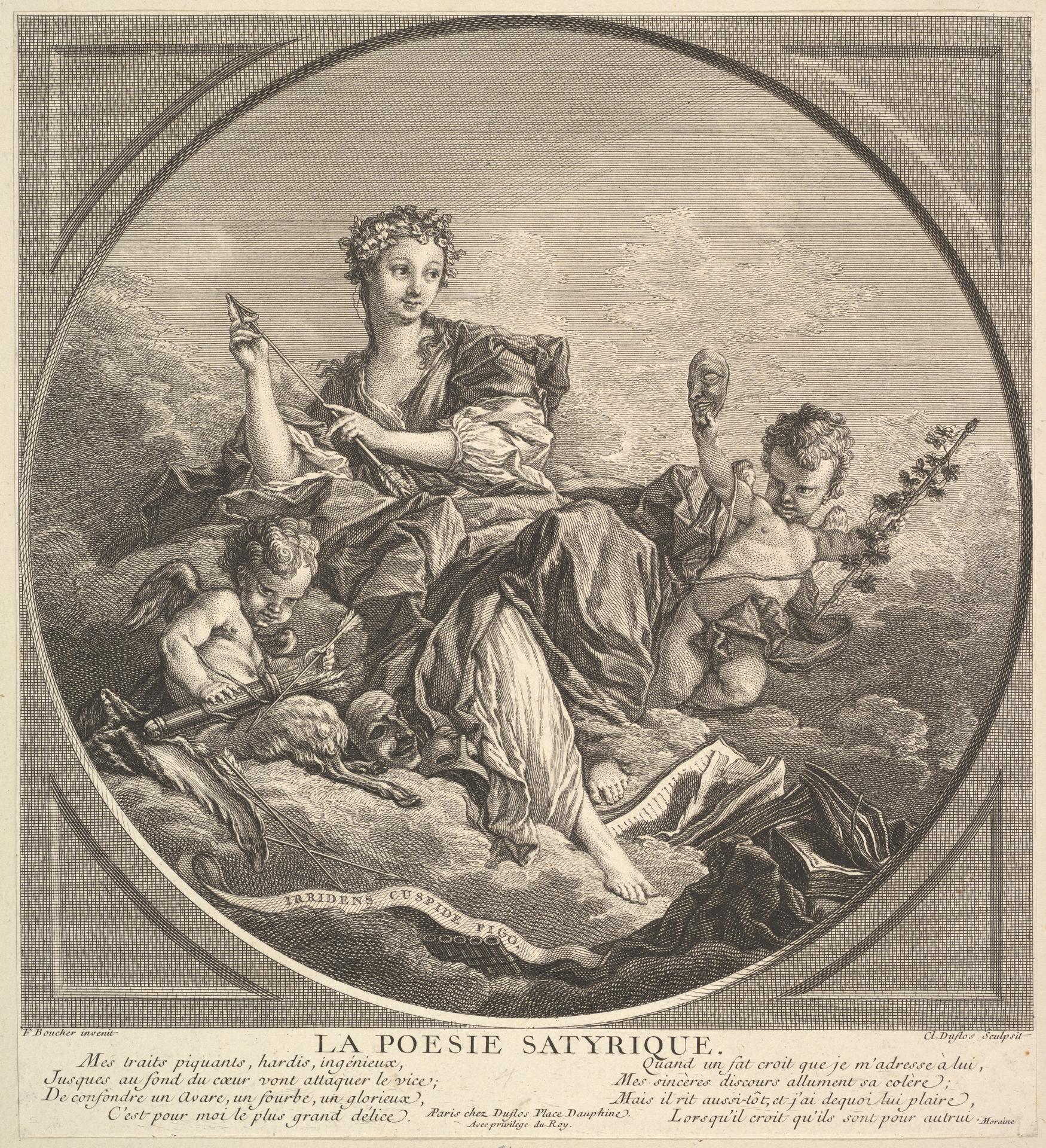
Claude Augustin Duflos le Jeune made this print, titled Satirische Poesie, around 1741, combining etching and engraving. Within a circular frame, an allegorical scene unfolds: a woman in classical drapery and a flower wreath sits at the center, holding an arrow and a quill. Two putti accompany her—one bears a mask, the other a bouquet.
Description
A round frame encloses the scene, where a woman in antique dress with a floral wreath appears; she holds an arrow and a writing quill. Flanking her are two putti, one presenting a mask and the other a bouquet. Beneath the putto with the mask, a skull rests on the ground. Clouds and a sky backdrop give the image a heavenly or supernatural mood. A text in the lower section underscores the satirical character of the view.
Context
The French engraver Claude Augustin Duflos le Jeune, prized in the eighteenth century for his fine prints, created this work around 1741. In that era, allegorical and satirical subjects enjoyed great popularity in French art. The arrow and quill, together with masks and skull, suggest a link between poetry and satire—a theme gaining weight in the Enlightenment.
Impact
Between heavenly loftiness and ironic detachment, the sheet unfolds an ambivalent mood. Careful shading and precise lines give it an elegant yet contemplative note. The contrast between the playful putti and the somber skull heightens the satirical message of the motif.
Technique
Etching and engraving—a common combination in the eighteenth century—allow fine lines and exact shading, so that figures and objects stand out in detail. With sheet dimensions of about 26 × 23.6 cm, it is a compact, richly detailed print.
AI-generated description text
Source: Metropolitan Museum of Art · Public Domain (CC0 1.0)