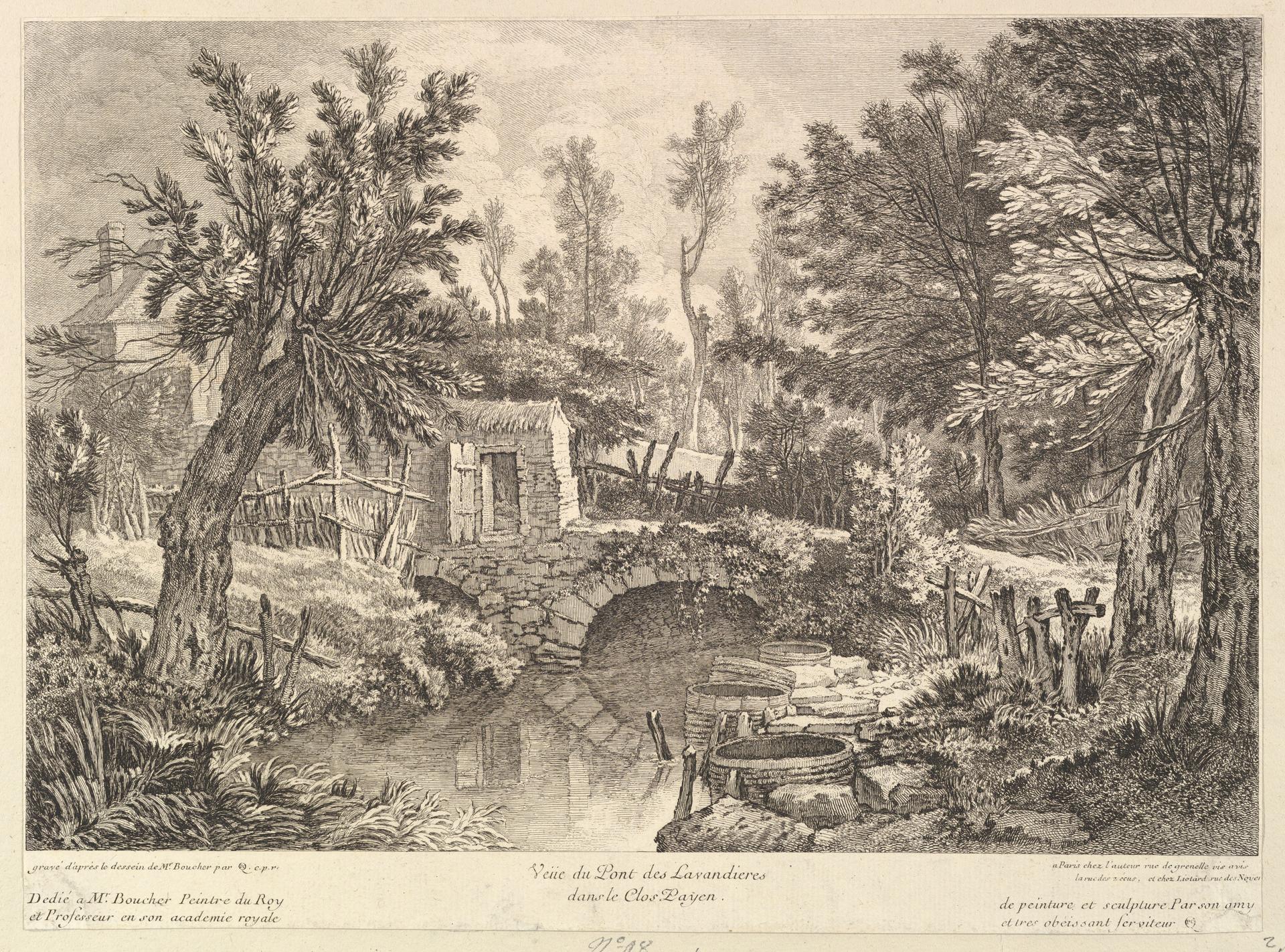
View of the Bridge of Washerwomen at the Peasant House
Original title: View of the Bridge of Washerwomen at the Peasant House
kurzbeschreibung
Quentin Pierre Chedel etched this view of the washing bridge at the farmhouse in the mid-eighteenth century. It leads into the garden of Yvain, where a bridge spans a stream. Dense trees and shrubs surround the rural setting, and a small building with an open gate stands beyond.
Description
A bridge carrying laundry baskets crosses a stream in the foreground. On the left rises a tree with a full crown; on the right, more trees and bushes line the path. Beyond, a small building with a gate, used as a washhouse, opens onto the garden. The stream runs through grounds whose banks are thickly overgrown. Rendered in black and white, the print records nature and architecture in abundant detail.
Context
Chedel, an eighteenth-century French draughtsman and engraver, was known for his landscapes. Idyllic scenery and rural subjects were popular in French art of the mid-eighteenth century. The garden of Yvain with its washing bridge was a real place that artists valued for its picturesque charm. The sheet belongs to the veduta, a genre that gave topographical views an artistic form.
Impact
A quiet, rural mood emanates from the etching, carried by the dense vegetation and the flowing water. The delicate linework and clear layout invite viewers to explore the details of the scene. Because it is printed in black and white, the work feels timeless and documentary.
Technique
Etching is an intaglio process: the drawing is scratched into an acid-resistant layer on a copper plate and then bitten by acid. Fine lines and graded hatching reproduce light and shadow precisely. The sheet was printed on paper and trimmed to 26.4 × 35.8 cm.
AI-generated description text
Source: Metropolitan Museum of Art · Public Domain (CC0 1.0)