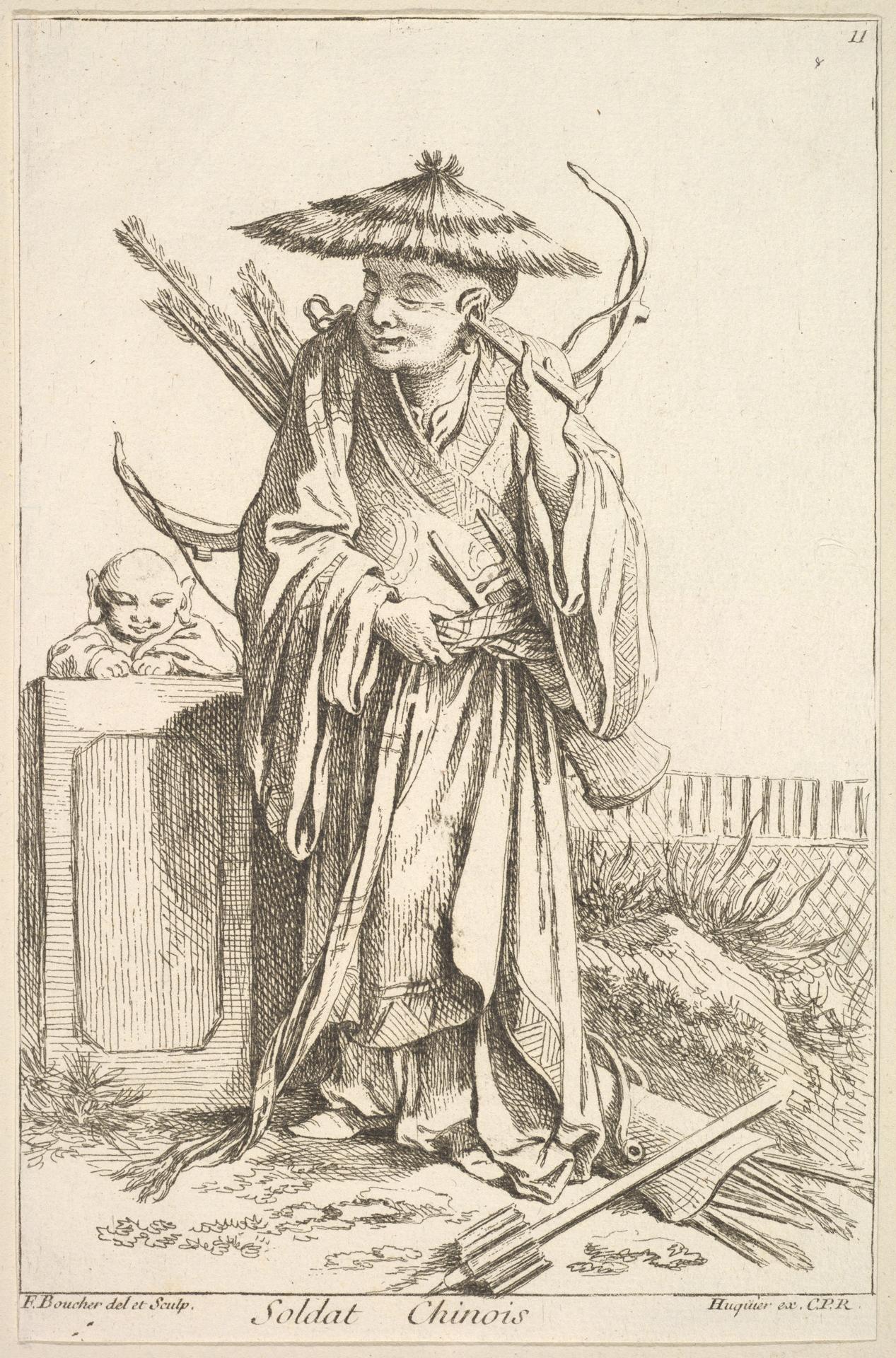
Chinese Soldier
Original title: Chinese Soldier
kurzbeschreibung
François Boucher made the etching Chinesischer Soldat between 1738 and 1745. It depicts a soldier in Chinese dress, equipped with bow and arrow; behind him a boy sits at a table. The print belongs to the European chinoiserie of the eighteenth century and is an early example of that enthusiasm.
Description
Boucher places the soldier at the centre of the foreground, while a small boy sits at a table behind him and gestures with one hand. A traditional headdress and a folds-rich garment define the figure, whose materiality emerges from fine hatching. Grass and individual branches cover the ground. The motif remains monochrome; hatching of varying density creates light and shadow.
Context
When Boucher made this etching, Chinese art was greatly admired in Europe. The print is part of a series of prints with Chinese subjects that were in demand at the time. The artist never saw China himself; his knowledge came from travel accounts and from imported porcelain and lacquer work. The print was probably intended for collectors who enjoyed exotic motifs.
Impact
Calm and elegance emanate from the print, which at the same time seems exotic through its linework and balanced arrangement. The symmetrical layout and the carefully observed costume of the soldier give the print a decorative quality characteristic of the Rococo.
Technique
The work is executed as an etching: the drawing is scratched into a wax layer on a copper plate and the metal is then etched. Depending on the etching time and the placement of the lines, fine lines and gradations of shadow are produced. The sheet has been trimmed to 20.9 × 13.5 cm, which suggests later treatment.
AI-generated description text
Source: Metropolitan Museum of Art · Public Domain (CC0 1.0)