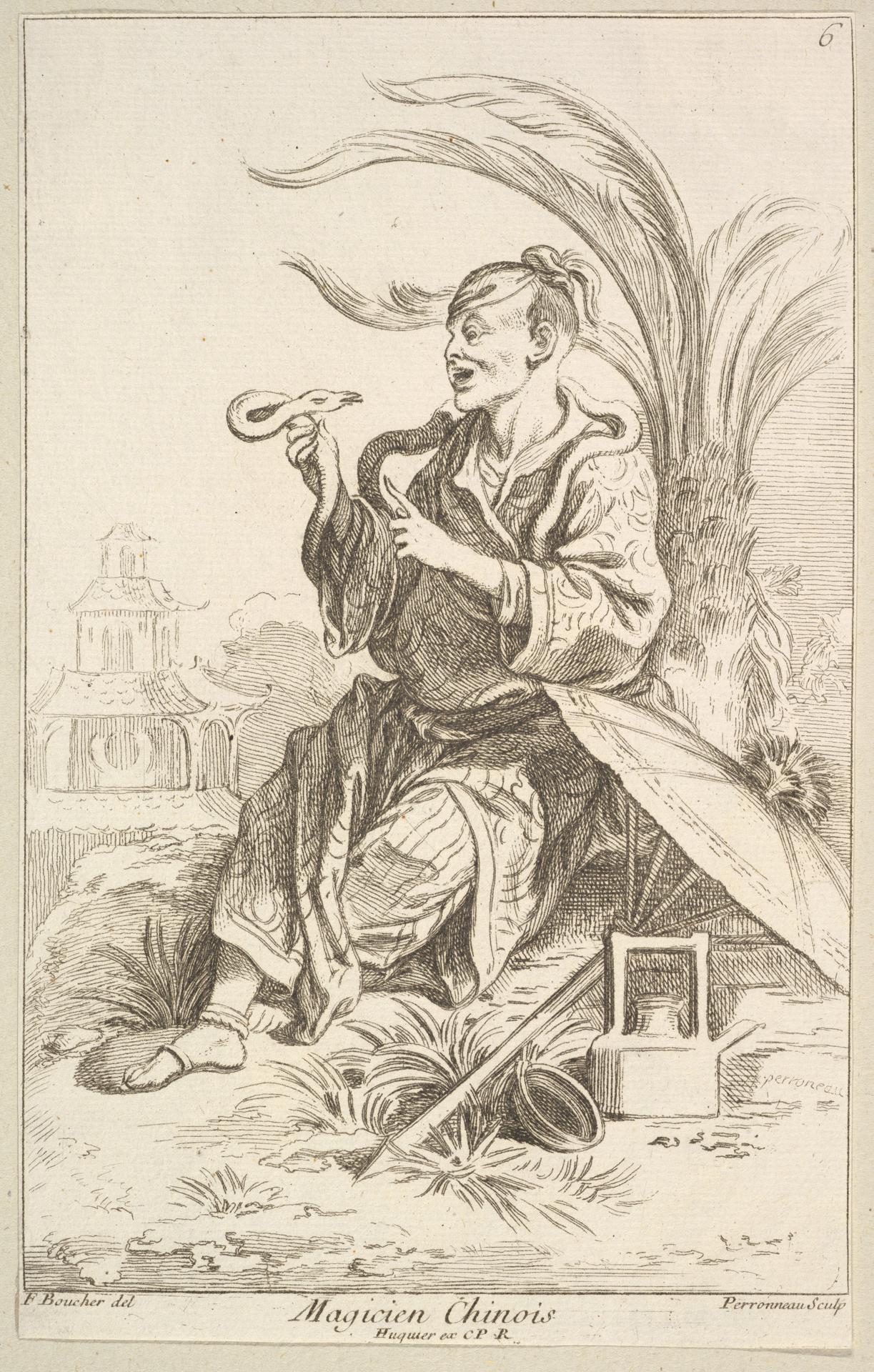
Chinese Magician
Original title: Chinese Magician
kurzbeschreibung
A Chinese figure in traditional dress sits on a rock, holding a quill — this is the subject of Jean-Baptiste Perronneau's etching Chinesischer Magier, made between 1738 and 1745. Exotic architecture and plants frame the figure, making the sheet a typical example of Chinoiserie.
Description
The magician sits enthroned on a rock, quill in hand, his patterned robe carefully rendered. His posture and expression feel theatrical and reinforce the magical mood. Behind him rises a Chinese building with a curved roof, a palm tree reaching above it. A cylindrical object lies beside the figure, and leaves and plants cover the ground. The layout is asymmetrical, drawing the eye clearly to the figure and the palm; diffuse light creates a muted atmosphere.
Context
Jean-Baptiste Perronneau, an eighteenth-century French painter and printmaker, is best known for his pastel portraits. This etching falls in a period when European artists increasingly took up Asian motifs, encouraged by the China trade. The sheet was probably made as part of a series of exotic subjects suited to Rococo taste. Nothing is recorded about the exact circumstances of its making, yet the work is regarded as an example of the Chinoiserie fashion in Europe.
Impact
Fine lines and a calm arrangement give the sheet an elegant and at the same time mysterious note. Exotic props meet restrained lighting, producing a quiet, almost meditative presence. The viewer is transported to a distant, idealized world of the kind Chinoiserie is known for.
Technique
As an etching, the work shows fine lines and nuanced shading achieved through varying depths of acid bite. The black-and-white print relies entirely on line and tone to create depth and texture. The sheet was printed on paper and trimmed to 20.7 × 13 cm.
AI-generated description text
Source: Metropolitan Museum of Art · Public Domain (CC0 1.0)