Rocks at Fontainebleau
Original title: Rocks at Fontainebleau
kurzbeschreibung
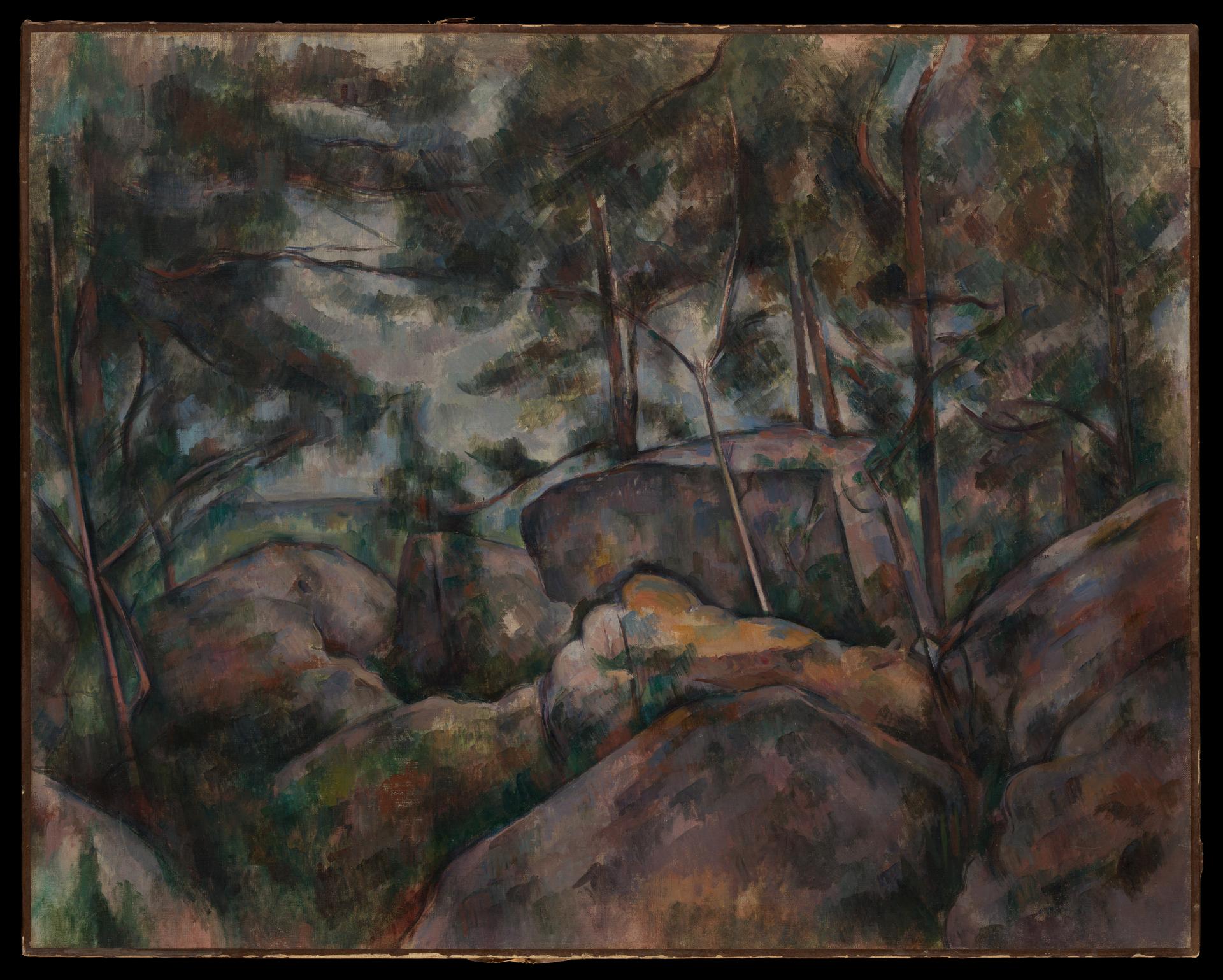
Paul Cézanne painted 'Rocks in Fontainebleau' in the 1890s. The oil on canvas, measuring 73.3 by 92.4 cm, presents a landscape with striking rock formations and trees.
Description
Large, irregular boulders in shades of grey, accented with green and brown, dominate the foreground; their edges remain soft. Behind them rise trees with dense branches and foliage in various greens, interspersed with brown and grey shadows. The sky appears grey, suggesting overcast weather. Light is diffuse and gentle, and the overall palette is restrained.
Context
Cézanne returned repeatedly to motifs in the Forest of Fontainebleau, a popular retreat for artists in the nineteenth century. During the 1890s he increasingly experimented with simplifying forms and emphasizing areas of colour. This work dates from a period when he was breaking away from Impressionism and developing his own constructive pictorial language.
Impact
The muted colours and soft light evoke a calm, somewhat melancholy mood. Expressive brushstrokes and simplified forms give the picture a modern, almost abstract appearance that prompts the viewer to study its structures closely.
Technique
Cézanne worked with oil paint on canvas, using visible, expressive brushstrokes. He applied colours in layers, employing areas and contrasts of colour to suggest depth and form. His technique combines Impressionist painting of light with a Post-Impressionist emphasis on structure.
AI-generated description text
Source: Metropolitan Museum of Art · Public Domain (CC0 1.0)