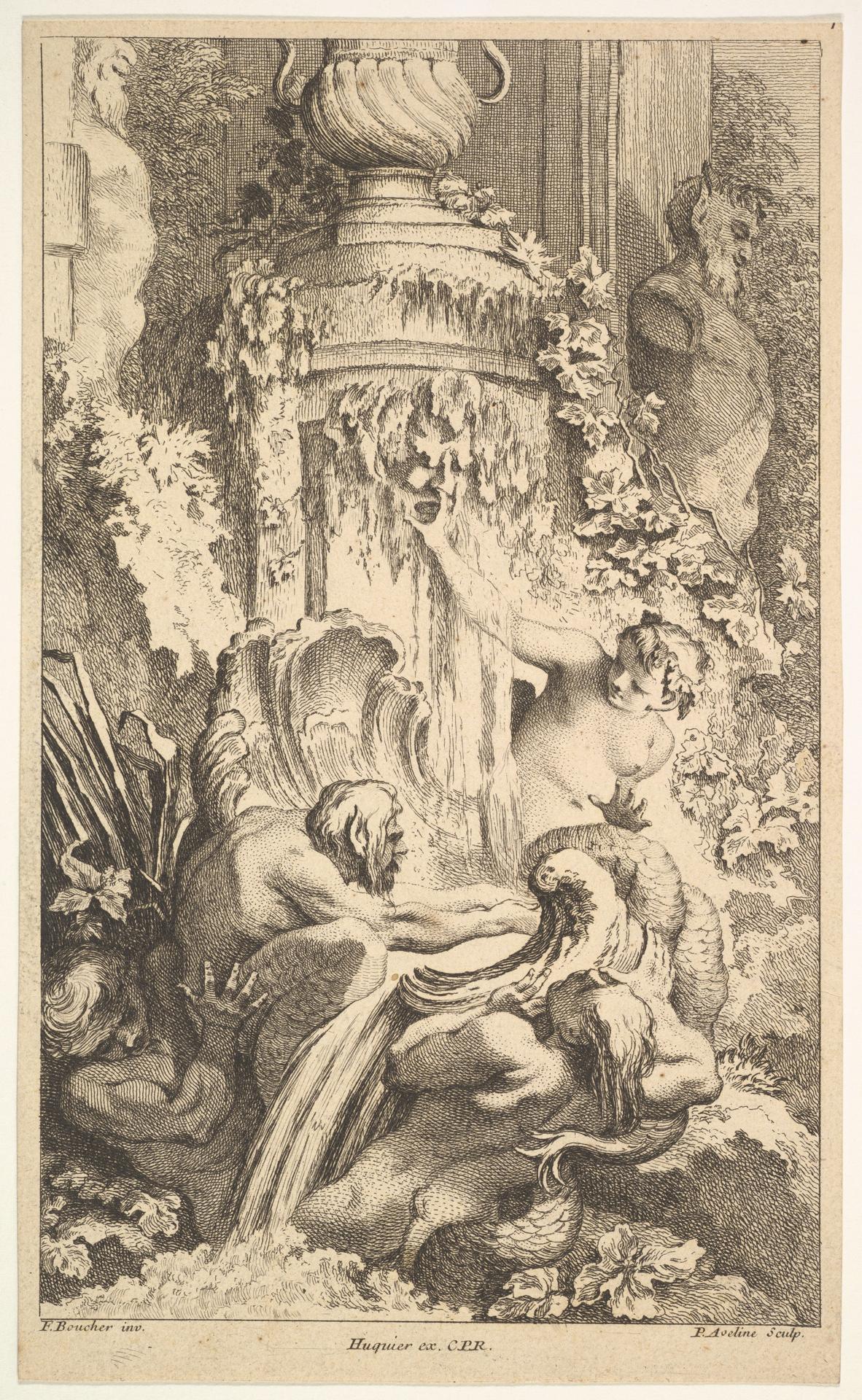
Naiades, Tritons and the Bath of Priap
Original title: Naiades, Tritons and the Bath of Priap
kurzbeschreibung
Pierre Alexandre Aveline issued this etching and engraving in 1736, bringing together naiads, tritons and the bath of Priapus. Within his printed oeuvre, the sheet stands for the French reception of mythology in the eighteenth century and combines narrative figure art with ornamental richness.
Description
Two tritons occupy the foreground of a lavishly equipped water fountain: one carries a fish, the other dives into the basin. A naiad also appears in the pool, surrounded by hanging floral work and tendrils. Behind them, further figures and architectural elements belonging to the mythological cast of the scene can be made out. The layout feels densely woven and rich in detail; the print remains monochrome, with light and shade created by fine hatching and cross-hatching.
Context
Aveline ranks among the French copperplate engravers of the eighteenth century who made a name for themselves with ornamental prints and mythological subjects. Made in 1736, the sheet falls in a phase when Baroque and incipient Rococo shaped French art. Courtly and aristocratic circles valued such scenes as decorative models or illustrations. Who commissioned the print and what purpose it served are not recorded.
Impact
The dense arrangement and wealth of detail give rise to a lively mood reminiscent of a stage. Delicate lines and gradations lend the image an elegant lightness characteristic of French printmaking of these years. Anyone stepping before the sheet is transported into a fantastic world that both adorns and narrates.
Technique
Etching and engraving were combined so that fine lines and precise hatching were possible. Printing was done on paper cut to approximately 25.5 × 15.4 cm. Together, the two processes allow high accuracy in the reproduction of figures and ornaments.
AI-generated description text
Source: Metropolitan Museum of Art · Public Domain (CC0 1.0)