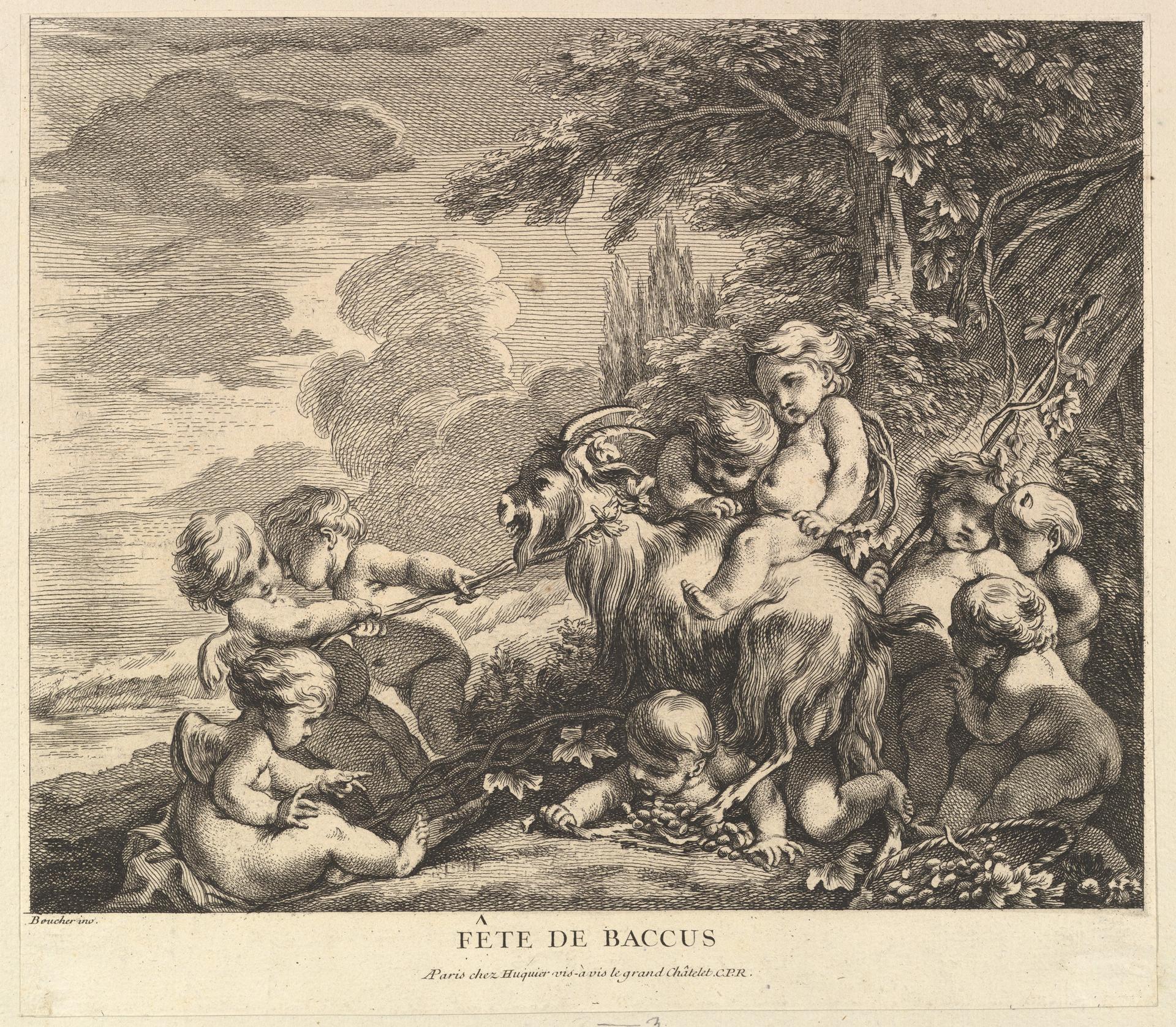
The Feast of Bacchus
Original title: The Feast of Bacchus
kurzbeschreibung
Pierre Alexandre Aveline made this etching and engraving around 1738 under the title The Feast of Bacchus. A group of putti clusters around a satyr sprawled on the ground. The sheet is a monochrome print.
Description
A large satyr dominates the center, stretched out and surrounded by several putti. Some hold flowers or other objects, while others have sat down or press close to the figure. Trees and a cloudy sky close off the background. The arrangement feels symmetrical, with the satyr as the pivot. Light and dark arise from dense hatching and lines, as is typical of etching.
Context
Aveline was an eighteenth-century French engraver whose reputation rests mainly on ornamental prints and mythological scenes. In the late Baroque period, from which this sheet dates, mythological subjects were ubiquitous in art. Aveline often produced reproductions after other artists' designs; here too a painting or drawing may have served as the starting point.
Impact
The even arrangement and the satyr's prominent position give the image calm and balance. Fine lines and hatching create a lively surface that guides the eye through the scene. The putti bring a cheerful, playful note characteristic of Rococo aesthetics.
Technique
Etching and engraving are combined here, allowing precise linework and nuanced tonal gradations. The plate was probably first bitten with acid and then reworked with a burin to sharpen details. Printing was in black on paper; the hatching models the light conditions.
AI-generated description text
Source: Metropolitan Museum of Art · Public Domain (CC0 1.0)