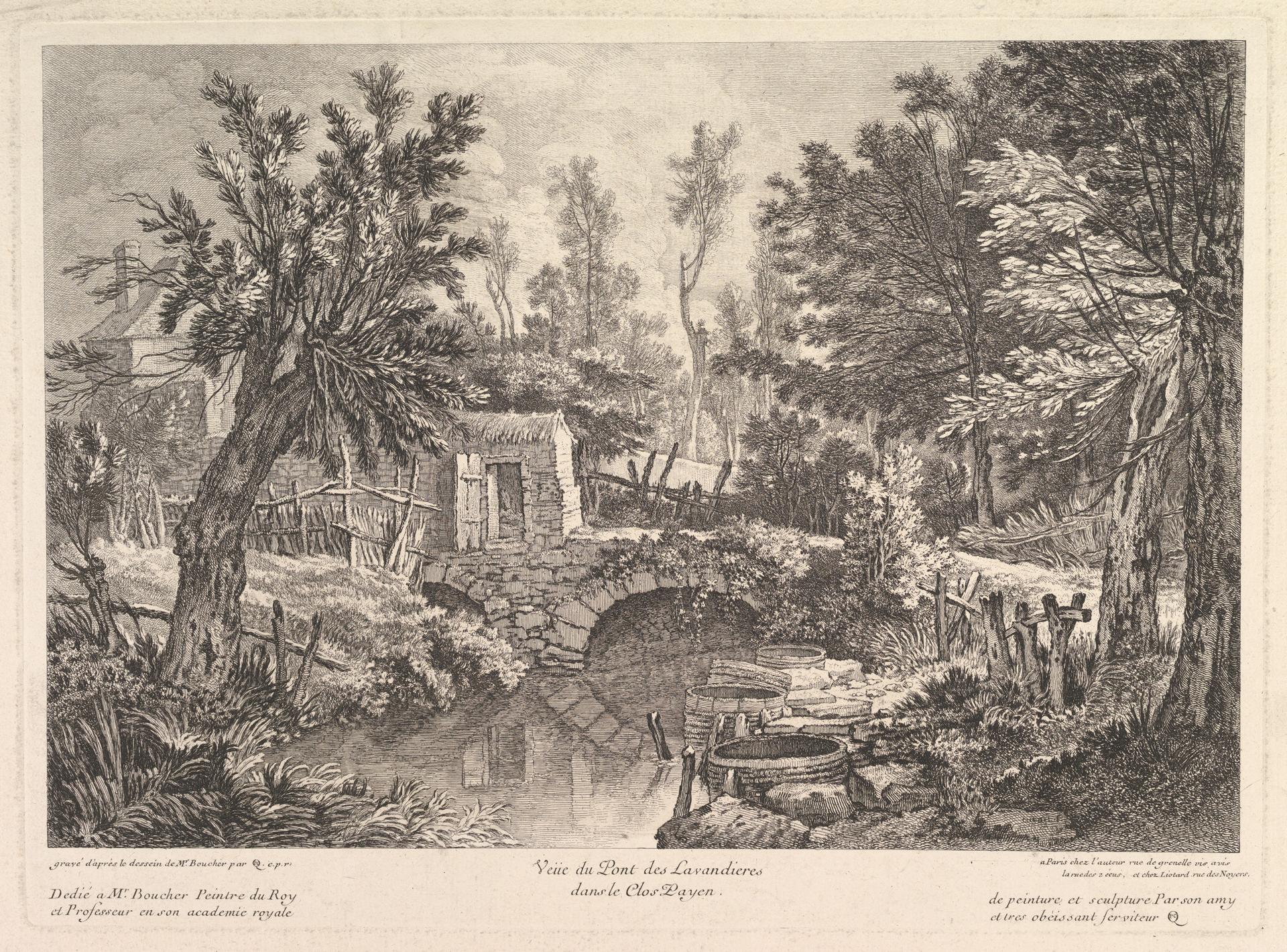
View of the Lavandieres Bridge at the Peasant House
Original title: View of the Lavandieres Bridge at the Peasant House
kurzbeschreibung
Quentin Pierre Chedel's mid-eighteenth-century etching gives a rural view of the Lavandieres bridge near the farmhouse at Clos Payen. A stream, a stone bridge and a building beyond appear among trees and shrubs.
Description
A stream runs through the foreground, crossed by a stone bridge lined with trees and shrubs. On the left stands a tree with a dense crown; on the right, one with a slimmer trunk and looser foliage. Behind rises a building with a roof and door, surrounded by more vegetation. The layout runs horizontally, with stream and bridge as the central element. Light falls evenly, without strong shadows, suggesting a bright time of day.
Context
Chedel, an eighteenth-century French artist, was known for his landscapes. The print was made around the middle of the century, when etching was a widespread artistic technique. Clos Payen belongs to the countryside that served often as a subject in this period. The etching is held in the collection of the Metropolitan Museum of Art.
Impact
The eye is drawn first to the even brightness that lies over the whole scene. Fine lines and mild light create a calm, idyllic mood. Nature and architecture feel harmonious and inviting, without dramatic accents, leaving the impression of a quiet rural view.
Technique
For this etching the lines were cut into a metal plate and then bitten with acid. This allows fine, detailed shading that captures the texture of foliage and masonry. The sheet measures 33.8 × 48.6 cm, the plate 27 × 37 cm.
AI-generated description text
Source: Metropolitan Museum of Art · Public Domain (CC0 1.0)