Saint André
Original title: Saint André
kurzbeschreibung
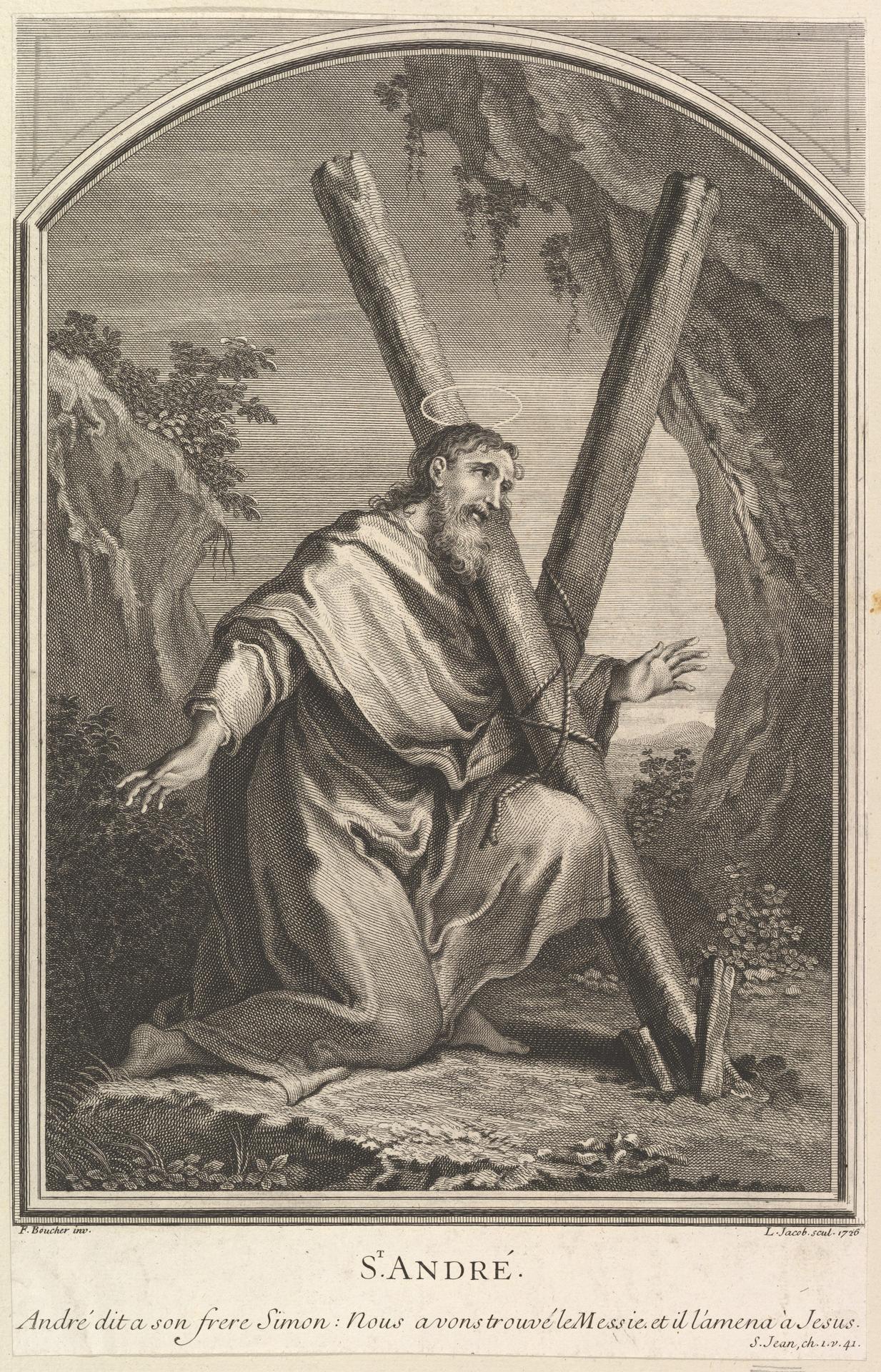
Made in 1726, Louis Jacob's print of Saint Andrew was worked in etching and engraving. The apostle appears kneeling in a landscape, holding a cross staff, with crosses around him recalling his martyrdom. The trimmed sheet measures 34.3 × 21.8 cm.
Description
Andrew kneels in the foreground, wearing a long-sleeved robe and a cloak. A cross staff rests on the ground while his hands form a gesture of explanation or preaching. Trees, rocks and further crosses appear behind him, pointing to the place of crucifixion. Greys and blues dominate the sky and give the scene a quiet mood. Fine lines and hatching, characteristic of etching and engraving, run through the sheet.
Context
In 1726, when engraving and etching were common reproductive techniques, Louis Jacob produced this print. It belongs to the Baroque depictions of saints, often made for devotional use or as part of a series. An inscription at the lower edge, giving the saint's name and a biblical quotation, suggests the image served devotion. Neither a patron nor a possible series membership has come down to us.
Impact
The calm landscape and muted colouring create a contemplative atmosphere that invites devotional use. Precisely drawn lines give the print a detailed yet elegant appearance, characteristic of eighteenth-century printmaking.
Technique
Etching and engraving are combined here, as the fine lines and precise hatching reveal. This method allows great accuracy of detail and subtle gradations of tone. The image was printed on paper that was later trimmed, as the dimensions indicate.
AI-generated description text
Source: Metropolitan Museum of Art · Public Domain (CC0 1.0)