Mont Sainte-Victoire
Original title: Mont Sainte-Victoire
kurzbeschreibung
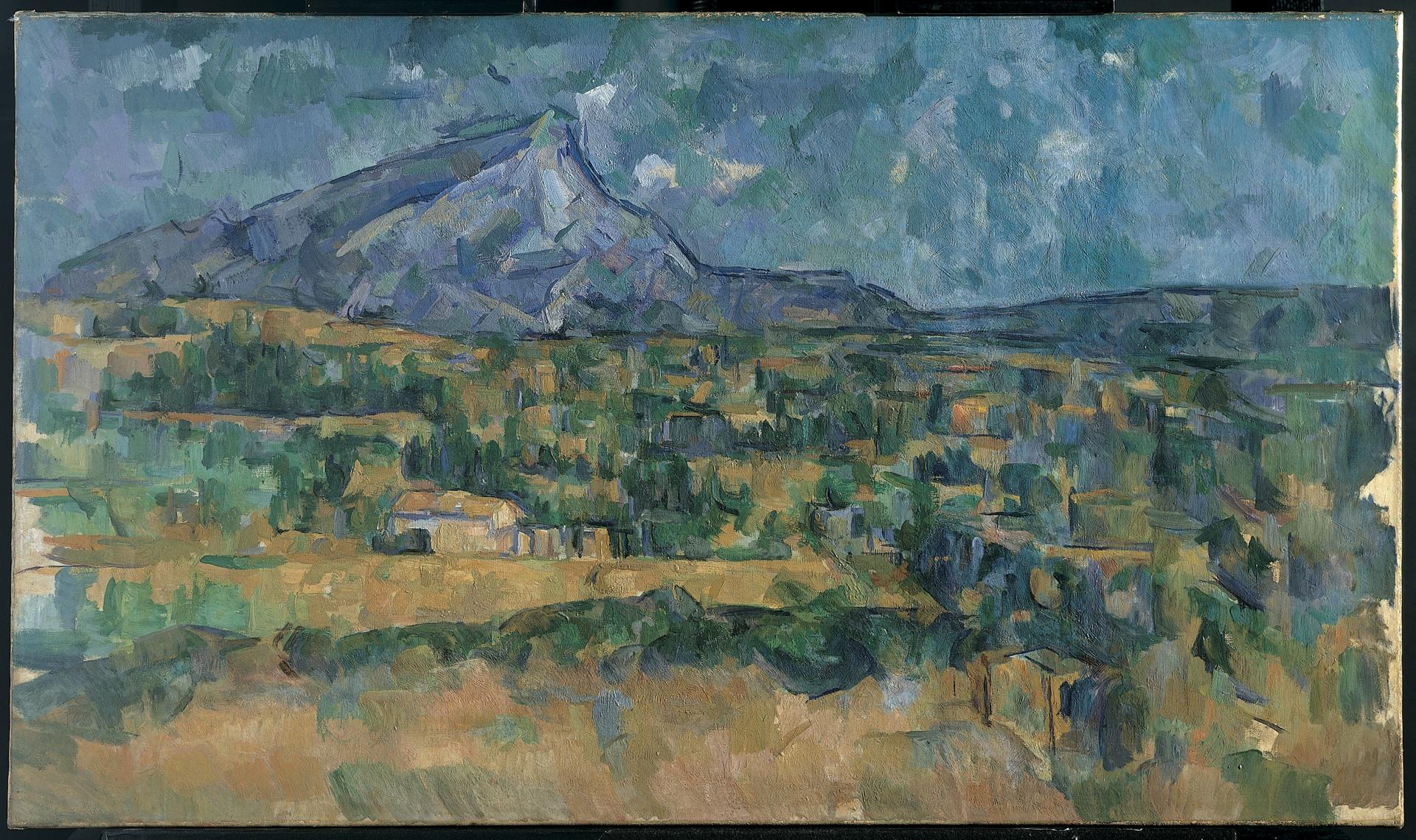
Paul Cézanne painted Mont Sainte-Victoire around 1902–1906 in oil on canvas, capturing the striking mountain range of Provence. A late work, it renders the landscape with bold colors and clearly visible brushstrokes.
Description
The layout is horizontal, with the Montagne Sainte-Victoire dominating the back of the picture. Blues and greens fill the cloudy sky. In the foreground, fields and trees appear in warm orange and yellow, interspersed with a few buildings. The areas of color stand out distinctly from one another, and the strokes feel animated, creating a lively surface.
Context
In his final years, Cézanne returned to the Montagne Sainte-Victoire again and again, capturing it from shifting perspectives and under different lighting conditions. This painting belongs to a phase in which he increasingly reduced forms to geometric essentials. These late landscapes are considered a landmark for modern art, especially for Cubism.
Impact
The soft light and calm mood invite a reflective state and draw the viewer into the landscape. Strong colors and visible brushwork give the painting a sensuous presence that goes beyond mere recording of nature.
Technique
Cézanne worked with oil paint on canvas, applying color in short, parallel strokes that structure the forms. His approach combines Impressionist color with a constructive, almost architectural arrangement of the pictorial elements.
AI-generated description text
Source: Metropolitan Museum of Art · Public Domain (CC0 1.0)