Saint Paul
Original title: Saint Paul
kurzbeschreibung
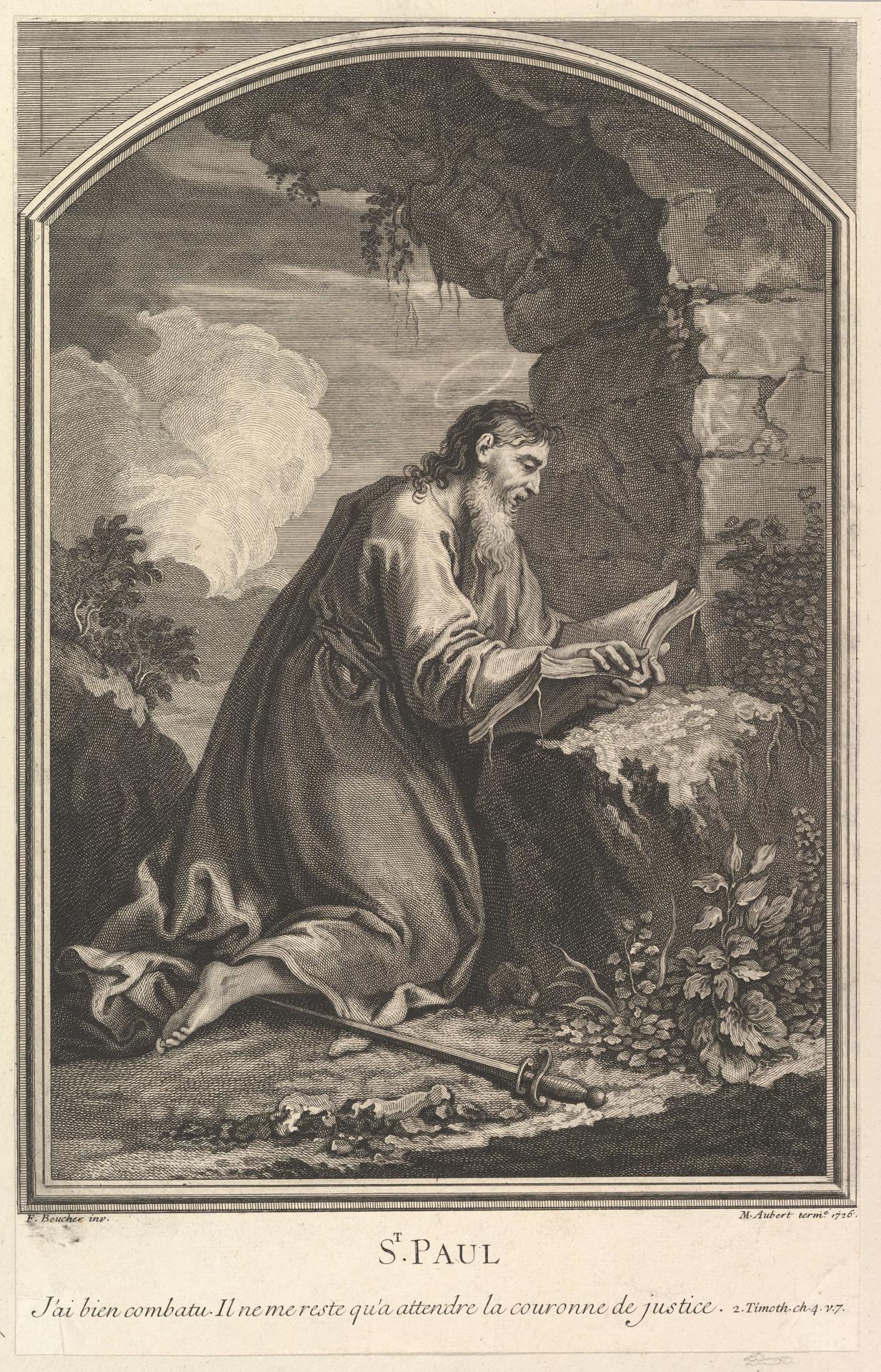
Michel Aubert's 1726 etching Saint Paul places the apostle kneeling inside a cave, a book or scroll held between his hands. The plate was worked in etching and engraving and, trimmed, measures 34.3 × 21.7 cm.
Description
Paul kneels at the middle of the sheet, his face thoughtful and composed. A sword rests on the ground at his feet; behind him clouds part to reveal a stretch of landscape. The arrangement converges symmetrically on the kneeling figure. Tonal, restrained values define the monochrome print, as is usual with etching. Baroque form speaks through dense hatching and hard contrasts of light and dark.
Context
The sheet dates from 1726, when French printmaking was flourishing. Religious subjects were often reproduced as etchings or engravings so that biblical scenes could reach a wider public. Neither patron nor purpose of the print has been recorded; it belongs to the Baroque tradition of devotional images.
Impact
The saint's pensive bearing and the muted light give off a quiet, gathering mood. Symmetry and the strong play of light against dark lend the print something solemn, almost monumental.
Technique
The work was made as an etching and engraving: lines were bitten into a metal plate and cut with a burin. After printing, the paper was trimmed, which accounts for the 34.3 × 21.7 cm format. Monochrome colour and delicate linework are hallmarks of these printmaking methods.
AI-generated description text
Source: Metropolitan Museum of Art · Public Domain (CC0 1.0)