Children playing
Original title: Children playing
kurzbeschreibung
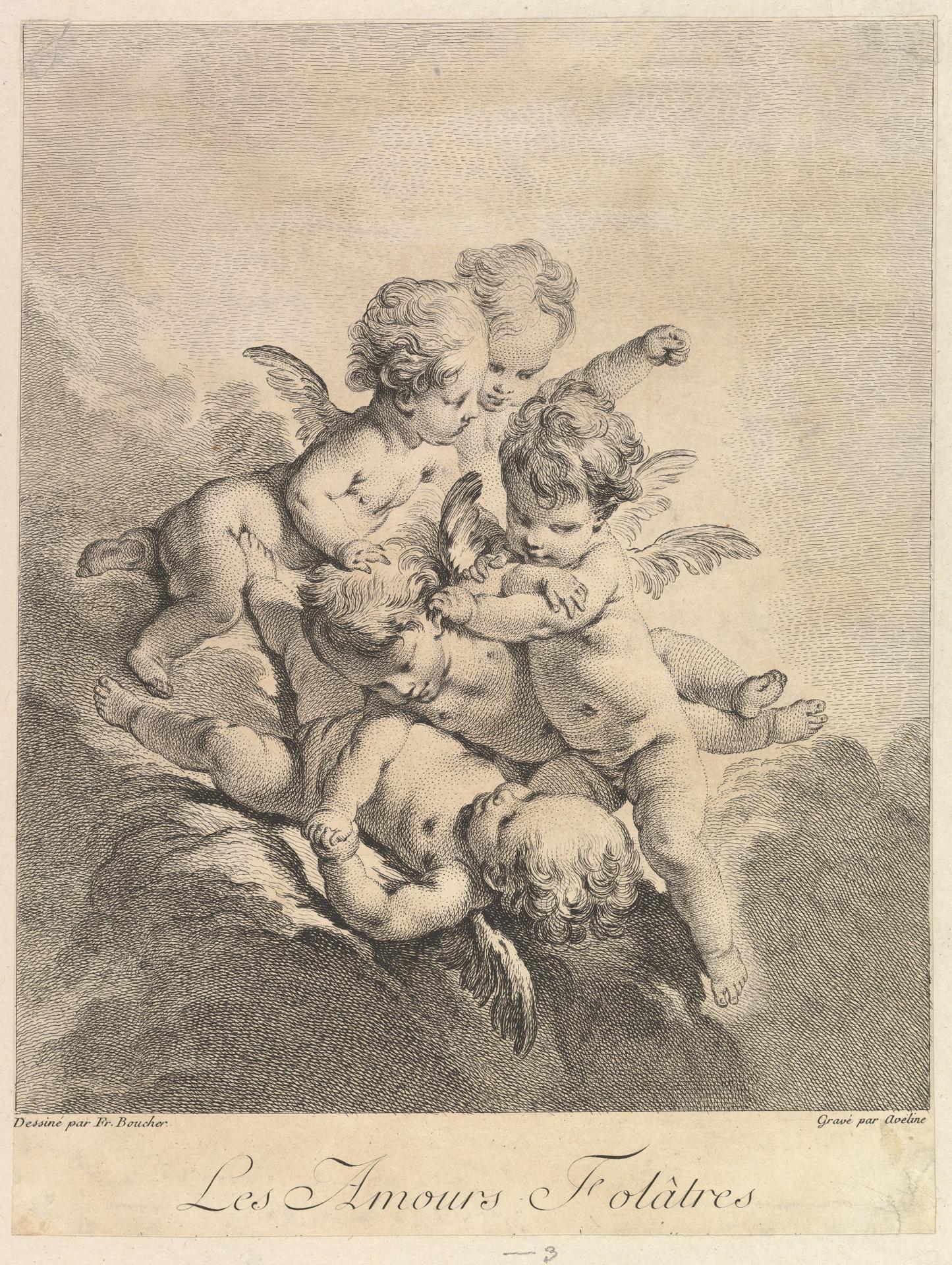
Pierre Alexandre Aveline's etching and engraving of 1750, titled Spielende Kinder, stands apart from related putti depictions through its easy blend of allegorical tradition and lively everydayness. A troop of five putti appears in exuberant, animated poses within a spare landscape. The motif couples the carefree nature of children's play with the visual language of the love gods.
Description
Five winged, barefoot putti are scattered across the sheet: some rest on the ground, others sit or seem to hover in the air. Their expressions are vivid, conveying pleasure and curiosity. The background remains deliberately bare, making the figures stand out clearly. Fine, dense engraved lines shape bodies and wings with great precision, producing a monochrome palette of graduated grays. Along the lower edge of the sheet is the engraved inscription 'Les Amours Folâtres.'
Context
Aveline, an eighteenth-century French engraver, became known chiefly for ornamental prints and genre scenes. His work falls within the Rococo period, when putti and cupids were ubiquitous in French art. Prints of this kind often served as decorative sheets for collectors and art lovers. The combination of etching and engraving met the period's demand for finely executed reproductive graphics.
Impact
Lively poses and expressive faces give the sheet an immediate playfulness and movement. Thanks to the precise linework, the figures appear almost sculpturally three-dimensional and draw the viewer into the action. Because the background stays restrained, attention focuses entirely on the cheerful doings of the putti.
Technique
This sheet combines engraving and etching, so directly cut lines stand alongside softer, etched passages. Parallel, finely laid hatching creates nuanced gray values and gives the putti's bodies plastic fullness. The artist presumably worked the plate with burin and acid to bring out the details precisely.
AI-generated description text
Source: Metropolitan Museum of Art · Public Domain (CC0 1.0)