The Swimming putto
Original title: The Swimming putto
kurzbeschreibung
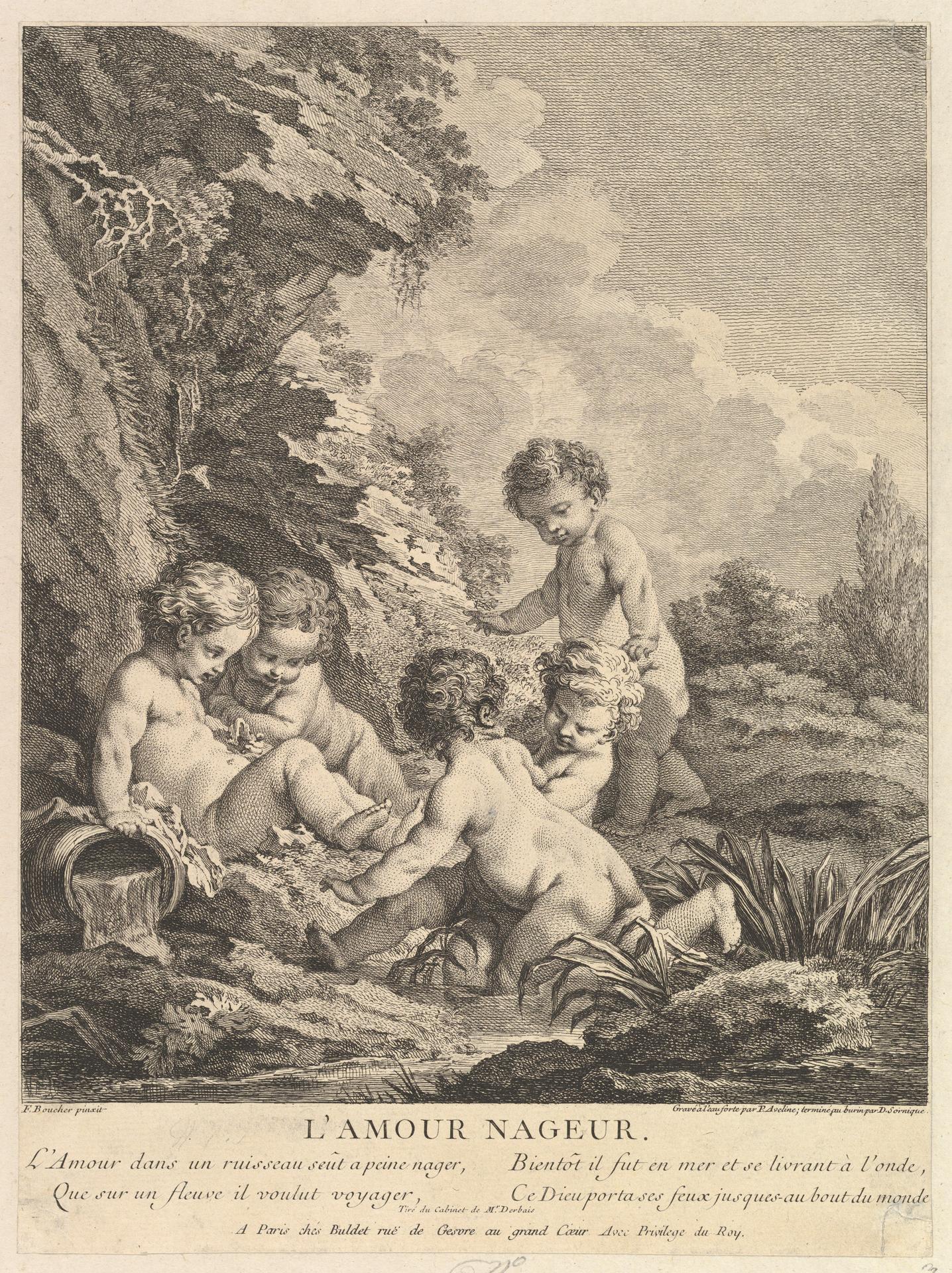
Amor glides through the water, his gaze fixed on the very edge of the world. This is the tale told in Dominique Sornique's print Der schwimmende Putto, made around 1741 as an etching with engraving. A troop of putti appears in a quiet landscape with a stream, boulders and wooded slopes. The grouping of figures is balanced and symmetrical.
Description
Several putti have settled or stretched out on a rock at the front of the picture, barefoot, among plants and the water of a stream. One stands farther back and looks across at the others. Above the group rises a chain of wooded hills beneath a cloudy sky. Soft contours and delicate lines define the figures' bodies. Along the lower edge runs the inscription "L'AMOUR NAGEUR".
Context
Sornique worked as an engraver in the eighteenth century; the sheet belongs to French art production around 1741. Putti and cupids were among the most popular motifs of the Rococo. The accompanying inscription takes up a narrative in which Amor swims and carries his eyes to the end of the world.
Impact
The symmetrical arrangement and soft outlines produce a calm, balanced overall impression. The still landscape and the relaxed posture of the figures lend the image a cheerful, idyllic mood. Through the delicate linework the sheet acquires an elegant, decorative character.
Technique
Etching and engraving are combined here, as can be seen in the fine strokes and graduated shading. This method allows details in the figures and the landscape to be rendered precisely. The paper has been trimmed to 30.4 × 22.6 cm.
AI-generated description text
Source: Metropolitan Museum of Art · Public Domain (CC0 1.0)