La Bergère Laborieuse
Original title: La Bergère Laborieuse
kurzbeschreibung
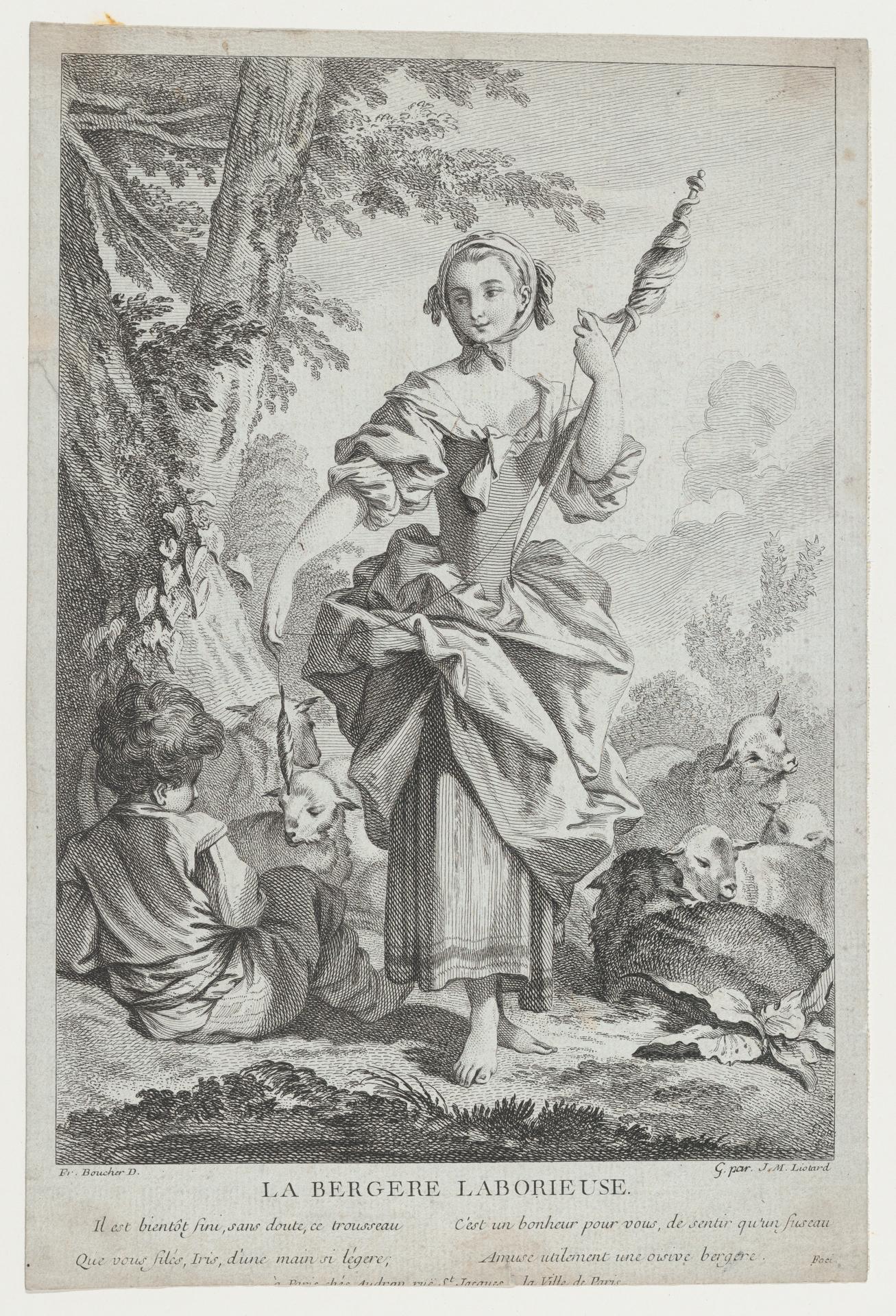
A young woman in rustic dress stands in an idyllic landscape, a stick in her hand. A boy and a flock of sheep surround her, shaping the pastoral mood. This black-and-white etching by François Boucher from the 18th century is distinguished by its delicate linework and precise detail.
Description
A woman in traditional peasant clothing holds a stick topped with yarrow. Beside her, a boy sits on the ground and looks toward the grazing sheep. Trees and shrubs in the background emphasize the rural setting. The layout is clearly structured: the woman as the main figure, with the animals and boy framing the scene. The monochrome palette and sharp, detailed lines give the print a precise, graphic quality.
Context
François Boucher, a leading French painter and printmaker of the Rococo, is known for his pastoral and mythological scenes. This etching was made in the 18th century, when shepherd scenes were highly popular in French art, depicting an idealized country life. Boucher produced numerous prints that often served as models for paintings or as independent works. The motif belongs to a series of shepherd images that the courtly society valued as a counterworld to urban etiquette.
Impact
A calm, idyllic atmosphere invites the viewer into an idealized rural world. Clear arrangement and fine linework create an aesthetic order typical of 18th-century art. The working shepherdess appears both graceful and close to nature—that is precisely the appeal of the work.
Technique
The combination of etching and engraving means that lines were bitten into a metal plate and also cut with a burin. This process allows fine, precise rendering of details and shading. Monochrome printing and sharp lines are characteristic of 18th-century printmaking; here Boucher demonstrates his mastery of line.
AI-generated description text
Source: Metropolitan Museum of Art · Public Domain (CC0 1.0)