Arion
Original title: Arion
kurzbeschreibung
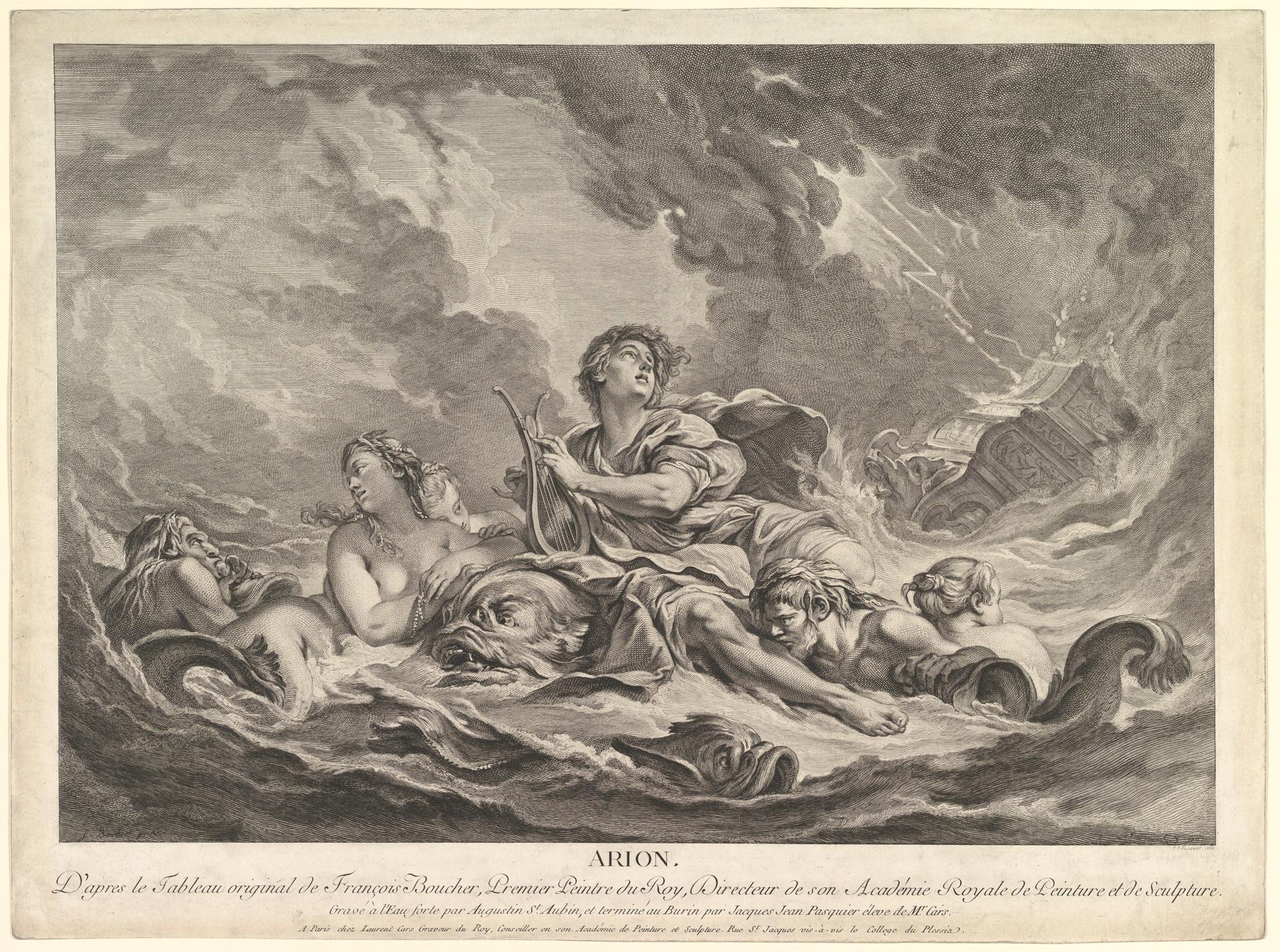
Between 1763 and 1766, Augustin de Saint-Aubin produced the print Arion, which recounts an episode from Greek mythology. The poet Arion appears with his lyre, surrounded by a crowd and an enraged sea serpent. The work is executed as an etching and engraving; it is the third state of three (Bocher), measuring 36.5 × 49.1 cm.
Description
Arion forms the still point at the center of the image, his lyre in play, while around him press a group of people and a powerful, agitated sea serpent. The figures' poses are marked by violent movement, heightening the tension of the moment. Dark, cloud-covered areas in the background darken the mood. The rendering remains monochrome; gradations of gray arise from the technique of etching and engraving. The layout draws the eye to Arion and thus underscores the drama of the event.
Context
Augustin de Saint-Aubin, an eighteenth-century French engraver, was known for his careful reproductive prints. In that era, the turn toward antiquity and mythology left a lasting mark on French art. The Arion subject enjoyed great popularity in the eighteenth century, as it linked poetry, music, and rescue from peril at sea. Saint-Aubin often worked after designs by other artists; for this print, the exact model is not recorded.
Impact
The heavy clouds and impassioned poses of the figures evoke a menacing yet theatrical mood. Arion with his lyre stands calmly at the center, forming a counterpoint to the agitation around him. The monochrome gray of the print emphasizes the serious, mythological content of the subject.
Technique
Etching and supplementary engraving come together here, allowing for finely graduated linework and nuanced gray tones. The sheet is in the third state of three, suggesting that the plate was reworked. The technique permits precise rendering of light and shadow and thus contributes to the dramatic effect of the scene.
AI-generated description text
Source: Metropolitan Museum of Art · Public Domain (CC0 1.0)