Vertumnus and Pomona (1765)
Original title: Vertumnus and Pomona
kurzbeschreibung
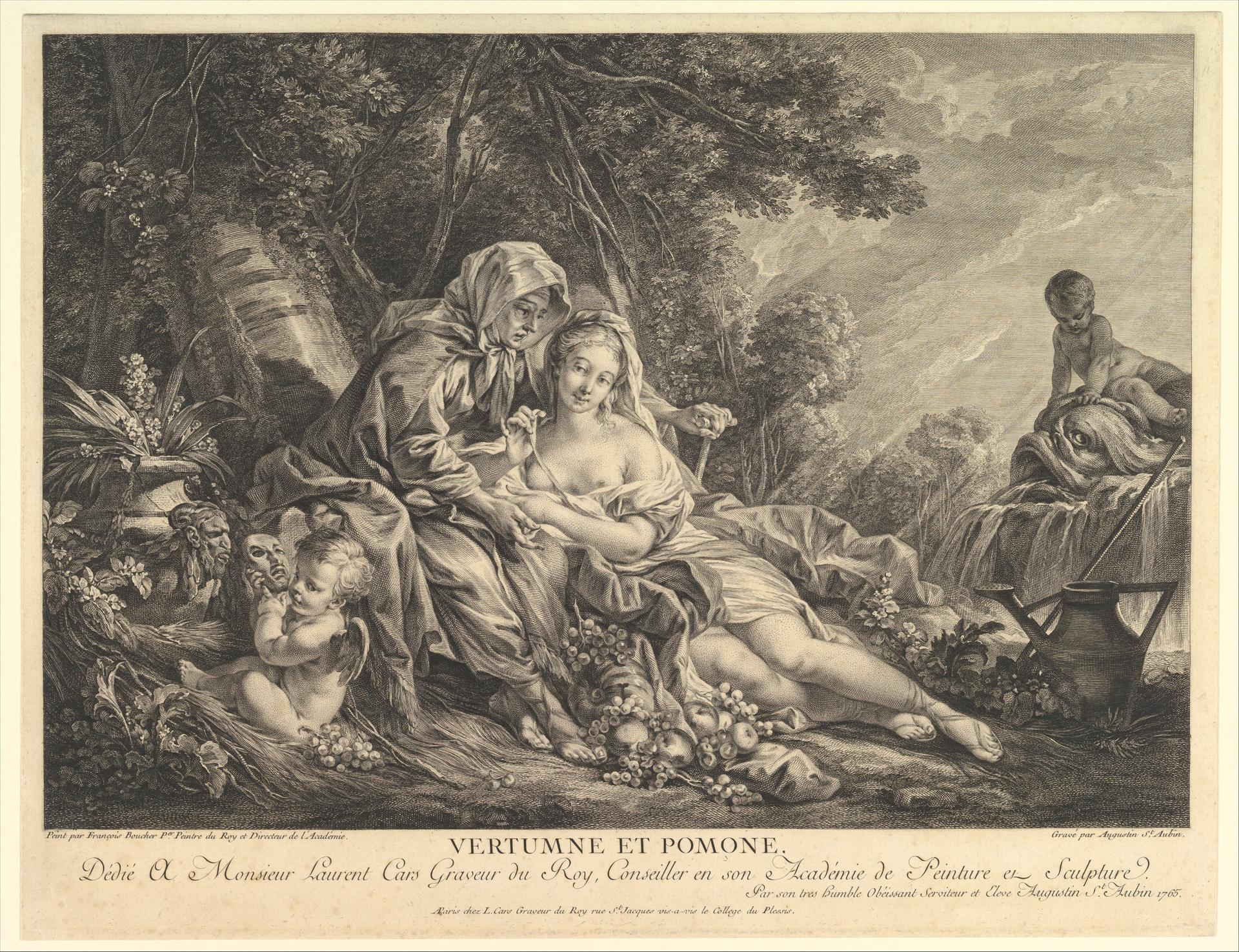
In 1765 Augustin de Saint-Aubin made the etching Vertumnus and Pomona, which captures an encounter from Roman mythology: the god Vertumnus woos the nymph Pomona, appearing either as an old man or as a youth. The print survives in its third state of three (Bocher) and measures 36.5 × 47 cm.
Description
In the foreground a woman in a long gown, Pomona, sits with a branch in her hand; beside her is a small boy, likely Vertumnus, also holding a branch. Behind them another figure seems to attend to the pair, while on the right a child leans against a large rock. Trees, shrubs, and flowers frame the action, and the sky is clouded. The main figures occupy the middle, with secondary ones at the sides — an arrangement that is nearly mirror-symmetrical.
Context
Created in France in 1765, during a period when mythological subjects were widespread in art. Saint-Aubin worked extensively as an engraver and was known for faithful, detailed reproductions. The motif draws on a popular tale from Ovid's Metamorphoses, often read as an allegory of fertility.
Impact
Fine lines and clear shading give the image a calm, idyllic mood. The balanced placement of the figures together with the natural motifs produces a harmonious overall impression that draws the viewer into the rural mythology.
Technique
Etching and engraving in grayscale. The technique yields sharp, detailed lines and delicate shading that make the figures and landscape stand out with a sense of volume.
AI-generated description text
Source: Metropolitan Museum of Art · Public Domain (CC0 1.0)