Chinese Lady
Original title: Chinese Lady
kurzbeschreibung
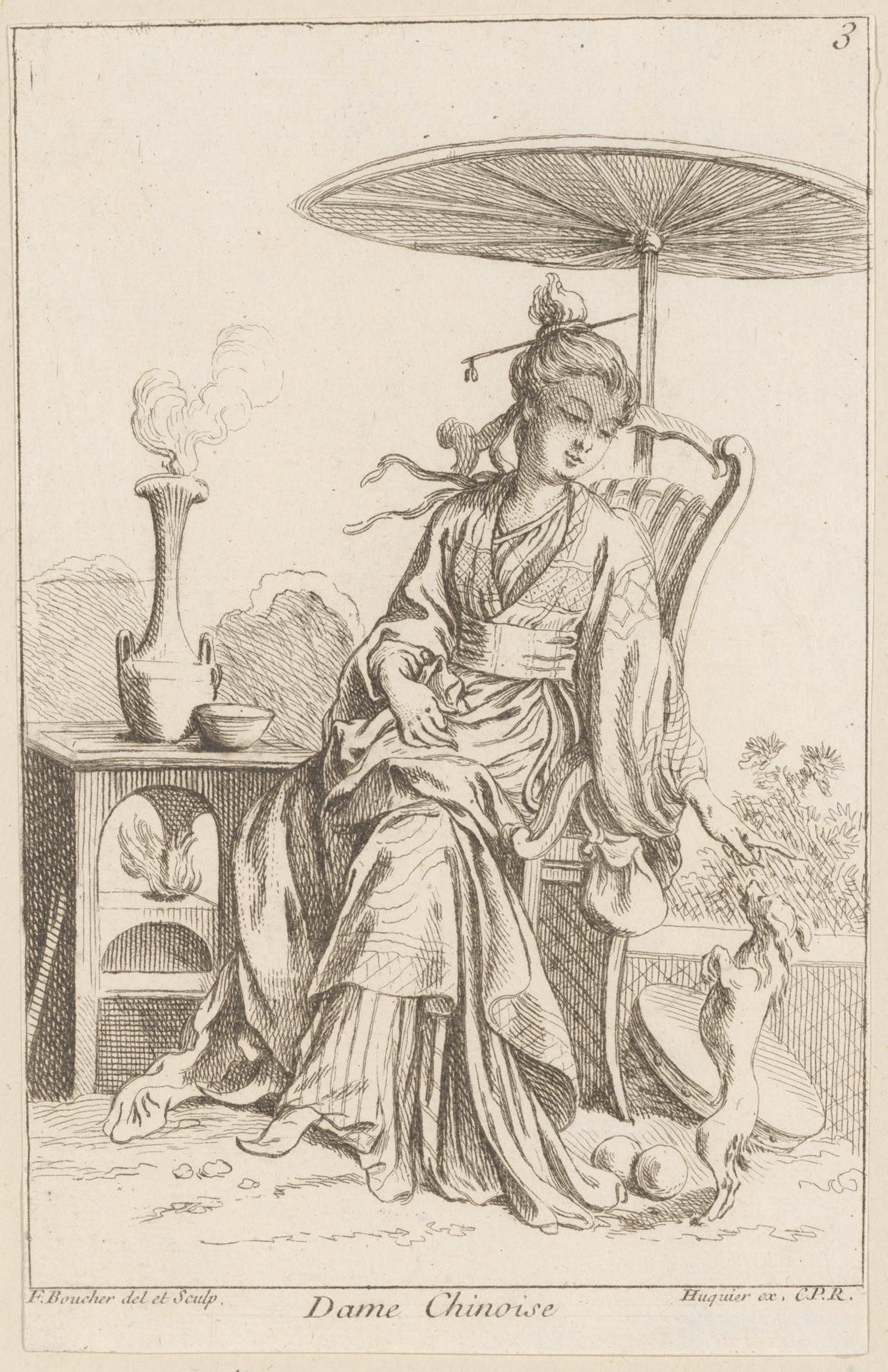
A seated woman holds a large, upright parasol — this motif is captured in François Boucher's etching "Chinesische Dame", made between 1738 and 1745. The figure wears traditional Chinese dress. The print belongs to the 18th-century chinoiserie style and was issued as a single sheet.
Description
At the centre, the lady sits on a chair, holding a tall parasol upright in her hand. Her hair is gathered into a high knot, and her robe follows Chinese models. A table to her side carries a vase with smoke rising from it, and a bowl next to it. Trees and shrubs suggest the background, and a small dog has settled on the ground in front of the seated woman. The layout feels balanced: the woman forms the still point, and the lines are drawn clearly and precisely.
Context
Like many European artists of his time, Boucher took up Asian motifs without aiming for faithful reproduction. Several etchings with Chinese subjects come from his hand; they often served as models for interior decoration or porcelain painting. Their creation between 1738 and 1745 falls in a busy period when Boucher was working as court painter to Louis XV. The sheet belonged to a series that reflected Europe's enthusiasm for distant China.
Impact
The clear, elegant linework gives the sheet a calm, almost idyllic mood. Balanced arrangement and carefully placed details create a harmonious effect that draws the eye into the exotic scene. Because the etching uses no colour, its graphic quality stands out; the lady thus appears both detached and graceful.
Technique
As an etching, the sheet counts among intaglio processes: the drawing is worked into a metal plate, which is then etched with acid. Boucher used fine, precise lines to render the dress, parasol, and accessories. Trimmed, the paper measures 21 × 13.3 cm — a format common for single prints of the period.
AI-generated description text
Source: Metropolitan Museum of Art · Public Domain (CC0 1.0)