Mucius Scaevola Before King Porsenna
Original title: Mucius Scaevola Before King Porsenna
kurzbeschreibung
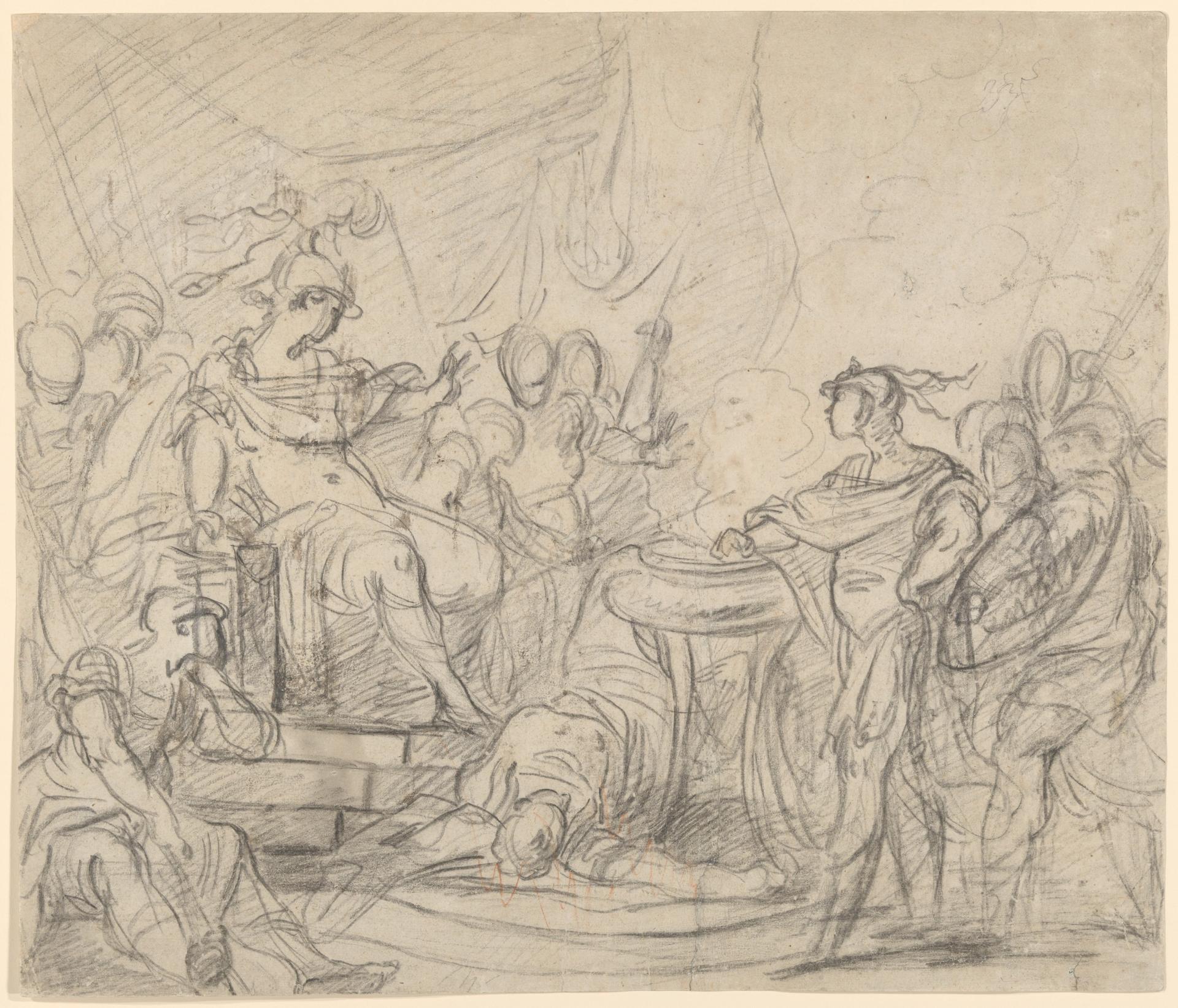
François Boucher drew Mucius Scaevola appearing before King Porsenna in the 18th century. Executed in black chalk with a few red chalk accents on cream-colored laid paper, the sheet captures the moment when the Roman hero thrusts his hand into the fire to prove his defiance.
Description
One figure sits at the front on a throne, wrapped in traditional robes and wearing a helmet, surrounded by other figures in historical costume. Some of those standing nearby raise their arms or fix their eyes on the seated man, while further people behind them spread out in various poses. The arrangement presses toward the center and never settles. Grays and whites dominate the palette, broken by red accents; soft, diffuse light draws out the contours and shadows of the figures.
Context
The drawing dates from the 18th century, when historical and mythological subjects were in demand in French art. Its source is the Roman legend of Gaius Mucius Scaevola, who burns his hand before the Etruscan king Porsenna to prove his loyalty to Rome. Boucher, known for decorative and theatrical arrangements, often made such designs as models for tapestries and paintings.
Impact
Clearly structured and carried by expressive gestures, the sheet feels dramatic and elegant at once. Delicately drawn lines join sparse traces of red chalk to create a lively, almost sketch-like quality that draws the viewer into the historical narrative.
Technique
Black chalk was used, with accents in red chalk, on off-white antique laid paper. This allowed precise contours and soft shading at the same time; Boucher applied the red traces deliberately for details such as faces or the hems of garments.
AI-generated description text
Source: Metropolitan Museum of Art · Public Domain (CC0 1.0)