Half-Length Study of a Man
Original title: Half-Length Study of a Man
kurzbeschreibung
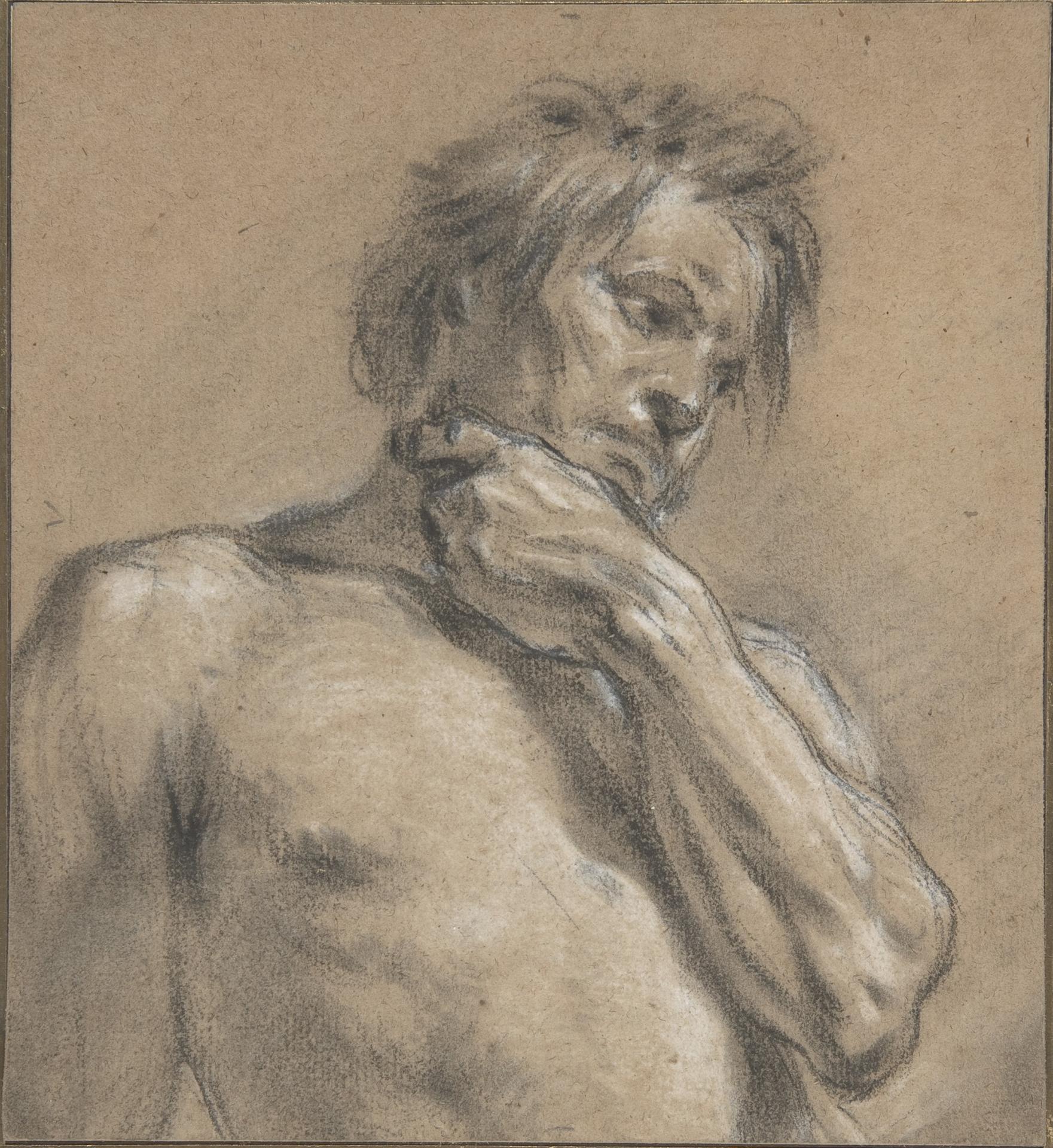
What sets this sheet apart from related nude studies is the combination of a barefoot, half-naked figure and a pensive pose: in the 18th century, François Boucher drew a man with a bare torso, his head bowed in thought. The study is executed in black and white chalk on beige laid paper, which was probably once blue-toned.
Description
We see the bust of a man, his hand under his chin and his head tilted slightly to one side. His hair falls in a tousled, unkempt manner, and his chest muscles are clearly defined. Light falling from the front accentuates the contours of his face and body. The composition is limited to the head and upper body, while the background remains empty.
Context
Boucher was one of the leading painters of the French Rococo. Sheets like this one were often made as preliminary studies for larger paintings or as independent exercises in anatomy. Tinted paper was a common part of the drawing repertoire in 18th-century France.
Impact
The man's direct gaze and the pensive placement of his hand give the sheet a quiet, inward-looking mood. Despite the spare execution, the chalk modeling gives the body an almost tangible plasticity. The viewer is drawn into the calm of the pose.
Technique
Boucher used black and white chalk on tinted paper to model light and shadow. White chalk sets targeted highlights, while black chalk defines the deep areas. The paper was originally blue; over time, the tone faded to beige.
AI-generated description text
Source: Metropolitan Museum of Art · Public Domain (CC0 1.0)