New Book of Various Figures
Original title: New Book of Various Figures
kurzbeschreibung
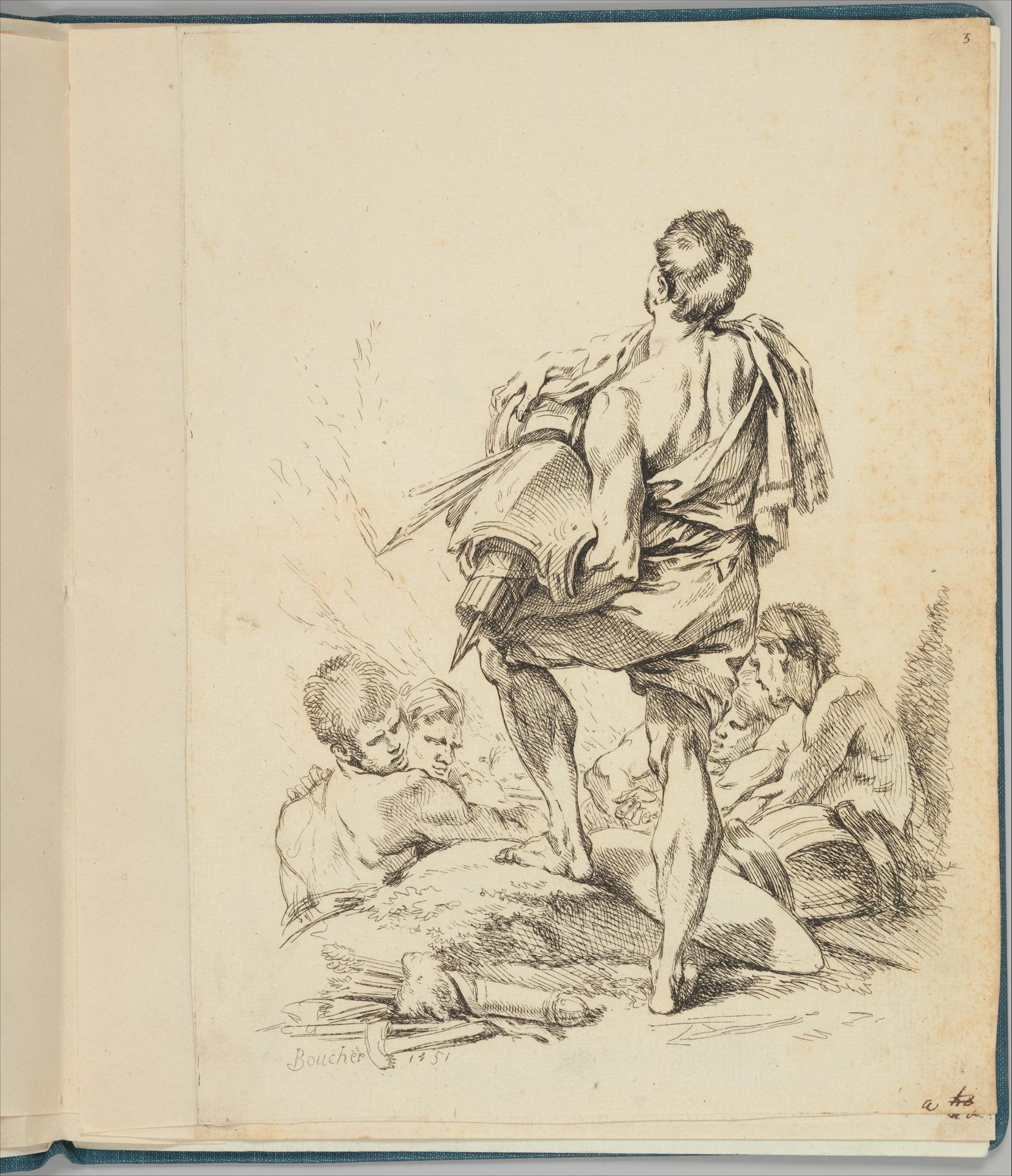
Unlike many figure studies of its day, this sheet draws its energy from the twisted, almost dancing posture of its main character. It belongs to François Boucher's set of prints, the "New Book of Various Figures," published in 1751, and survives here as an etching in the second state of two (Baudicour). A man throws his left leg high and clutches an object, while other figures surround him.
Description
A powerfully built man in a garment reminiscent of a toga twists upward in a strenuous, forceful pose. His left leg is bent and lifted, and one hand grips an object that is hard to identify. Tools and materials lie scattered along the lower edge, pointing to craftwork. Several figures are distributed around him in shifting attitudes. The layout is deliberately off-balance, and the main actor's contorted body sets him clearly apart from the rest.
Context
The print was made in 1751 as part of a series of figure studies that served artists and craftsmen as models. Such portfolios were common in eighteenth-century France and were often sold by publishers like Gabriel Huquier. Boucher was then among the leading painters and printmakers of the Rococo, and he used etching regularly to circulate his designs.
Impact
The image feels lively and expressive, chiefly through the dynamic stance of the principal figure and the varied handling of line. Strong contrasts and shading give the monochrome sheet a sculptural depth that draws the eye to the central figure.
Technique
In etching, the drawing is scratched through a wax layer on a copper plate, and the metal is then bitten in acid. Printing was done in black on paper; fine lines and hatching build the details and shadows. The second state suggests reworking or corrections made after the first.
AI-generated description text
Source: Metropolitan Museum of Art · Public Domain (CC0 1.0)