The Five Senses
Original title: The Five Senses
kurzbeschreibung
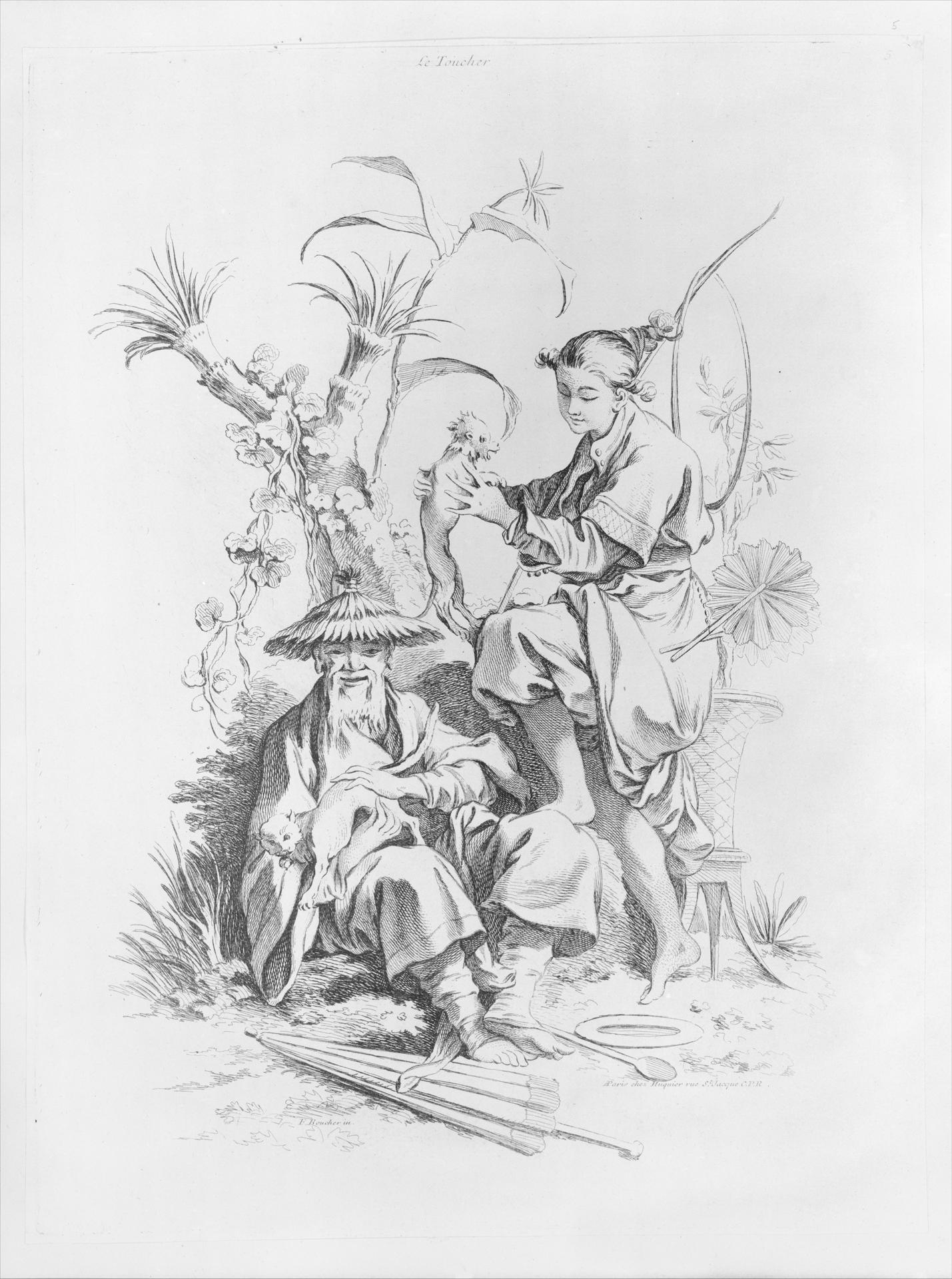
François Boucher made the etching Die fünf Sinne (The Five Senses) between 1720 and 1770. The print presents two figures in a natural landscape and suggests the five senses as an allegory by including resting and plant elements.
Description
Two people appear on the sheet: at left, a figure sits on a low seat, wears a traditional hat with a lace edge, and holds a cloth in both hands. At right, a second figure leans forward and holds a plant or a branch. Plants and leaves in the background give the scene an uncultivated feel. Some tools or objects lie on the ground in the foreground. The black-and-white execution reveals the technique of etching and engraving.
Context
Boucher ranked among the leading painters of the French Rococo and produced numerous mythological and allegorical works. The sheet arose at a time when allegories of the senses were widespread in the visual arts. Boucher often worked for court and nobility, which is reflected in the elegant design of the figures. The exact date within the fifty years remains open, since Boucher was active over a long period.
Impact
The calm, idyllic scene and the delicate linework give the sheet a harmonious and inviting effect. The figures in traditional garments create a timeless, almost pastoral mood that draws the viewer into a contemplative world.
Technique
The etching was supplemented by engraving, which allows precise and detailed linework. The black-and-white execution emphasizes contrasts and shading created by hatching. At about 45.7 × 35.2 cm, it is a medium-format sheet intended for printing.
AI-generated description text
Source: Metropolitan Museum of Art · Public Domain (CC0 1.0)