Pygmalion and Galatea
Original title: Pygmalion and Galatea
kurzbeschreibung
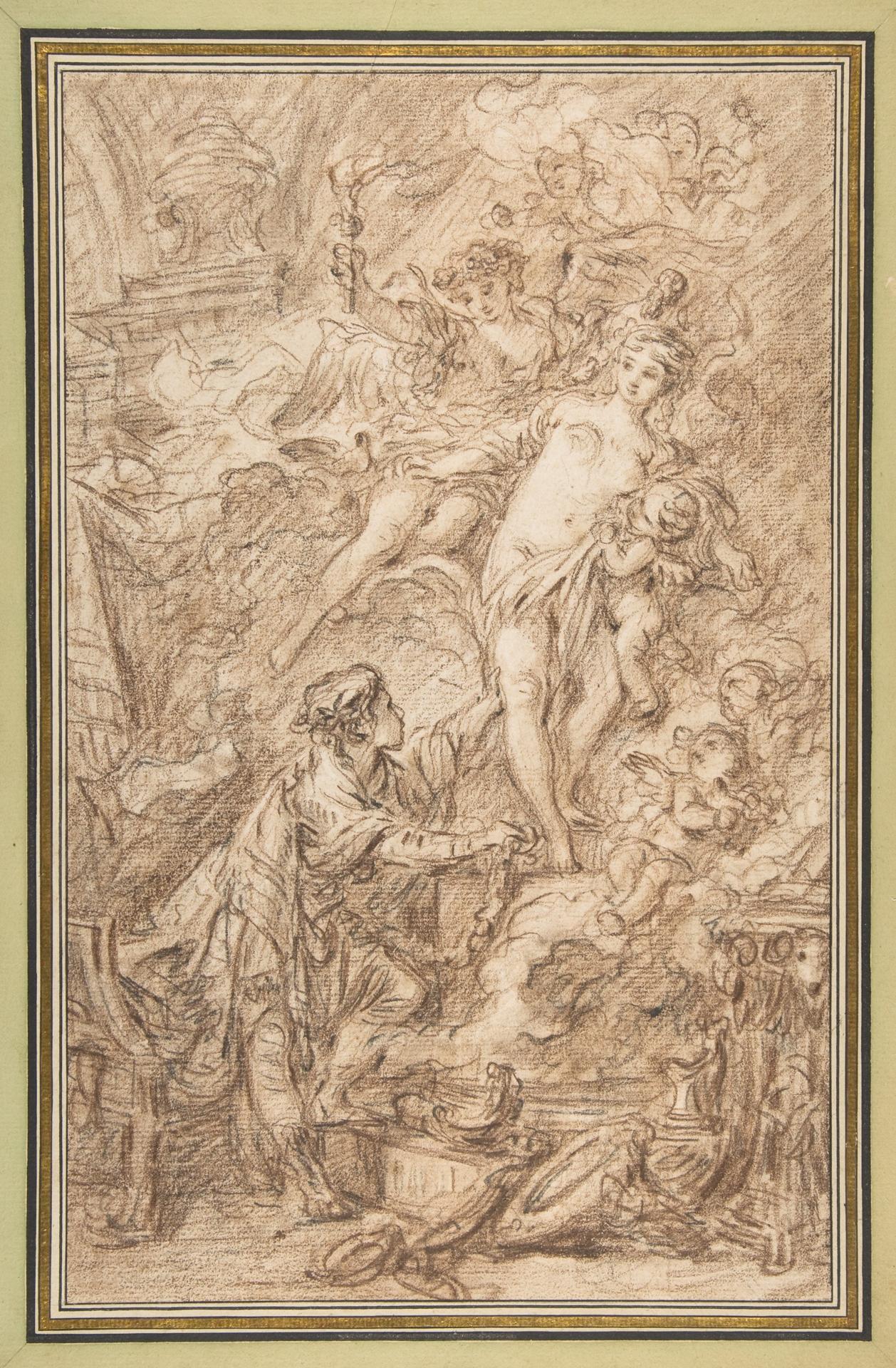
François Boucher drew the sculptor Pygmalion holding a nude female idol in his arms — an emblem of Galatea, the figure he has created. Executed in brown chalk, the sheet was probably made around the middle of the 18th century. Measuring 35.2 by 22.2 centimetres, it ranks among the typical studies by this Rococo artist.
Description
Pygmalion embraces a female idol on a pedestal, his gaze directed downward at the figure. The unclothed idol gains liveliness from the chalk strokes, while the sculptor appears in the dress of his own time. Above the scene several angels hover, one of them carrying a candle that brings light into the image. Brown tones dominate, the lines are finely set, and the figures are arranged symmetrically.
Context
Here Boucher turned to a mythological subject often found in 18th-century French art. Ovid's Metamorphoses tell the story of Pygmalion, who falls in love with his own sculpture — a theme revived in the Rococo. As first painter to Louis XV, Boucher was known for sensual images that suited aristocratic taste. Whether the drawing served as a preparatory study for a larger painting or remained independent cannot be said with certainty.
Impact
The viewer's eye is first drawn to the candlelight that the hovering angels bring into the scene, then glides down to the intertwined figures. Elegant lines and a delicate modelling of the bodies define the sheet and are characteristic of Boucher's hand. A tension arises between a sacred mood and erotic suggestion, holding the gaze. The candle's light and the angels give the motif a transcendent note that reaches beyond mere mythology.
Technique
Boucher worked here in brown chalk on paper — a medium he liked to use for studies and designs. Chalk allows fine shading and a soft, flowing stroke that emphasises the movement of the figures. At 35.2 by 22.2 centimetres, the sheet is intimate and handy, likely intended for private use or as a model.
AI-generated description text
Source: Metropolitan Museum of Art · Public Domain (CC0 1.0)