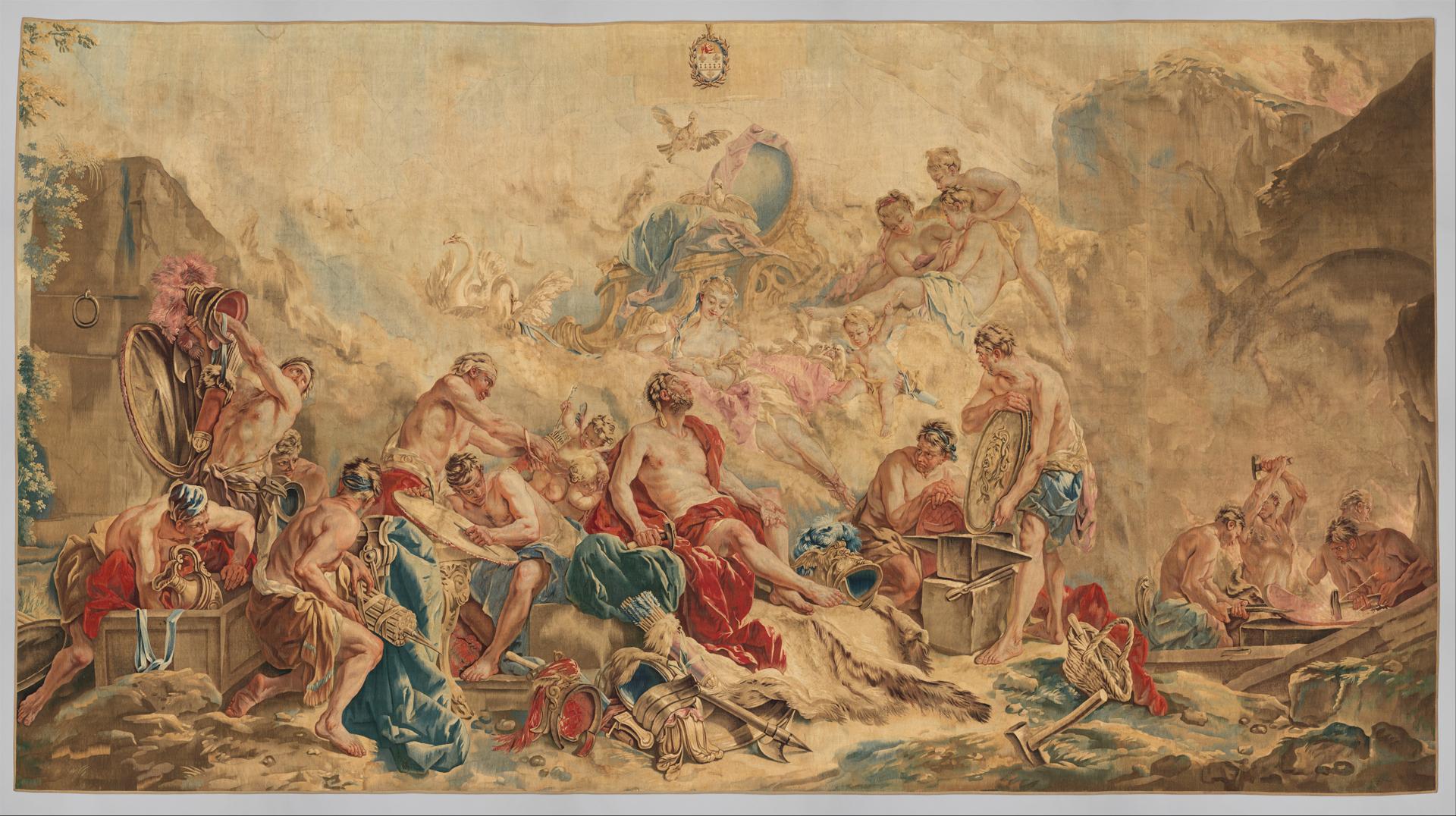
Vulcan Presenting Arms for Aeneas to Venus
Original title: Vulcan Presenting Arms for Aeneas to Venus from the set The Loves of the Gods
kurzbeschreibung
This tapestry, Vulcan Presenting Venus with Arms for Aeneas, derives from a design by François Boucher dated 1749 and was probably woven around 1771 in silk and wool. It depicts the blacksmith god Vulcan handing his wife Venus the armour made for her son Aeneas. The piece belongs to the tapestry series The Loves of the Gods.
Description
Gathered in an idyllic landscape of antique cast, with mountains and clouds behind them, a group of figures has come together. At its heart Vulcan passes the finished weapons to Venus, while around the pair others, some of them nude, are busy dyeing cloth or at similar handwork. Earth tones govern the palette, loosened here and there by touches of red and blue. Diffused light bathes the action in a warm, almost golden atmosphere.
Context
The design was commissioned in 1749 by the Paris Gobelins manufactory for the series The Loves of the Gods. The weaving is dated to around 1771, after Boucher's death, and was carried out under the direction of Jacques Neilson. The series counted among the royal collections and was woven several times during the 1770s. The tapestry reflects the Rococo taste for mythological subjects, which joined courtly elegance to antique narrative.
Impact
Warm light and a balanced palette produce a sensuous, almost bucolic mood. The gods in their idyllic landscape appear at once elegant and withdrawn, a hallmark of Boucher's style. The large format gives the scene a monumental presence that draws the viewer into the world of myth.
Technique
The tapestry was woven in silk and wool, as was customary at the Paris Gobelins manufactory. The fine weave allowed an exact rendering of the painterly details and the soft transitions of colour. The silk content lent the piece a lustrous, noble character and emphasised the light effects of the original design.
AI-generated description text
Source: Metropolitan Museum of Art · Public Domain (CC0 1.0)