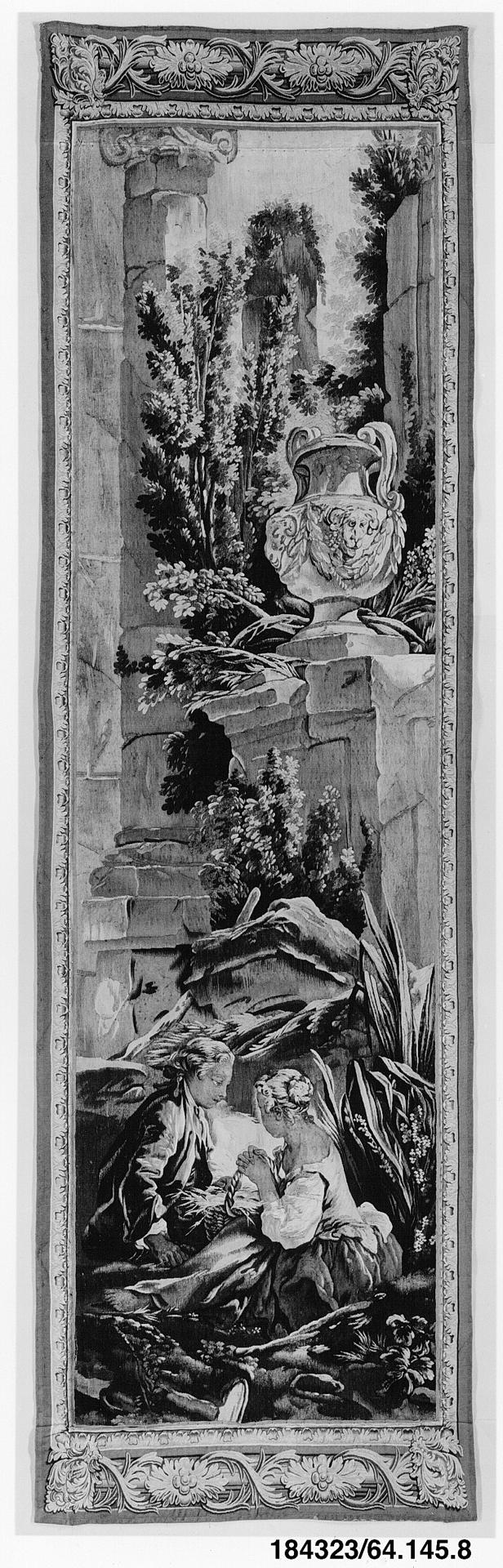
The Egg Seller from a set of the Italian Village Scenes
Original title: The Egg Seller from a set of the Italian Village Scenes
kurzbeschreibung
François Boucher designed Der Eierverkäufer between 1734 and 1736 as part of his series of Italian village scenes; the tapestry was woven in 1762 in wool and silk. Two figures stand at the heart of a rural setting framed by ruins and plants.
Description
A kneeling man holding an eggshell and a woman seated opposite him, something in her hand, form the focus of the image. Both wear traditional dress. To either side, ruins and plants frame the arrangement, including a large amphora on a pedestal. The layout feels symmetrical, with the figures centered and landscape elements distributed toward the edges. Grays dominate the palette, the light is even, and the style is Baroque with detailed drawing.
Context
The designs for this tapestry series were made in the 1730s under commission from the royal Gobelins manufactory. Boucher's Italian village scenes draw on the period's interest in arcadian landscapes and rural motifs. The tapestry itself was not executed until 1762, some 26 years after the design, suggesting a later revival of the pattern. By then Boucher was an established artist, known for pastoral and mythological scenes.
Impact
The symmetrical distribution and calm arrangement give the tapestry balance and harmony. Grays and even light create a quiet, almost timeless atmosphere, characteristic of Boucher's idealized village scenes. Fine details and precise execution lend the work a noble, decorative presence.
Technique
The tapestry was produced in a weaving technique from wool and silk, with a density of 21 to 23 warps per inch (8 to 9 per centimeter). This fine weave allowed a detailed rendering of the figures and ornaments. Wool and silk were common for high-quality French tapestries of the 18th century.
AI-generated description text
Source: Metropolitan Museum of Art · Public Domain (CC0 1.0)