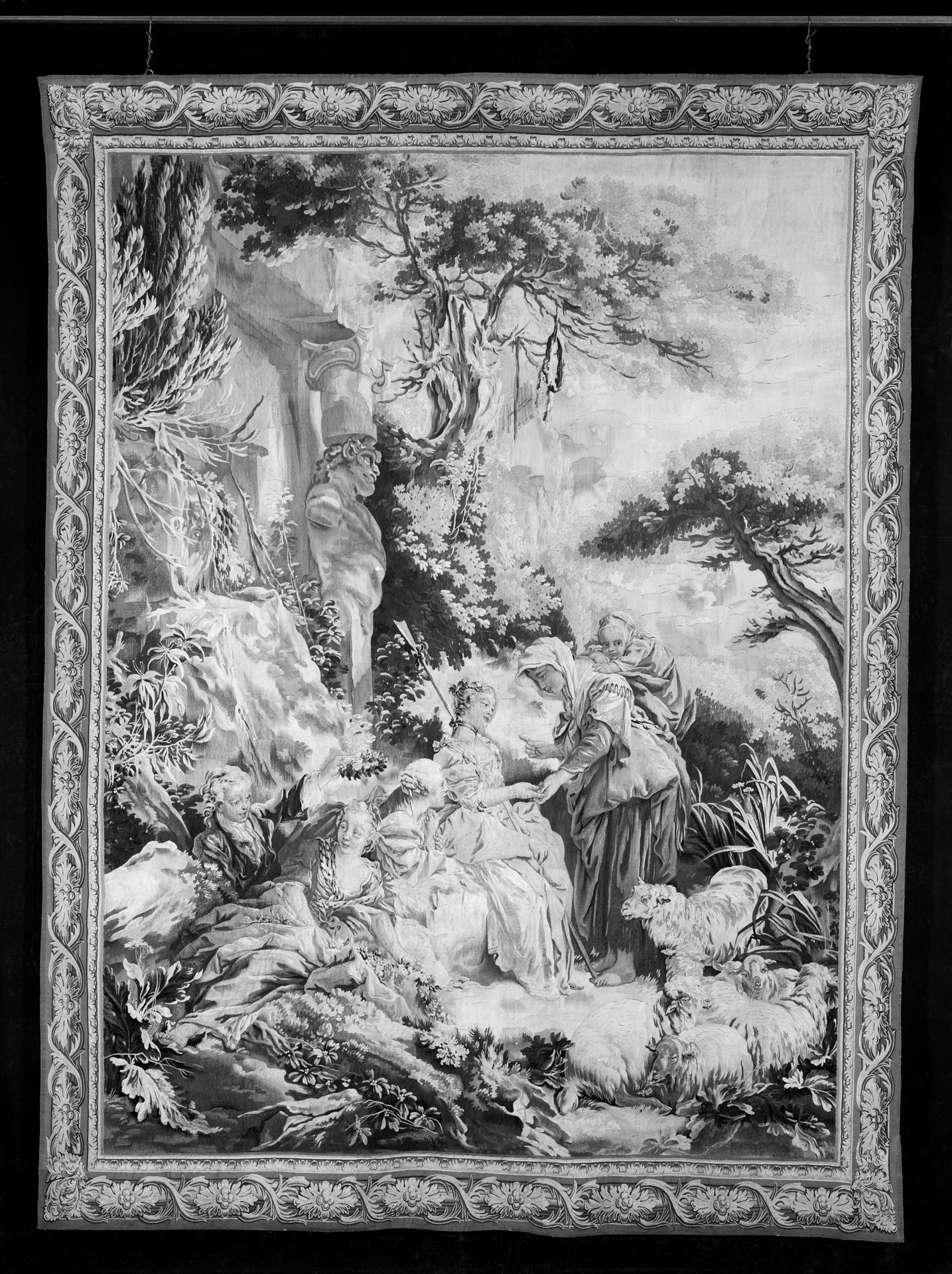
The Gypsy Fortune-Teller from a set of the Italian Village Scenes
Original title: The Gypsy Fortune-Teller from a set of the Italian Village Scenes
kurzbeschreibung
Unlike the other panels of the Italian village scenes, this tapestry puts the act of fortune-telling at its heart. François Boucher designed the subject in 1734–36, and it was woven in 1762 in wool and silk. What unfolds is a rural idyll in which a woman in the foreground reads the future for a gathered group.
Description
What sets the layout apart from related pieces is its focus on the seated fortune-teller in traditional dress, surrounded by women and a single man. Trees, rocks and a temple close off the distance and place the action in the open air. The figures' garments follow conventional forms, while a border of floral motifs runs around the tapestry.
Context
Woven in 1762, the tapestry goes back to a Boucher design of 1734–36. Boucher ranked among the leading painters of the French Rococo and was known for pastoral as well as mythological subjects. The Italian village scenes were commissioned by the royal Gobelins manufactory and answered courtly taste for idealised landscapes. At the time, tapestries counted as a status symbol among the nobility.
Impact
Set beside the busier scenes of the same series, this panel radiates calm, carried by the loose spread of the figures and the wide landscape. The fortune-teller herself stirs curiosity and invites the viewer to spin the story further. The richly patterned frame gives the work a festive, decorative character.
Technique
The tapestry is woven from wool and silk at 21–23 warps per inch (8–9 per centimetre). This dense weave allowed the finest detail in the image. The silk content lends a sheen that brings out the colours and shadows of the scene. It was probably made on an upright loom of the kind customary at the Gobelins manufactory.
AI-generated description text
Source: Metropolitan Museum of Art · Public Domain (CC0 1.0)