The Charlatan and the Peep Show
Original title: The Charlatan and the Peep Show from a set of the Italian Village Scenes
kurzbeschreibung
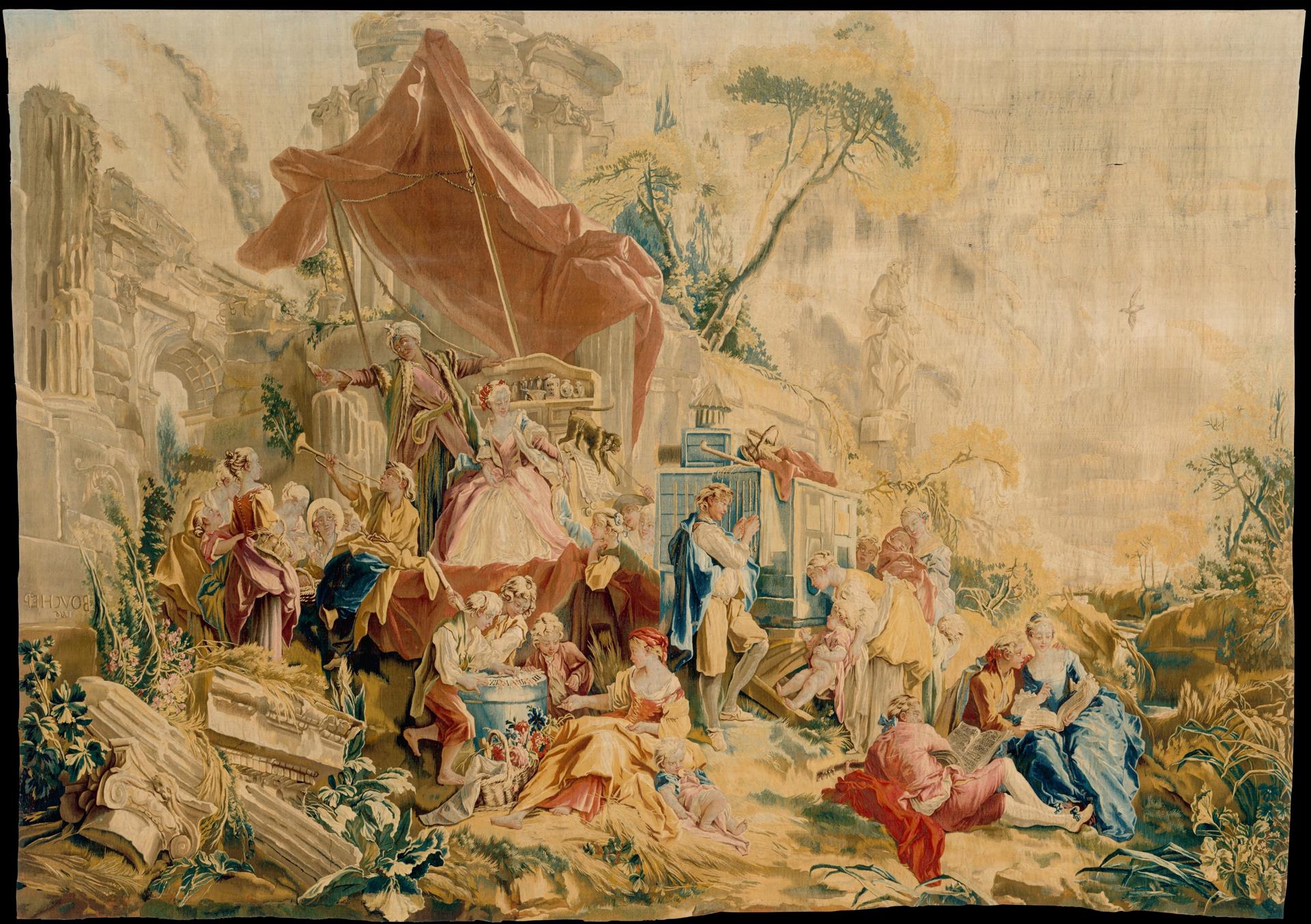
A mountebank presents his peepshow stage before a gathered crowd, a rustic subject drawn from the series of Italian village scenes. François Boucher designed it between 1734 and 1736, and the tapestry was woven in 1762 from wool and silk.
Description
Raised on a platform framed by a red curtain, the charlatan displays his little stage. Several figures can be made out through its windows. Around him a crowd has collected: some watch closely, others laugh or chat. The garments look sumptuous and brightly coloured, with reds, blues and golds. Antique ruins and trees enclose the action, and the light stays soft, bathing the tapestry in a warm golden glow.
Context
Boucher produced the design in the mid-1730s while working for the royal Gobelins manufactory. The Italian village scenes belonged to a larger commission that took up rural motifs in the pastoral spirit. That the weaving followed only in 1762 shows how long these designs stayed in use. Boucher was then among the leading artists of the Rococo and gave decisive impetus to French art of the period.
Impact
The dense, opulent rendering carries the viewer into an idealised rural world. Warm colours and lively figures create an inviting, almost theatrical mood. Careful weaving adds to the piece's ceremonial ambition.
Technique
The tapestry is woven from a mixture of wool and silk at 21 to 23 warps per inch (8–9 per cm). This fine weave allowed figures and ornament to be reproduced in close detail. Where silk is used, a slight sheen appears that heightens the luxurious impression.
AI-generated description text
Source: Metropolitan Museum of Art · Public Domain (CC0 1.0)