Boy with Bagpipe
Original title: Boy with Bagpipe
kurzbeschreibung
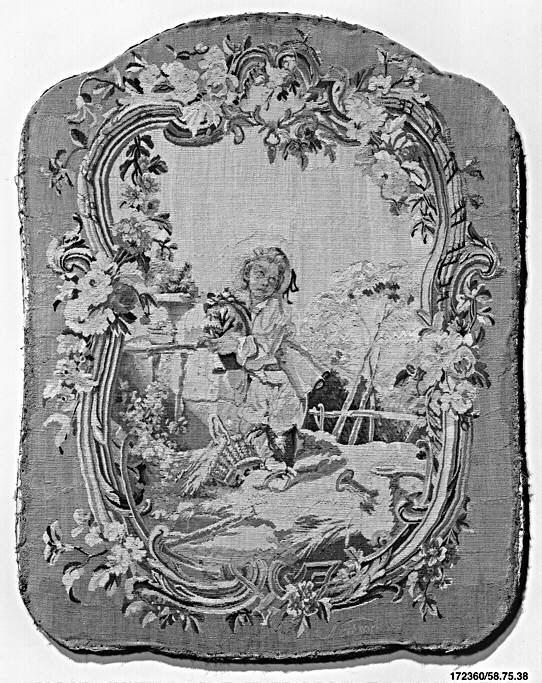
Woven in silk and wool around 1750–88, this tapestry titled Junge mit Dudelsack (Boy with Bagpipes) follows a design by François Boucher. It measures 81.3 × 63.5 cm and shows a young man in traditional dress seated on a rock, playing the bagpipes.
Description
A young man sits on a rock, playing the bagpipes. His clothing evokes the Baroque and Rococo periods. Trees and a stream form the setting, while on the left a flowering vine with blossoms and leaves frames the edge of the tapestry. Stylized flowers and tendrils ornament the border. The palette is muted, mostly grays and browns, and the light falls evenly, bringing out the texture of the tapestry fibers.
Context
François Boucher, a leading French Rococo painter, supplied numerous designs for tapestries, some of which were executed at the Gobelins. The dating of around 1750–88 falls within a period when Boucher served as director of the Gobelins manufactory. The tapestry probably belonged to a series of pastoral or musical scenes.
Impact
The muted colors and even lighting create a calm, historical mood. The detailed rendering of the boy and the ornamental border feel elegant and decorative, as is characteristic of Rococo art.
Technique
The tapestry was woven in silk and wool at a density of 22–25 warps per inch (9–10 per cm). This fine weave allows precise reproduction of details and shading, as can be seen in the analysis of the image.
AI-generated description text
Source: Metropolitan Museum of Art · Public Domain (CC0 1.0)