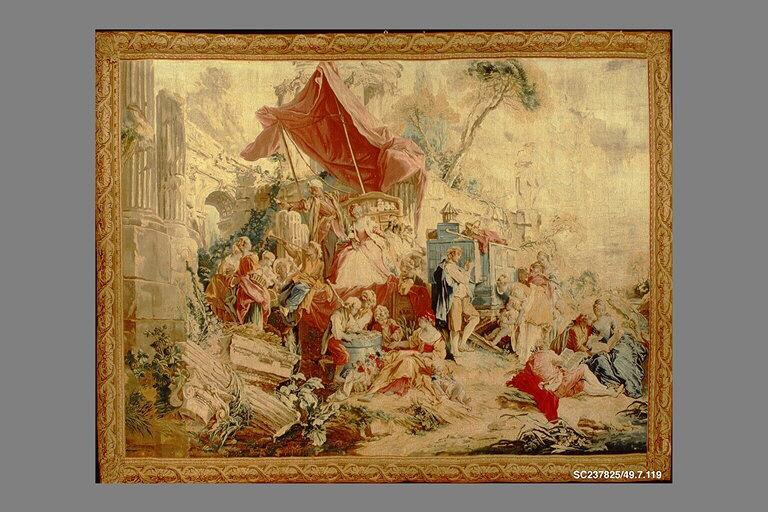
The Charlatan and the Peep Show from a set of Italian Village Scenes
Original title: The Charlatan and the Peep Show from a set of Italian Village Scenes
kurzbeschreibung
François Boucher designed this tapestry in 1736, and it was woven in wool and silk between 1736 and 1752. It belongs to a series of Italian village scenes and centers on a charlatan surrounded by a crowd of many heads. The weave density is 19 to 22 warps per inch.
Description
A group of people stands around a central figure: some sit, others stand and turn toward one another. Behind the crowd appear ruins and trees, suggesting a historical or antique setting. A large red cloth is hung across the middle and draws the eye. Warm tones—red, yellow, and brown—dominate the color scheme, which stands out through the textile structure and the coloring of figures and background. The layout is dense and multi-layered, with figures on different levels.
Context
Boucher created the cartoons for this tapestry series in 1736 on commission from the royal Gobelin manufactory. The scenes of Italian village life were first used to furnish the Château de Choisy and later other royal residences. This reflects the Rococo court's interest in rural and exotic motifs. The fact that execution stretched over several years points to the elaborate weaving process and the great demand for Boucher's designs.
Impact
The close arrangement and warm tones create a lively, almost theatrical mood that draws the viewer into the rural activity. The texture of wool and silk gives the work a tactile quality that emphasizes the richness and elegance of courtly art.
Technique
The tapestry was woven at the Gobelin manufactory from a mixture of wool and silk, with 19 to 22 warps per inch (8 to 9 per centimeter). This fine weave allowed high detail and nuanced color reproduction, which was crucial for rendering the figures and landscape. Silk for highlights and wool for the ground structure correspond to the usual practice of high-quality 18th-century tapestries.
AI-generated description text
Source: Metropolitan Museum of Art · Public Domain (CC0 1.0)