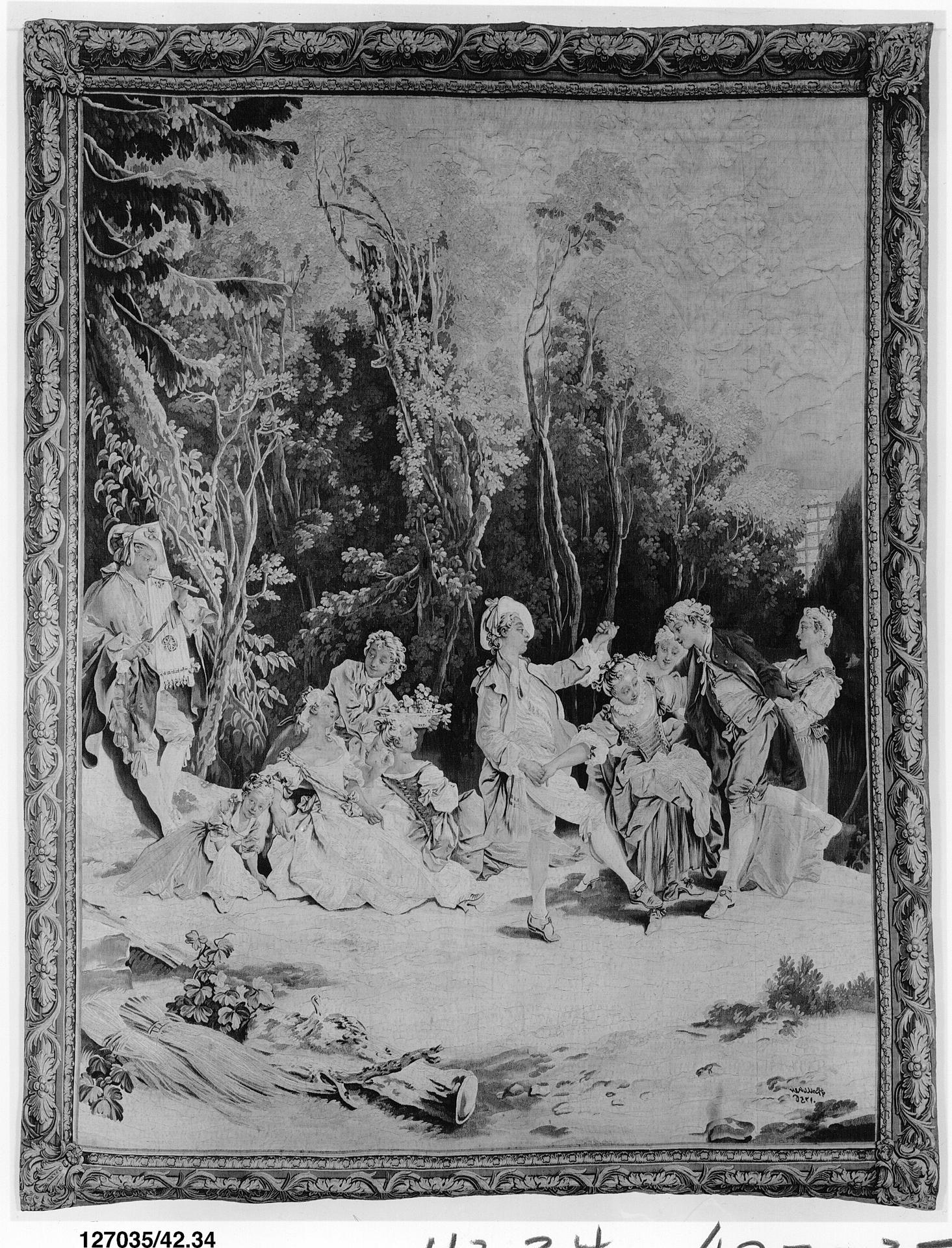
The Dance from a set of the Italian Village Scenes
Original title: The Dance from a set of the Italian Village Scenes
kurzbeschreibung
A dance unfolds in a rural setting, captured in wool and silk: the tapestry known as Der Tanz belongs to a series of Italian village scenes attributed to the Beauvais workshop and dating to around 1744–53. People of various ages are gathered here, some in motion, others at rest, set within a village backdrop.
Description
On the left stands a man in traditional dress, his posture suggesting the opening of a round dance; around him others have settled, lie in the grass, or move through the space. Trees and shrubs frame the action and establish the rural setting. The layout arranges the figures around the central figure, with the rest loosely distributed. The clothing points to a past or imagined world.
Context
Beauvais was among the leading tapestry workshops of the eighteenth century. The series of Italian village scenes belongs to the pastoral motifs popular in the Rococo period. Such wall hangings were often woven for the interiors of noble houses, where they served representative purposes. Who commissioned the series and where it originally hung can no longer be determined.
Impact
A calm, idyllically rural mood emanates from the tapestry, transporting the viewer to an idealized world of the countryside. The balanced arrangement of the figures and their relaxed postures create a harmonious overall impression, characteristic of eighteenth-century court art.
Technique
The tapestry was woven in the technique of pictorial tapestry, using wool and silk. With 21–23 warps per inch (8–9 per centimeter), the weave has a fine density that allows precise contours and graduated color nuances. This process enabled the high pictorial accuracy visible in the figures and the landscape.
AI-generated description text
Source: Metropolitan Museum of Art · Public Domain (CC0 1.0)