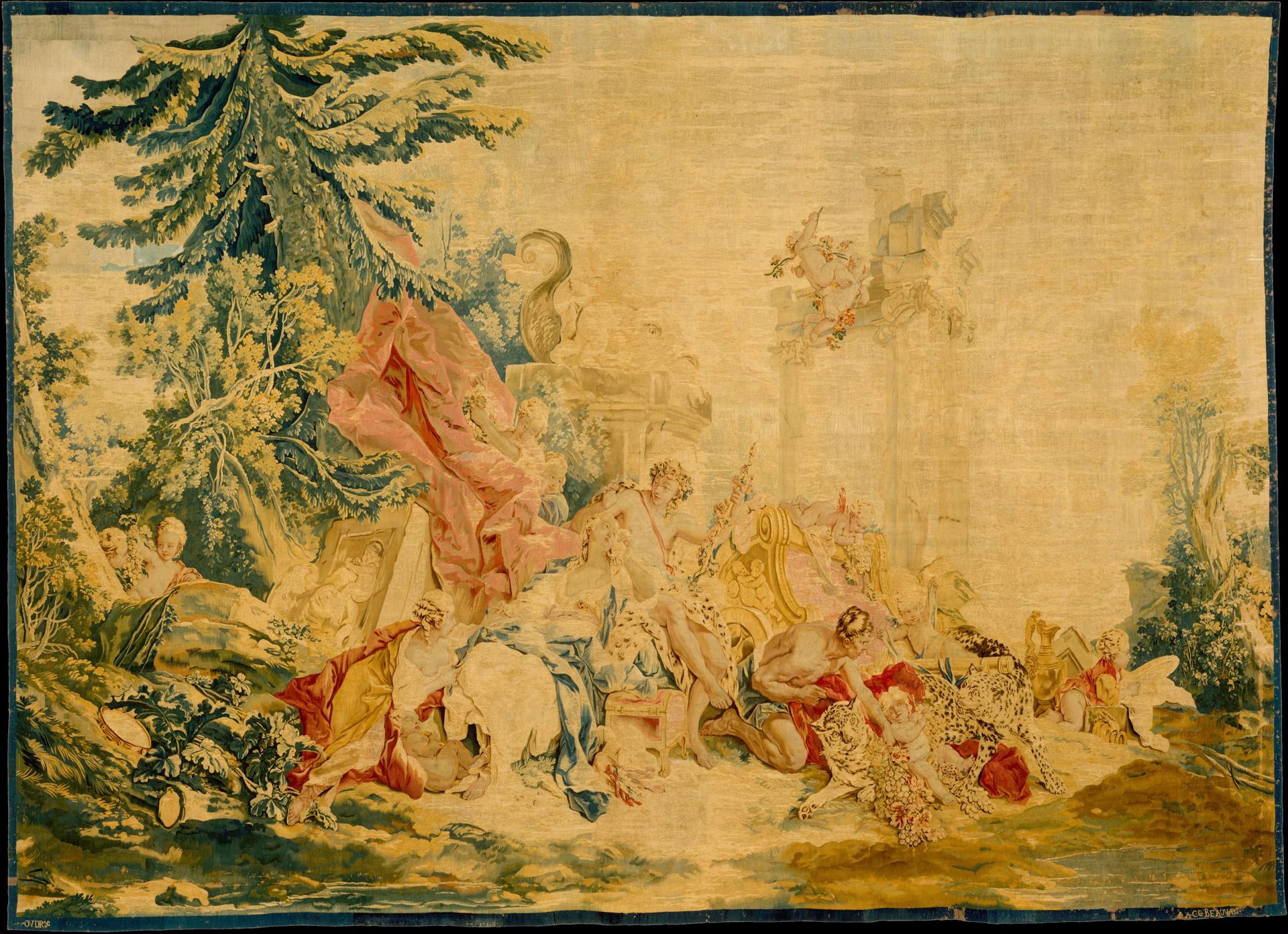
Bacchus and Ariadne from a set of The Loves of the Gods
Original title: Bacchus and Ariadne from a set of The Loves of the Gods
kurzbeschreibung
In 1754, François Boucher designed the tapestry "Bacchus and Ariadne" for the cycle "The Loves of the Gods"; it was woven at the Manufacture des Gobelins. The subject is the mythological encounter of the two deities in an idyllic landscape. Executed in wool and silk, the work measures 365.8 × 533.4 cm.
Description
Bacchus is seated on a chair, surrounded by a group of figures, among them Ariadne in a red gown holding a flower and a person with a panther. The layout converges symmetrically on the center, with trees, rocks, and flowers forming the backdrop. Warm tones of red, yellow, and blue, along with the flowing draperies, bring dynamism to the image. Evenly distributed light creates a calm mood.
Context
The tapestry belongs to a series of six tapestries depicting the loves of the gods, produced between 1749 and 1760 at the Manufacture des Gobelins. François Boucher designed the cartoons; Jean-Baptiste Oudry, then director of the manufactory, oversaw the execution. The series was commissioned for the French court to represent the Rococo courtly art. The high weave density of 23–25 shots per inch attests to the luxurious execution intended for royal rooms.
Impact
The warm palette and symmetrical arrangement produce a harmonious, almost theatrical effect characteristic of the Rococo. Gods in an idyllic landscape — playful and elegant, without pathos. The detailed weaving technique enhances the impression of liveliness and precision.
Technique
The tapestry was woven in the high-warp loom technique, with a density of 23–25 shots per inch (9–10 per centimeter). Wool and silk were used, with silk employed for the brilliant colors and fine details. The precise interweaving allowed a faithful reproduction of Boucher's designs.
AI-generated description text
Source: Metropolitan Museum of Art · Public Domain (CC0 1.0)