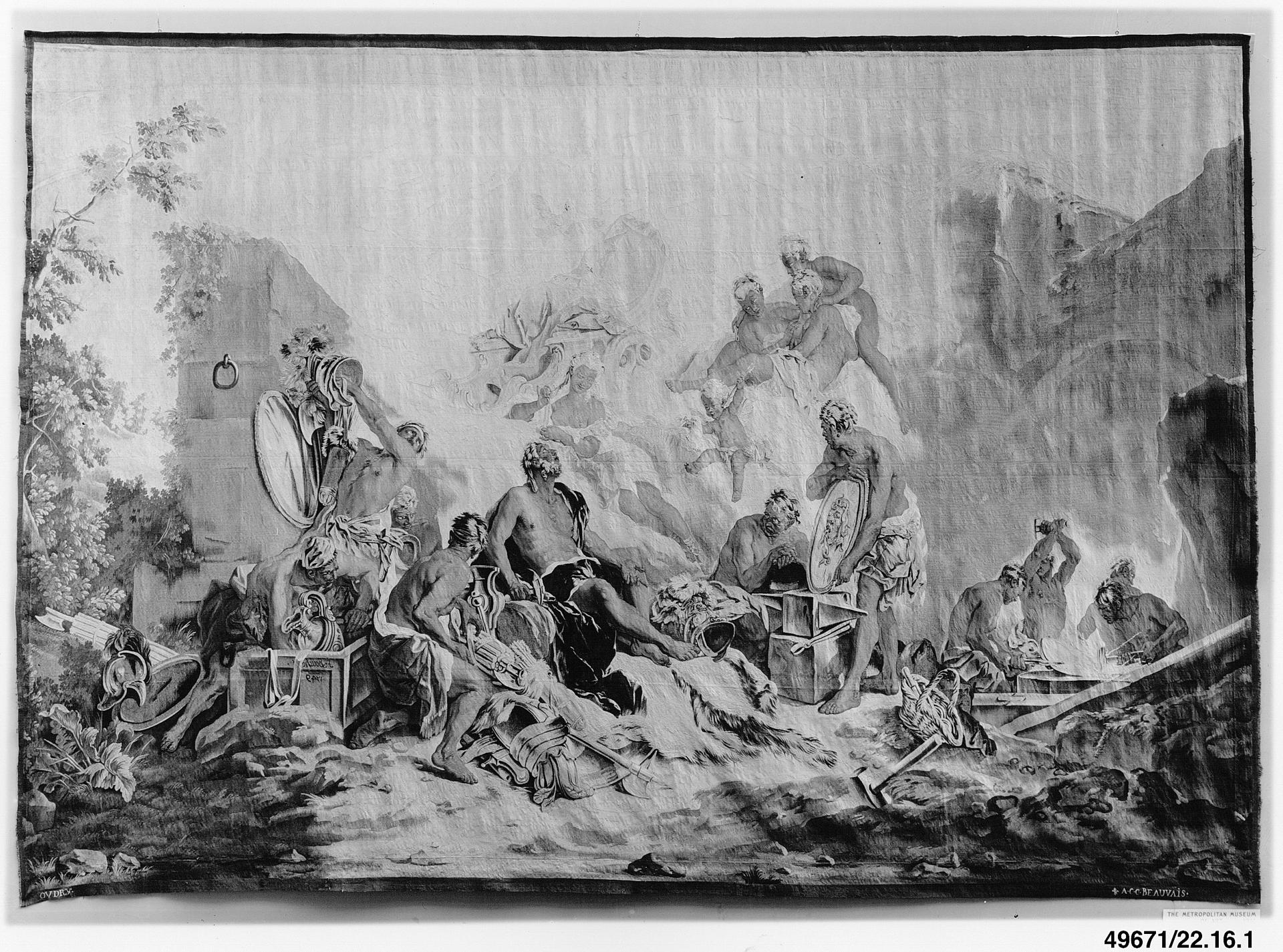
Vulcan Presenting Arms for Aeneas to Venus, from a set of The Loves of the Gods
Original title: Vulcan Presenting Arms for Aeneas to Venus from a set of The Loves of the Gods
kurzbeschreibung
Woven in 1754 after a 1749 design by François Boucher for the series 'The Loves of the Gods', this tapestry shows Vulcan, god of fire, handing Venus the weapons he has forged for her son Aeneas. Worked in wool and silk at 23–25 warps per inch, the piece measures 426.7 × 543.6 cm.
Description
Vulcan holds the middle ground, barefoot and plainly dressed, tools and metal parts at the ready. Around him barefoot figures are spaced in various poses, some turned to the forge, others carrying equipment. Trees, rocks and a bridge break up the background. The palette stays monochromatic, and the light falls evenly, avoiding strong shadows. The layout feels balanced, with Vulcan at its centre and the remaining figures grouped about him.
Context
The design traces back to a 1749 commission from the French crown to the Gobelins manufactory; the weaving followed in 1754. Boucher was among the most esteemed painters of the day and was often entrusted with mythological subjects. The series 'The Loves of the Gods' belonged to the furnishing of royal residences and was meant to represent the court. That the tapestries were produced in several editions speaks to the strong demand for them.
Impact
The balanced arrangement and calm light give the image a solemn, almost ceremonial mood. The precise rendering of figures and tools brings out the craftsmanship and the representational ambition of the tapestry. The monochrome palette reads as restrained, drawing the eye to the narrative moments.
Technique
The tapestry was made on a high-warp loom in wool and silk, with a density of 23–25 warps per inch (9–10 per cm). This fine weave allowed precise detail and a smooth surface. The silk content lends a discreet sheen that supports the baroque aesthetic.
AI-generated description text
Source: Metropolitan Museum of Art · Public Domain (CC0 1.0)