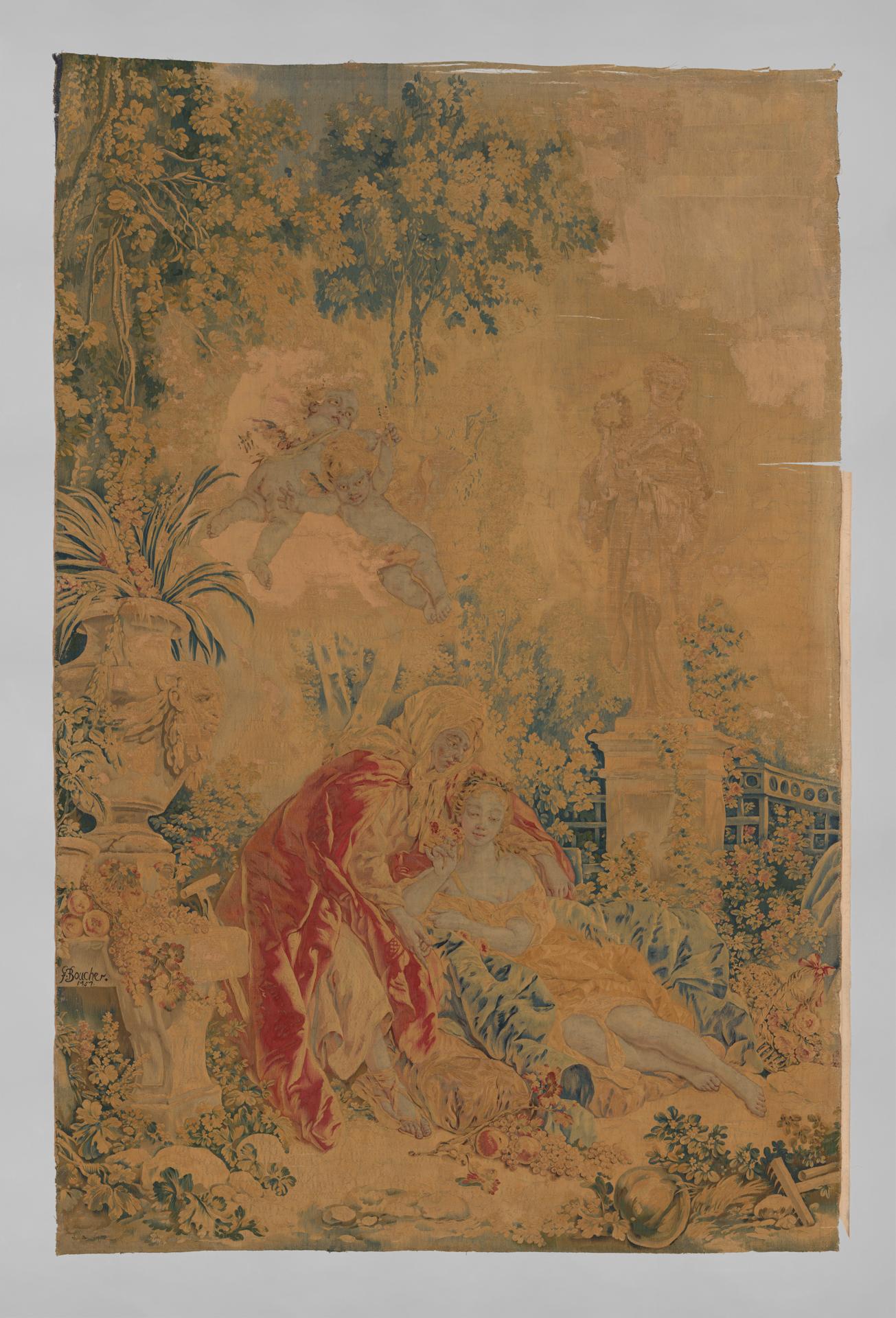
Vertumnus and Pomona from a set of Scenes from Operas
Original title: Vertumnus and Pomona from a set of Scenes from Operas
kurzbeschreibung
Unlike the other sheets in the series of opera scenes, this tapestry by François Boucher, woven between 1758 and 1776, centres on the encounter between the god Vertumnus and the nymph Pomona. Made of wool and silk, it belongs to the set that draws on scenes from the opera of its time.
Description
In the foreground a woman in a yellow gown sits with a child on her lap; beside her stands a figure in red. Trees and plants stage the space behind them, including one with yellow foliage and a plant in a large pot. An angel hovers above the scene, and a statue can be made out at the back right. Flowers and fruit adorn the ground. Yellow, red and brown dominate the warm palette, and light falling from above brings out the details of both figures and setting.
Context
The tapestry was woven at the Manufacture des Gobelins in Paris, whose workshop Boucher directed. The series 'Scenes from Operas' was created for the French court and takes up scenes from operas of the period. Boucher supplied the cartoons, which experienced weavers then translated into cloth.
Impact
The warm colouring and richness of detail give the tapestry a festive air. Otherworldly touches such as the hovering angel lend it a fairy-tale quality. The layout is balanced and draws the eye to the figures in the foreground.
Technique
The piece is made in tapestry weaving, with a wool warp and a silk weft. Twenty-one to twenty-two wefts per inch, or 8 per centimetre, allow fine resolution of detail. In this way Boucher's painterly designs could be reproduced closely.
AI-generated description text
Source: Metropolitan Museum of Art · Public Domain (CC0 1.0)