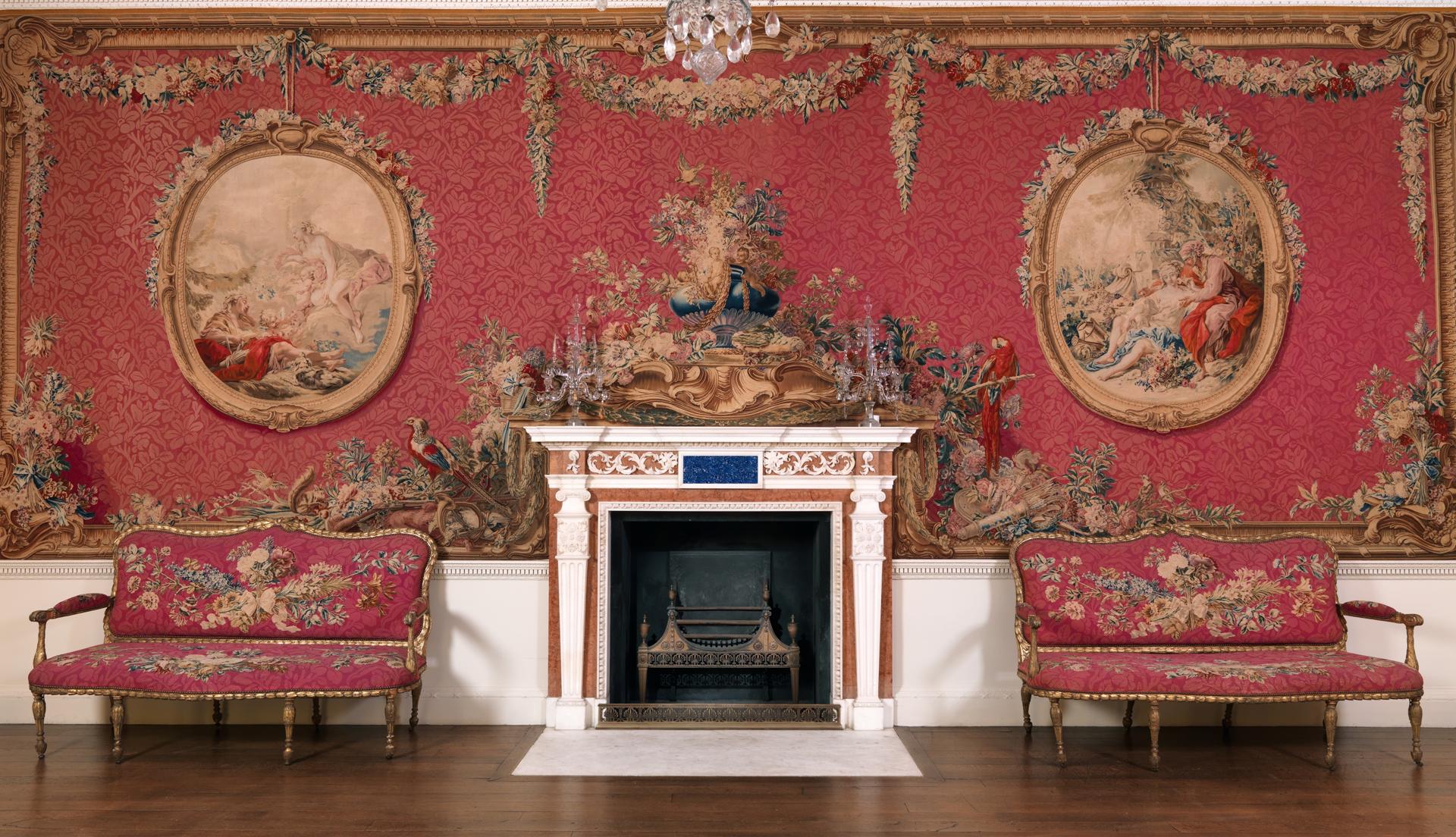
Tapestry Room from Croome Court
Original title: Tapestry Room from Croome Court
kurzbeschreibung
Robert Adam designed the Tapestry Room from Croome Court between 1763 and 1771. Its furnishings include wall hangings, seating and ornamental fittings made of plaster, wood, gilt bronze and silk. Together they form a complete room ensemble.
Description
Red tapestries with floral motifs cover the walls. Oval pictures showing scenes of classical figures hang to either side. Below stands a fireplace with a marble surround and gilded ornament. Two armchairs with red upholstery and flower patterns flank the chimney, a crystal chandelier hangs above it, and the floor is laid with wooden boards.
Context
The country house at Croome Court in Worcestershire belonged to the 6th Earl of Coventry. Robert Adam, a leading architect of British classicism, designed the interiors in the 1760s. The tapestries were woven at the royal Gobelins manufactory in Paris. As a formal reception room, it reflects the aristocratic taste of its day.
Impact
Deep red tapestries, gilded details and pictures with antique subjects give the room a solemn, stately mood. The symmetrical arrangement and precious materials assert a claim to elegance and cultural refinement.
Technique
The tapestries are woven from wool and silk at 22 to 24 warps per inch. Plaster, pine and mahogany, gilt bronze and marble attest to a wide range of craft skills. The room is conceived as a total work of art in which every element is keyed to the others.
AI-generated description text
Source: Metropolitan Museum of Art · Public Domain (CC0 1.0)