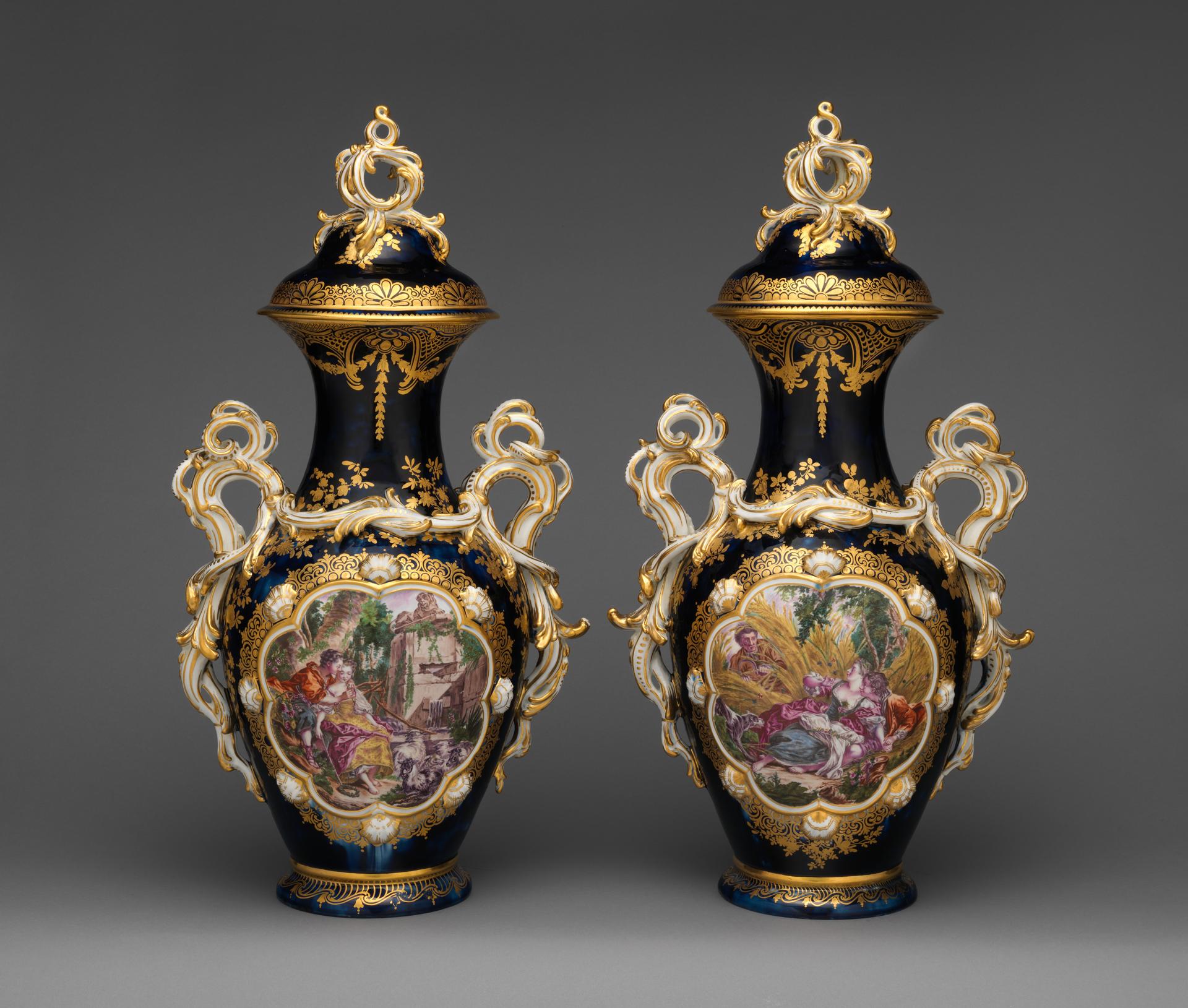
Vase (one of a pair) (ca. 1762, Met-Objekt 6162)
Original title: Vase (one of a pair)
kurzbeschreibung
This vase, one of a pair, was made around 1762 at the Chelsea Porcelain Manufactory. It is crafted from soft-paste porcelain and adorned with polychrome enamels and gold. The front features an oval panel with figures in historical dress set within a landscape.
Description
A deep dark blue forms the ground, over which golden leafy scrolls and ornaments are laid. At the front an oval panel opens: figures in historical garments stand in a landscape with trees and shrubs. Two large, richly decorated handles are also embellished with gold and enamel. On the lid sits a complex gold ornament reminiscent of a crown. The vase is placed against a neutral background.
Context
Chelsea was among England's earliest porcelain manufactories and from the mid-eighteenth century produced high-quality soft-paste porcelain. This piece dates to around 1762, when the firm was known for elaborate works influenced by the Rococo. The dark blue ground with gold decoration follows contemporary French and German models. Such vases served wealthy patrons as decorative showpieces.
Impact
The contrast between deep blue and gleaming gold immediately catches the eye, giving the vessel a noble, sumptuous presence. The gaze travels from the handles over the symmetrical form to the oval panel, whose detailed enamel painting invites lingering. The balanced arrangement feels formal and representative, and the crowning lid ornament underscores the regal character.
Technique
The material is soft-paste porcelain with a fine, smooth surface. The coloured decoration was applied with polychrome enamels over several firings and supplemented with gilding. The handles and lid ornament were probably made in separate moulds and then mounted.
AI-generated description text
Source: Metropolitan Museum of Art · Public Domain (CC0 1.0)