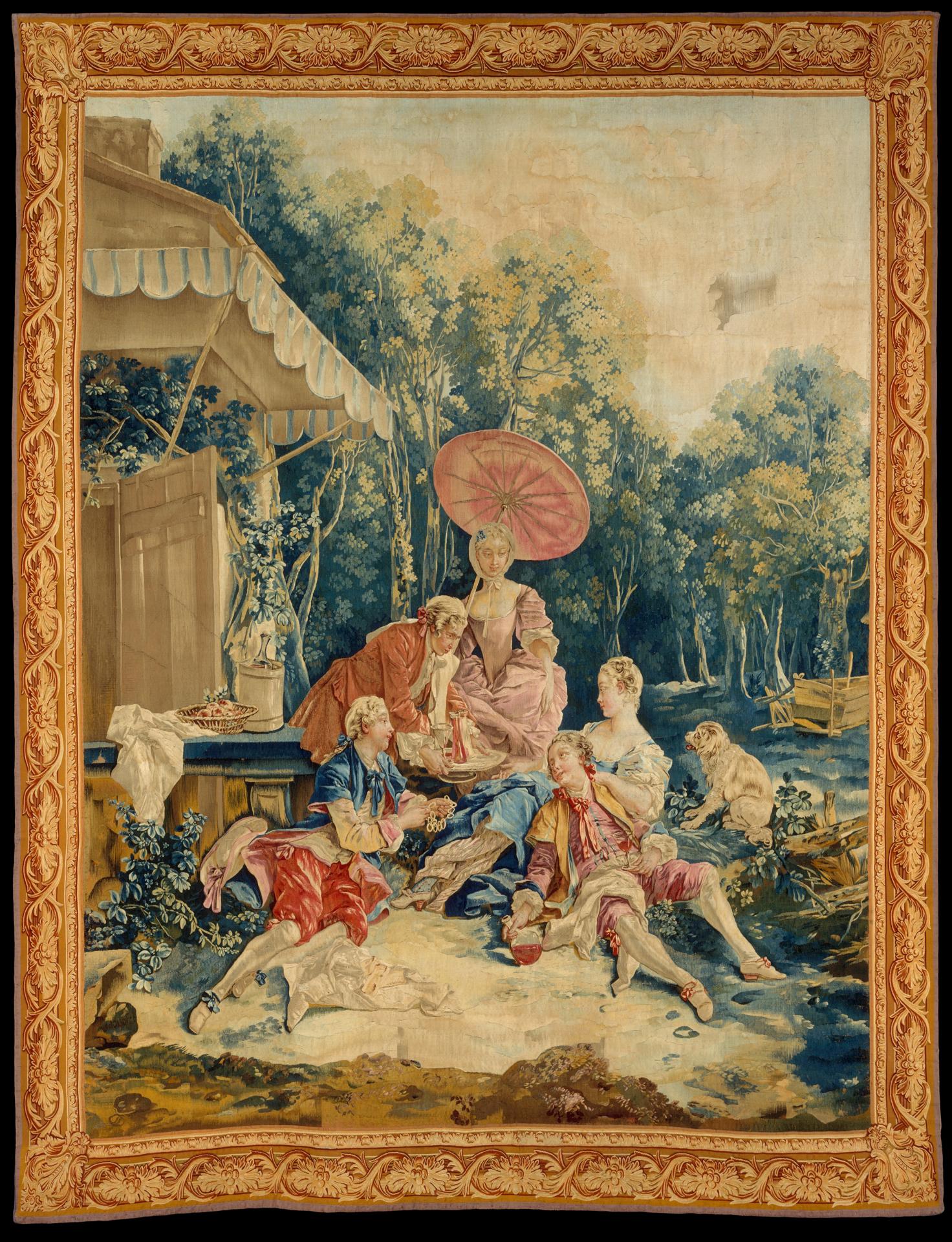
The Collation from a set of the Italian Village Scenes
Original title: The Collation from a set of the Italian Village Scenes
kurzbeschreibung
A design by François Boucher for the Italian Village Scenes series, made in 1734–36, was woven in wool and silk in 1762. The fabric, with 21–23 warps per inch, shows a rural gathering: several people in 18th-century dress have settled around a table and on the ground.
Description
In the foreground, a number of figures lounge and sit together, including a woman with a parasol in conversation with a child, and someone seated on the table holding a bowl. Trees and a house with a striped roof close the view at the back, and a dog has settled on the ground close to the people. The layout draws the eye toward the central group and opens out toward the landscape; blue, pink, red, and beige dominate the palette, and a richly patterned floral border frames the fabric.
Context
Boucher worked for the royal Gobelins manufactory in 1734–36, a time when pastoral and village scenes were in demand in the Rococo. The Italian Village Scenes series was woven several times, and the present piece dates to 1762. Buyers of such tapestries were nobles and wealthy burghers who furnished their rooms with them and valued an idealized image of country life.
Impact
The fabric feels cheerful and idyllic, carried by the balanced arrangement and friendly tones. Cleanly defined figures and evenly distributed light create the calm and harmony characteristic of Boucher's rural ideal landscapes.
Technique
The tapestry was woven in wool and silk at a fine density of 21–23 warps per inch (8–9 per centimeter). This density allowed details to be reproduced precisely and produced a smooth surface on which the fine gradations of color stand out.
AI-generated description text
Source: Metropolitan Museum of Art · Public Domain (CC0 1.0)