Allegory of Water (Neptune Rescuing Amymone)
Original title: Allegory of Water (Neptune Rescuing Amymone)
kurzbeschreibung
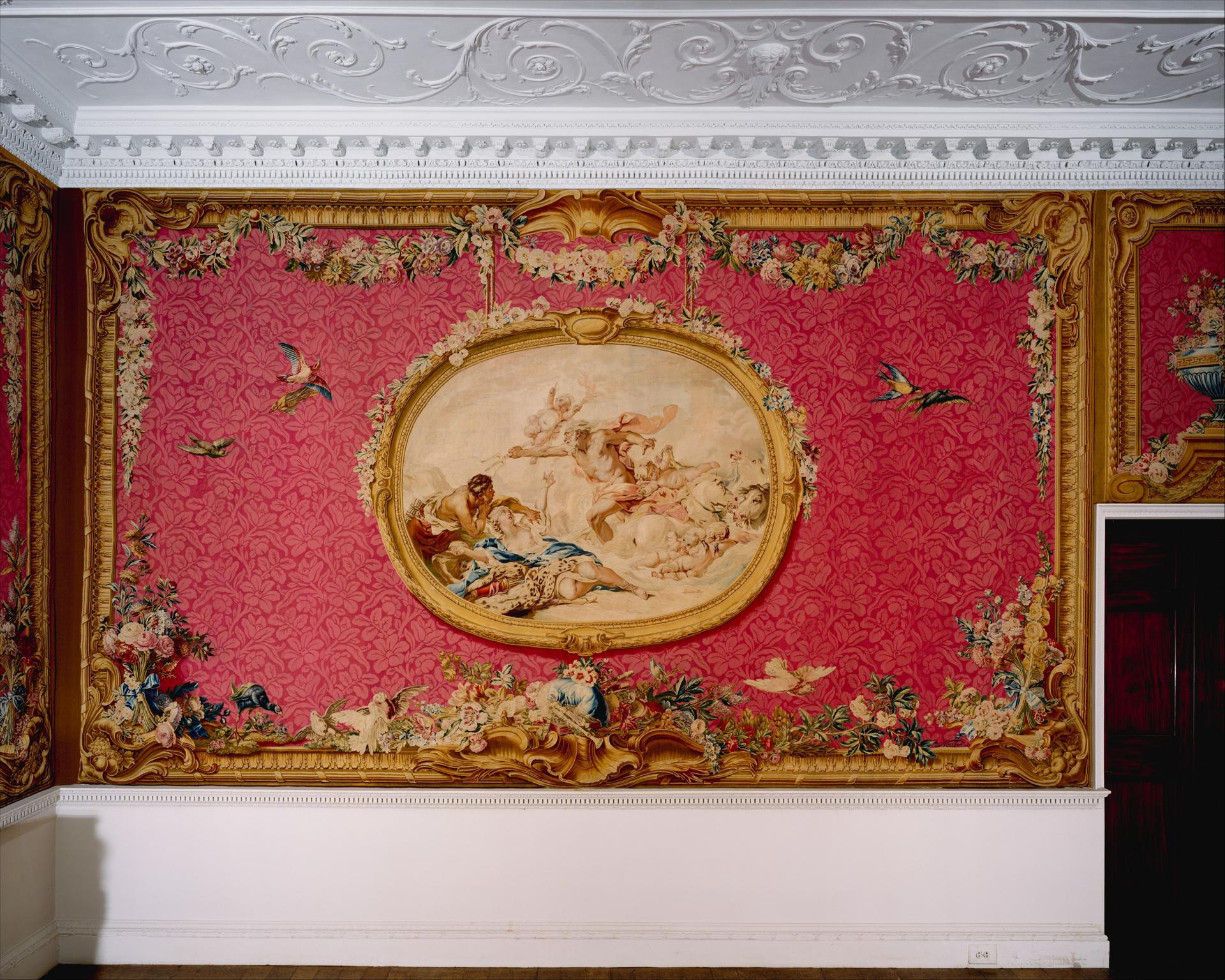
The tapestry titled Allegorie des Wassers depicts the sea god Neptune rescuing the nymph Amymone from a satyr. Jacques Germain Soufflot designed the work, which was woven in a Parisian manufactory between 1764 and 1771. Made of wool and silk, it measures approximately 3.05 × 5.18 meters.
Description
Within a central oval, Neptune, Amymone, and other mythological figures appear in a dramatic, heroic scene. The layout is symmetrical, with figures arranged in dynamic, flowing movement. Warm reds, gold, and white dominate the palette. The border area features floral and leaf motifs. Even light falls on the fabric, emphasizing colors and details.
Context
Soufflot, known as the architect of the Panthéon in Paris, designed the tapestry for the royal Gobelins manufactory. The series to which this piece belongs was dedicated to the four elements and created for the French court. It was executed between 1764 and 1771, probably under the direction of Pierre-François Cozette. The tapestry reflects late Baroque taste for allegorical subjects and magnificent furnishings.
Impact
This large-format tapestry work unfolds a monumental yet elegant presence that transports the viewer into a heroic mythology. The warm colors and symmetrical arrangement give the room a representative, festive atmosphere. The abundance of details and the flowing movements of the figures encourage prolonged contemplation.
Technique
The tapestry was made in high-warp weaving on a loom, with a density of 22–24 warps per inch (9–10 per centimeter). Wool and silk were used as materials, allowing fine detail reproduction and a silky sheen. The precise weaving permitted nuanced gradation of colors and the realization of complex scenes.
AI-generated description text
Source: Metropolitan Museum of Art · Public Domain (CC0 1.0)