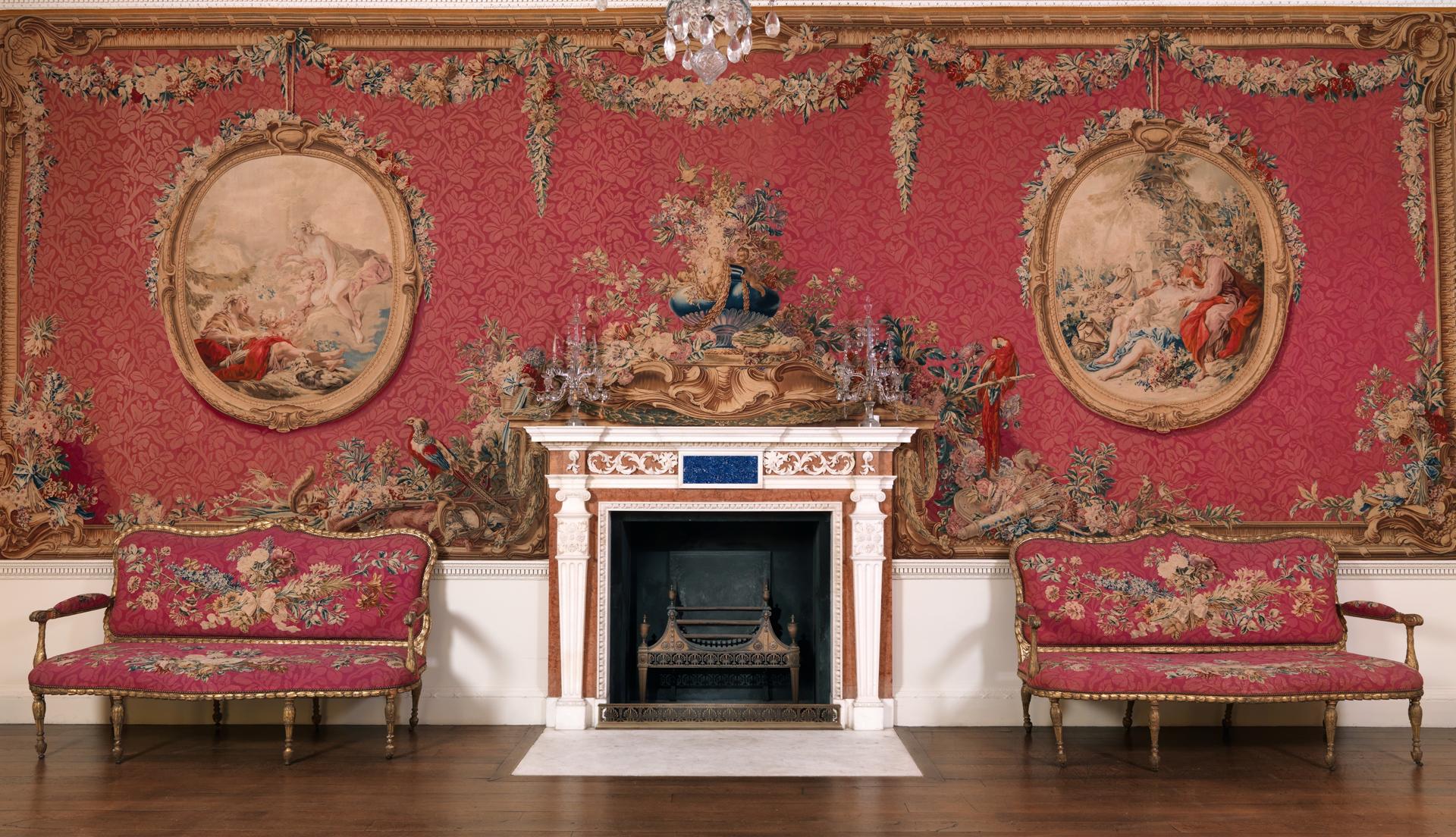
Allegories of Air (Cephalus and Aurora) and Earth (Vertumnus and Pomona)
Original title: Allegories of Air (Cephalus and Aurora) and Earth (Vertumnus and Pomona)
kurzbeschreibung
This tapestry, woven with the allegories of Air (Cephalus and Aurora) and Earth (Vertumnus and Pomona), was based on a design by Jacques Germain Soufflot. Planning spanned 1758 to 1767, and weaving in the manufactory took from 1764 to 1771. Worked in wool and silk, the piece presents two oval scenes in a baroque manner, framed by floral scrollwork. It measures 3.05 meters in height and 8.31 meters in width.
Description
Two oval picture fields divide the surface: on the left, the Air allegory with Cephalus and Aurora; on the right, the Earth allegory with Vertumnus and Pomona. Pastel tones lift the figures from a red ground covered with dense flowers and scrolls. The tapestry hangs in a sumptuous interior that includes a fireplace with blue mosaic, two matching armchairs, and a chandelier.
Context
The tapestry was designed for the Paris residence of Madame de Pompadour, mistress of Louis XV. Soufflot, a leading architect of classicism, supplied the cartoons for the Gobelins manufactory. The allegories draw on mythological themes prized in eighteenth-century court art. At a time when tapestries were status symbols of the nobility, this work was created.
Impact
Pastel figures against a red ground create a lively yet noble tension. The symmetrical arrangement of the allegories and the opulent framing give the work a ceremonial, representative air. Within the interior, it becomes clear how the tapestry dominates the room and heightens its splendor.
Technique
Weaving took place at the Gobelins manufactory with a fine warp of 22 to 24 threads per inch (9 to 10 per centimeter). Wool forms the basic structure; silk adds shining accents. This technique allows high detail and rich color gradations.
AI-generated description text
Source: Metropolitan Museum of Art · Public Domain (CC0 1.0)