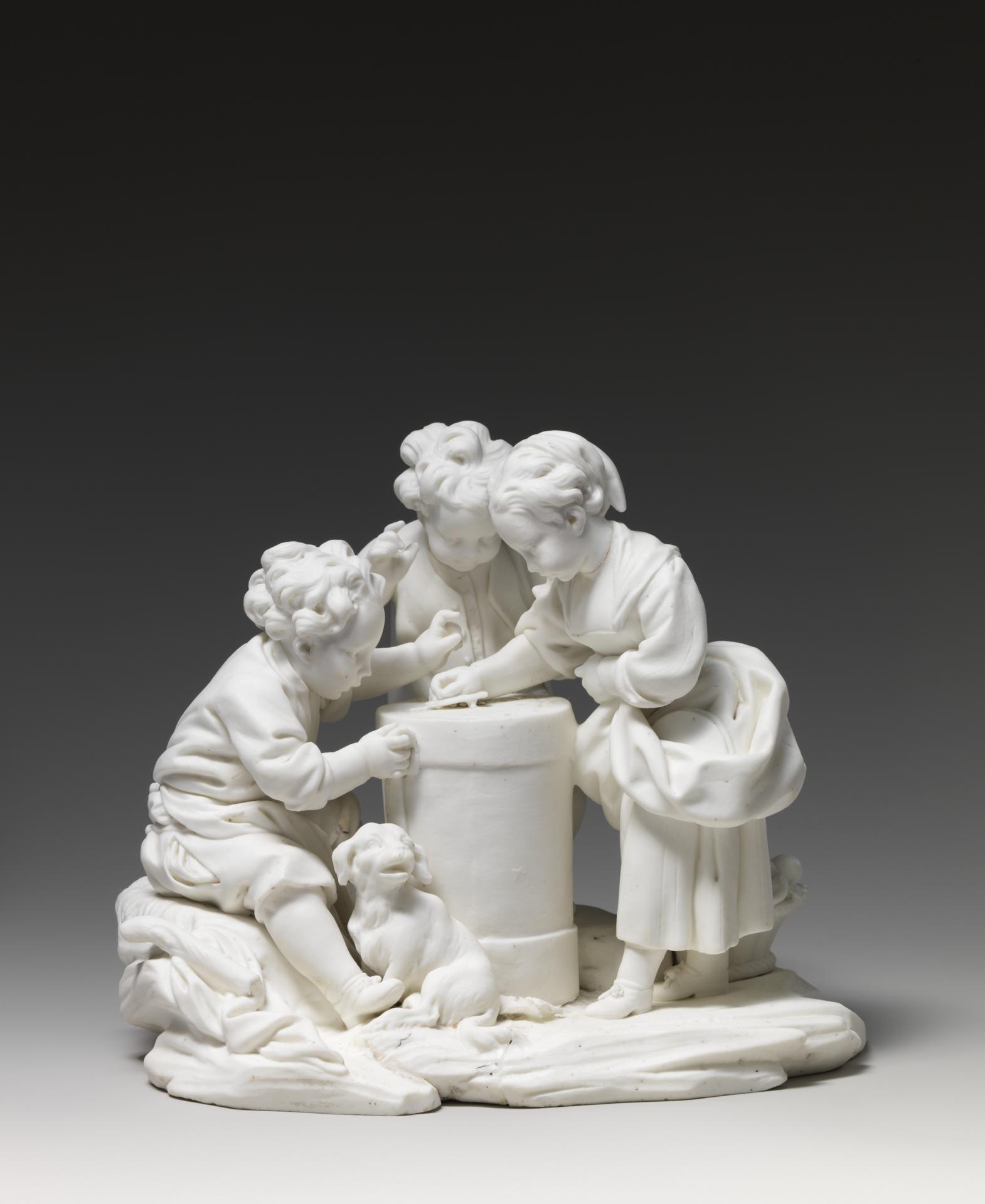
The Lottery
Original title: The Lottery
kurzbeschreibung
The Manufacture nationale de Sèvres made this porcelain group, titled Das Los (The Lot), around 1757. Modelled in soft-paste biscuit porcelain, it gathers three children around a cylindrical container. The moment seems shaped by decision or quiet deliberation.
Description
Two of the children kneel, the third sits, all arranged around a cylindrical vessel. A small dog rests on the ground between them. The white porcelain draws attention to the colour of the material and the texture of its surface. The arrangement is symmetrical, with the figures grouped about the vessel at the centre. Light falling from above picks out contours and details, while the neutral dark background sets off the group.
Context
From the 1750s onward the Sèvres manufactory produced biscuit porcelain, left unglazed and therefore matte white. Groups like this often served as table decoration or for cabinets, drawing on subjects from mythology, genre or allegory. Its making around 1757 falls in the period when Sèvres, under the patronage of Madame de Pompadour, rose to become the leading porcelain manufactory in Europe.
Impact
The unglazed white surface gives the group a sculptural quality reminiscent of marble, lending the figures a classical air. The calm, concentrated bearing of the children creates an intimate, reflective mood that invites the viewer to contemplation.
Technique
Made of soft-paste porcelain, a mixture of clay, quartz and a glazing agent fired at lower temperatures than hard-paste porcelain. In the biscuit state the surface remains unglazed and matte, which reproduces fine details well. The figures were presumably modelled in several parts and then assembled.
AI-generated description text
Source: Metropolitan Museum of Art · Public Domain (CC0 1.0)