The Magic Lantern
Original title: The Magic Lantern
kurzbeschreibung
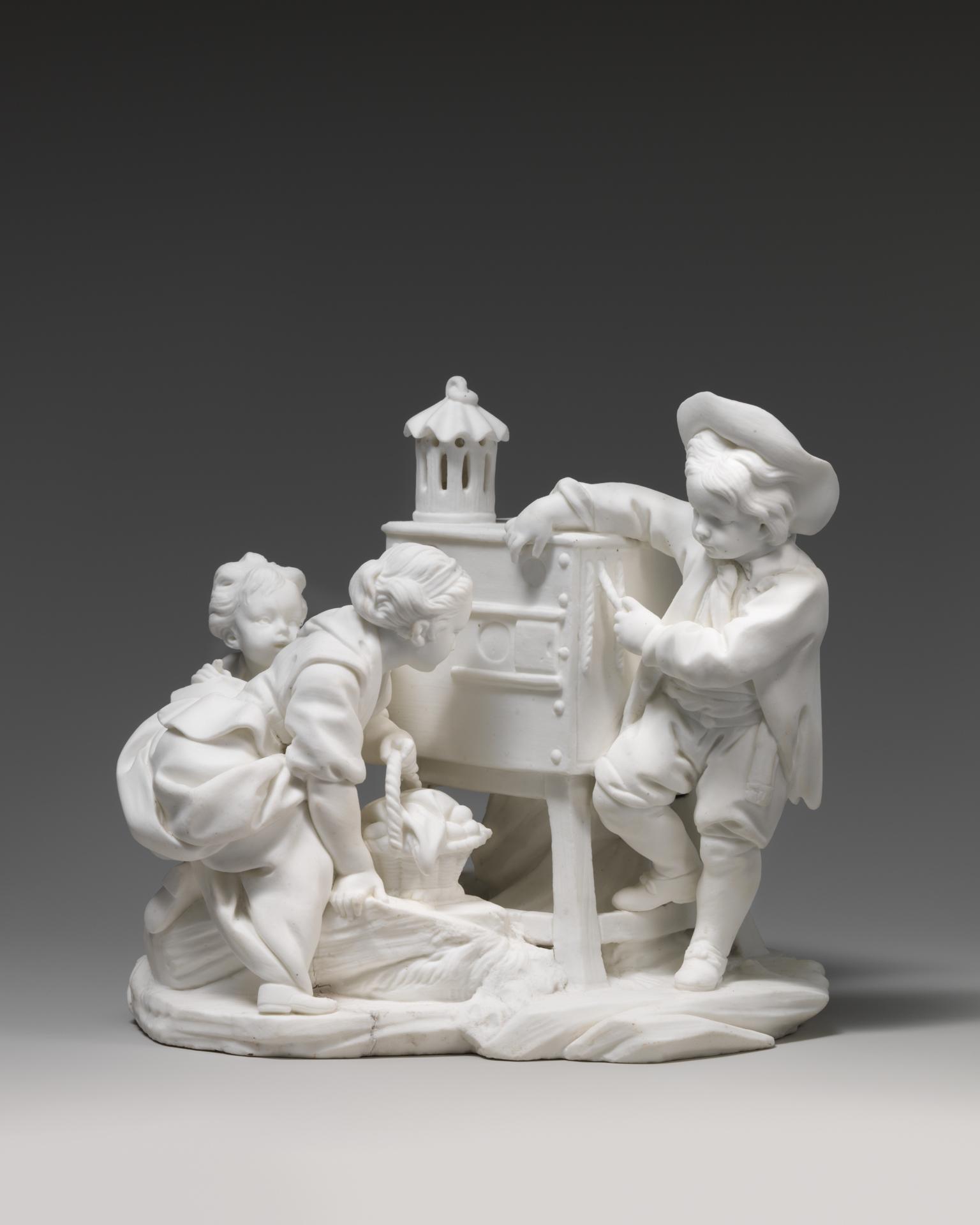
Four children cluster around a puzzling contraption that can be read as a magic lantern. This porcelain group was made around 1760 at the Manufacture de Sèvres from soft-paste biscuit porcelain. The subject pairs childhood curiosity with the Enlightenment delight in optical entertainments.
Description
Two children kneel, one stands and fiddles with the tall, upright object, and another sits on the ground looking toward it. The object resembles a chimney or a musical instrument and has a door and a small attachment on its roof. Everything is rendered in white biscuit porcelain, so figures and device share a uniform, bright surface. The light seems to fall evenly from above, without cast shadows. The modelling records clothing and accessories in the detail customary for children around 1760.
Context
In the eighteenth century the Manufacture de Sèvres was regarded as France's leading porcelain factory and supplied the royal court. From the 1750s it used biscuit porcelain—unglazed porcelain—for sculptures and figure groups to achieve a marble-like effect. The magic-lantern subject alludes to the optical devices widespread in the 1700s, which served both entertainment and education. Children in playful scenes were a favourite Rococo theme, one that emphasized the carefree nature and curiosity of childhood.
Impact
The white, matte surface of the biscuit porcelain gives the group a calm, almost sculptural presence that recalls marble and makes the scene feel timeless. The children are arranged symmetrically around the central object, which lends the layout a balanced and harmonious order and draws the eye to fine details. The even, shadowless lighting stresses the clear, idealized formal language of Rococo aesthetics.
Technique
For this group the makers used soft-paste biscuit porcelain, a material that gains a smooth, matte surface through frit and clay. Production without glaze allowed fine details and a texture reminiscent of carved marble. The figures were probably modelled in several parts, then assembled and fired at high temperature.
AI-generated description text
Source: Metropolitan Museum of Art · Public Domain (CC0 1.0)