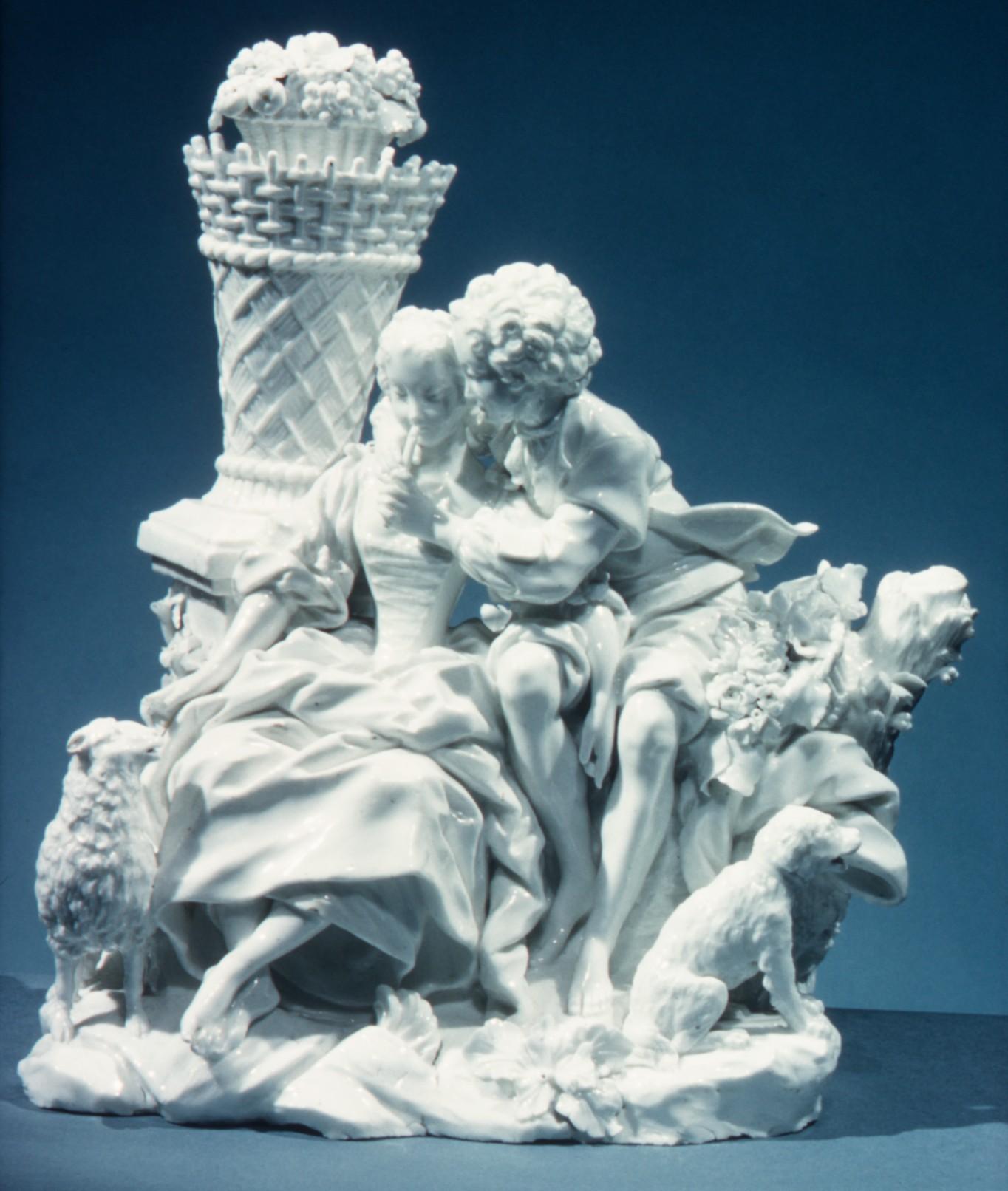
The Flute Lesson
Original title: The Flute Lesson
kurzbeschreibung
Made around 1752 at the Manufacture de Vincennes, the soft-paste porcelain group 'The Flute Lesson' brings together two figures in an instructive encounter, framed by animals and a tower-like porcelain element.
Description
On the left a woman sits in an armchair holding a flute; on the right a man stands or sits, evidently giving her instruction. Both wear baroque garments with rich folds. Behind them rises a large, multi-part porcelain structure in the form of a tower or pavilion with a dome and floral finial. Two dogs and a sheep lie on the ground, enclosing the scene. The layout is dense and full of detail; light from above accents the outlines.
Context
Founded in 1740, the Manufacture de Vincennes produced mainly soft-paste porcelain before moving to Sèvres in 1756. This object dates from a period when porcelain was made as a luxury ware for the courtly nobility. Figure groups with gallant or didactic subjects were widely popular in the mid-eighteenth century and often served as table centrepieces or room decoration. The portrayal of a music lesson points to courtly culture and the esteem for music in the Age of Enlightenment.
Impact
From the first glance, the uniform whiteness and delicate modelling hold the viewer, giving the object an elegant, precious air. Despite the rigid porcelain mass, gesture and animal staffage create a lively, narrative quality. The crowded arrangement and baroque details lend the group a representative, almost theatrical presence.
Technique
The group is made of soft-paste porcelain, a mixture of clay, glaze and frit that was common in Europe before the development of hard-paste porcelain. The figures were probably modelled in several parts, assembled, then glazed and fired. The detailed execution attests to the high craftsmanship of the Vincennes manufactory.
AI-generated description text
Source: Metropolitan Museum of Art · Public Domain (CC0 1.0)