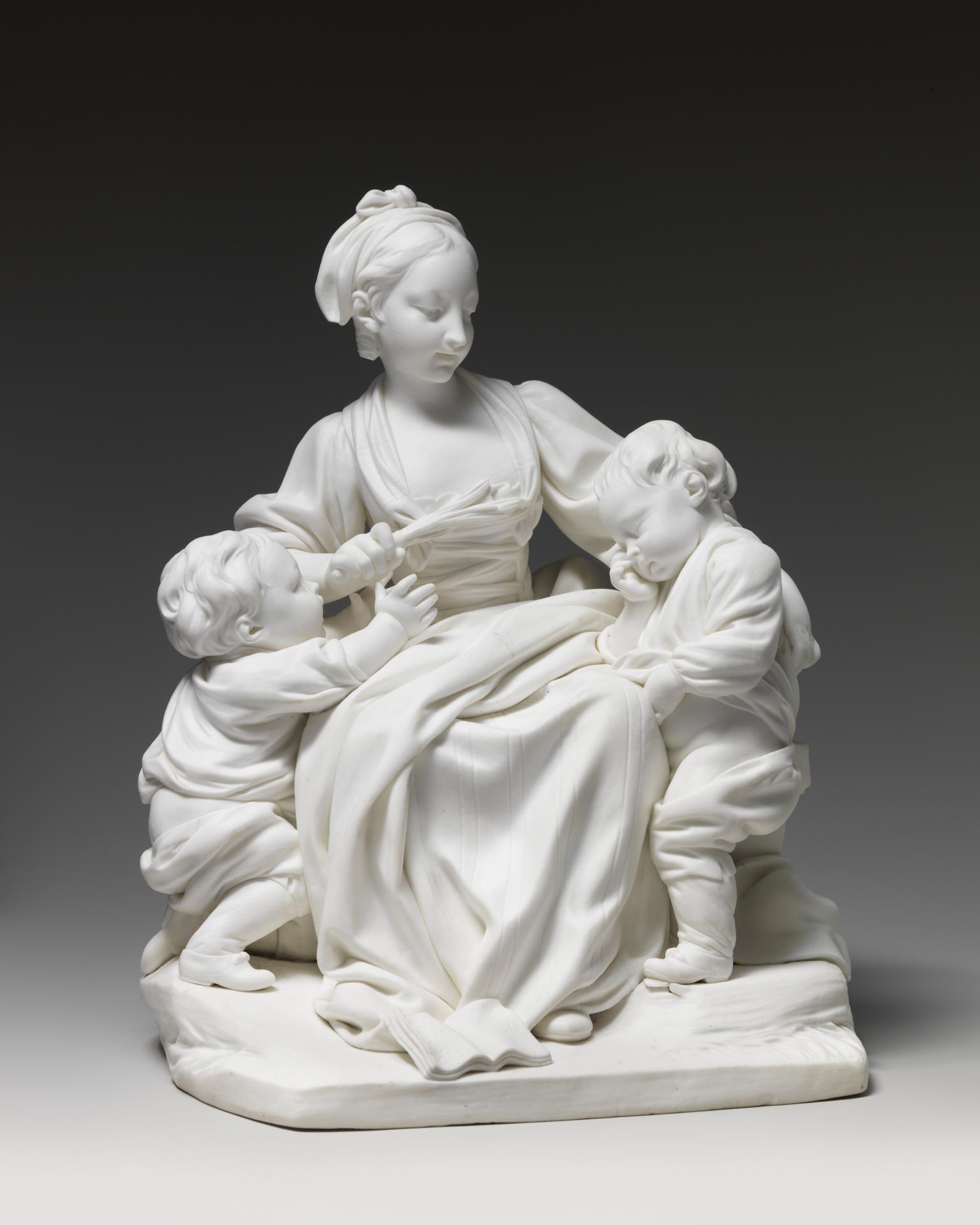
The Schoolmistress
Original title: The Schoolmistress
kurzbeschreibung
Made at the Manufacture de Sèvres around 1762, "Die Schulmeisterin" is a porcelain group in unglazed soft-paste biscuit. It brings together a seated woman and two children reading from a single book.
Description
A woman sits on a base, an open book in her hands. Her long, close-fitting gown and a headscarf define her figure. At her feet a boy and a girl have settled; both look into the book, the boy holding one page, the girl touching it. The layout is symmetrical, the woman at the center and the children ranged to either side. Even light draws out the smooth white porcelain, and the children's hair is short and curly.
Context
In these years, under Louis XV, the Manufacture de Sèvres rose to become France's leading porcelain factory. From about 1750 biscuit porcelain, fired without glaze, was used for sculpture to achieve a marble effect. The motif of the teaching woman reflects the educational interests of the Enlightenment. A work by Étienne-Maurice Falconet, active in Sèvres from 1757 to 1766, probably served as the model.
Impact
The white, matte porcelain makes the group look like a reduced marble sculpture. Its calm, symmetrical arrangement gives it a neoclassical air. The intimate moment of shared reading creates a quiet, instructive atmosphere.
Technique
Executed in soft-paste porcelain, a material of clay, quartz and glass frit developed before hard-paste porcelain. The figures were fired in the unglazed biscuit state, which gives the surface a matte, stone-like texture. The detailed lines and flowing garments came from molding and manual finishing before firing.
AI-generated description text
Source: Metropolitan Museum of Art · Public Domain (CC0 1.0)