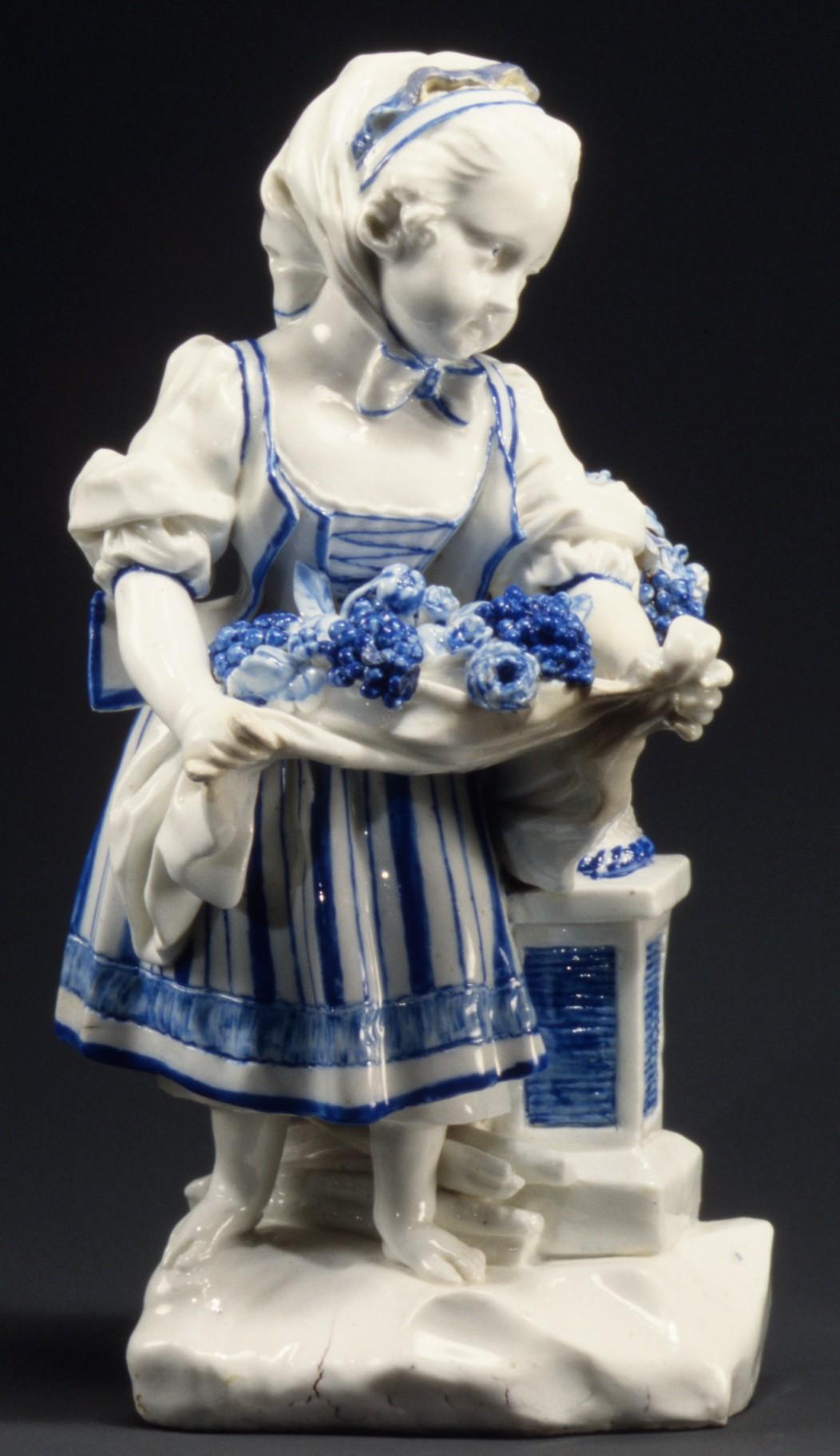
Girl in an Apron (La Fille au Tablier)
Original title: Girl in an Apron (La Fille au Tablier)
kurzbeschreibung
Around 1753–54, the Manufacture de Vincennes produced the porcelain figure known as Mädchen mit Schürze (La Fille au Tablier). Executed in soft-paste porcelain, it depicts a young woman with a basket full of blue flowers, standing on a decorated pedestal. The subject is an idealized, genre-like portrayal of a young woman in rural dress.
Description
A young woman appears in a white bodice with blue stripes and a matching blue-patterned scarf. Both hands hold a basket filled with blue flowers. The pedestal on which she stands also carries blue patterns. Her face is modelled in detail and conveys a thoughtful, almost worried expression. White and blue tones dominate the palette, as was common for porcelain figures of this period.
Context
Founded in 1740, the Manufacture de Vincennes preceded the later Sèvres porcelain factory. Its focus was on soft-paste porcelain, which allowed a fine, glazed surface. At the time the figure was created, porcelain figures served as decorative table centrepieces or room ornaments. They were often produced in series and showed idealized scenes from rural life or comedy.
Impact
Delicate in colour and calm in the figure's inward-turned posture, the work unfolds a quiet presence. The luminous white stands in tension with the strong blues, creating a fresh, elegant aura. Because the face is richly modelled and the clothing finely designed, the figure feels intimate and almost fragile.
Technique
The figure was made of soft-paste porcelain, a mixture of clay, glass and other additives fired at lower temperatures than hard-paste porcelain. The white porcelain was then painted with underglaze or overglaze colours, with blue and white predominating here. Face, clothing and flowers are modelled and painted by hand, demanding a high degree of artisanal precision.
AI-generated description text
Source: Metropolitan Museum of Art · Public Domain (CC0 1.0)