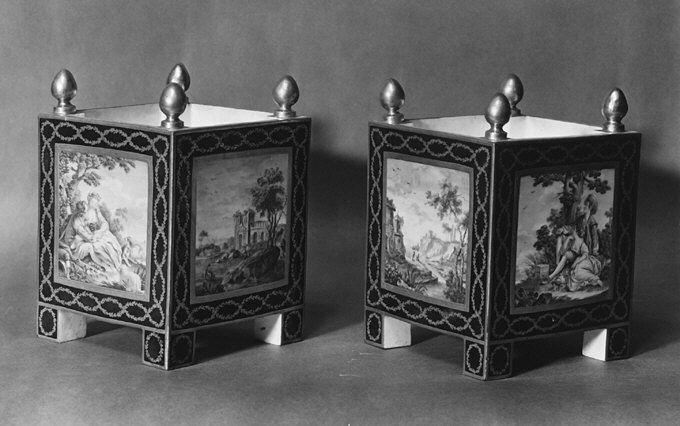
Flower pots (caisses carrés)
Original title: Flower pots (caisses carrés)
kurzbeschreibung
Two matching square containers in soft-paste porcelain were produced in 1771 at the Manufacture de Sèvres. Each side carries a relief with figures or landscapes, combined with a geometric decoration.
Description
Both vessels have a square base and rest on small square feet. Every side displays a relief: one with figures in a landscape, the others with pure landscape views. A black-and-white geometric pattern covers the surfaces and plays around the reliefs. Small round metal mounts sit along the upper edge.
Context
In the 18th century, the Manufacture de Sèvres was regarded as France's leading porcelain factory and supplied mainly the royal court. Flower pots like these furnished grand rooms and were often placed in pairs. The 'caisse carrée' (square box) shape was common for plant containers at the time.
Impact
Strictly geometric patterning and narrative reliefs create a decorative contrast. The symmetrical arrangement of the two identical containers emphasizes their role as representative ornaments.
Technique
The objects are made of soft-paste porcelain, a mixture of clay and glaze used in Europe before the invention of hard-paste porcelain. The reliefs were probably formed in molds and then painted with the geometric pattern.
AI-generated description text
Source: Metropolitan Museum of Art · Public Domain (CC0 1.0)