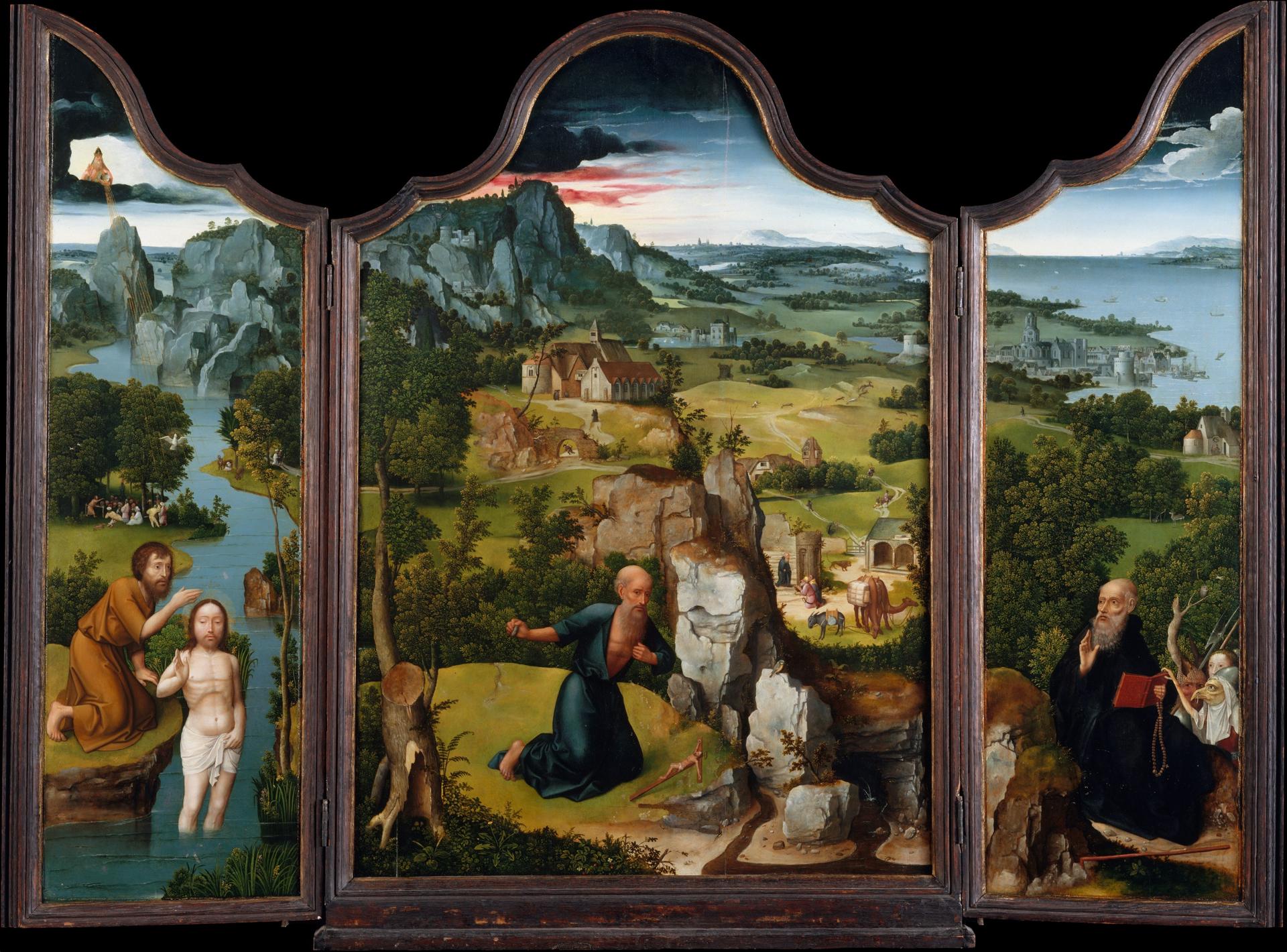
The Penitence of Saint Jerome
Original title: The Penitence of Saint Jerome
kurzbeschreibung
Joachim Patinir's triptych The Penance of Saint Jerome, painted around 1515, sets the saint's repentance within an expansive landscape. On the central panel Jerome kneels on a rock, while the side wings add scenes with Christ and a reading monk.
Description
At the centre, Saint Jerome kneels on a boulder, his head turned upward and a book held between his hands. Behind him a mountain landscape with scattered buildings opens up, placing the figure within a broad natural setting. On the left panel a figure representing Jesus Christ appears in a river landscape with a second person. The right wing belongs to a monk seated on a rock and reading, while a child points at something. The arrangement places the figures centrally, and the outer panels, with their detailed landscapes, draw the eye into the distance.
Context
Patinir, a Flemish Renaissance painter, was known for his landscapes and is regarded as a pioneer of independent landscape painting. Around 1515 he was working in Antwerp, where his religious subjects combined with sweeping landscapes were valued. The Penance of Saint Jerome was a common theme in Christian art, emphasizing solitude and contemplation. Altarpieces of this form were used in churches or private devotional spaces.
Impact
Muted, natural colours and soft light carry the calm, reflective mood and deepen the sense of space in the landscapes. The clear layout directs attention to the saint in the middle, while the far-reaching backgrounds create a meditative atmosphere that invites quiet contemplation.
Technique
The painting is executed in oil on wood, a common method in the Flemish Renaissance that allows fine details and subtle colour transitions. The panels sit in a wooden frame with a wavy top edge, pointing to the traditional construction of an altarpiece. Patinir's precise handling shows how carefully he treated textures such as garments and landscape forms.
AI-generated description text
Source: Metropolitan Museum of Art · Public Domain (CC0 1.0)