Paying the Hostess
Original title: Paying the Hostess
kurzbeschreibung
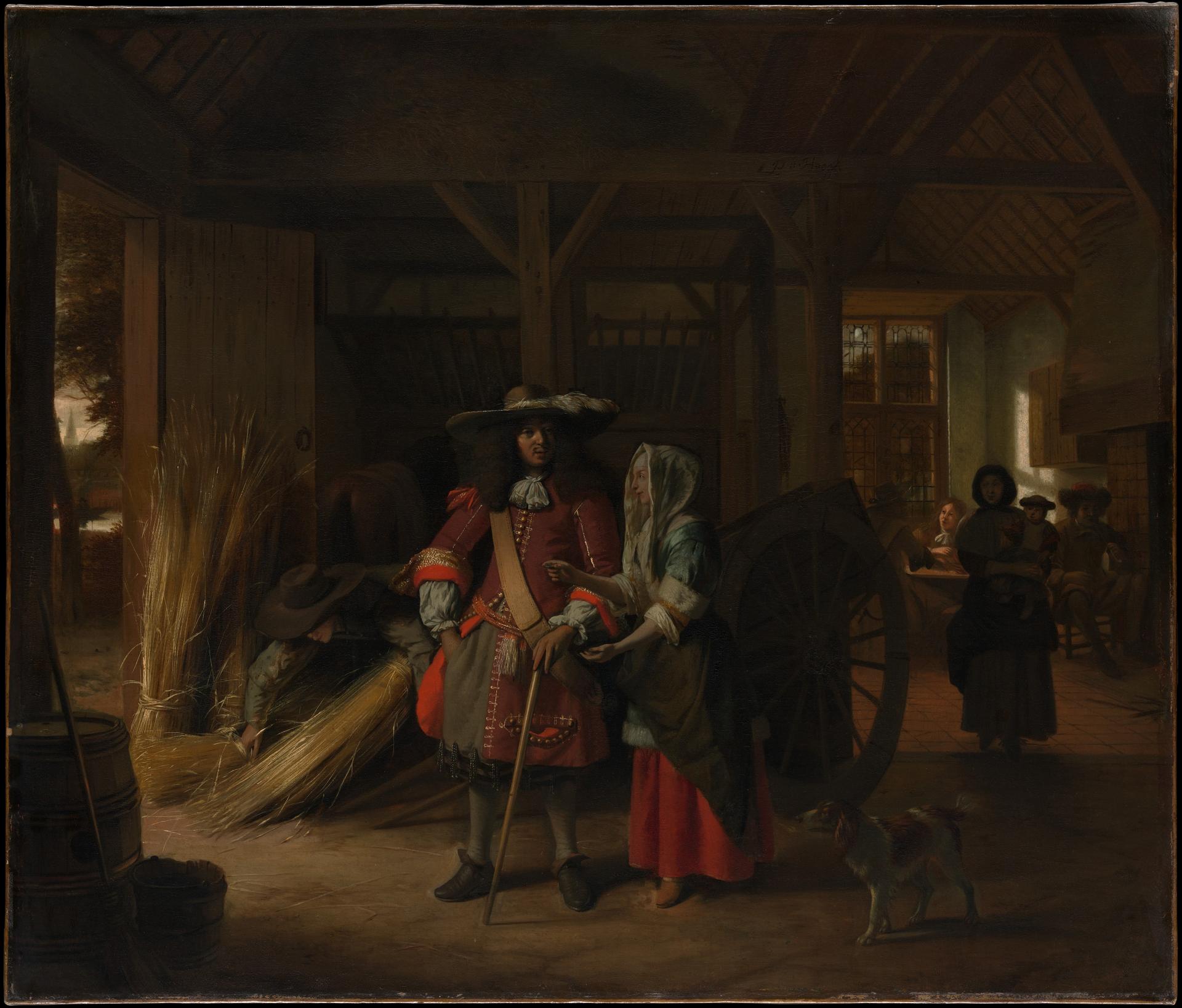
Unlike many comparable genre pieces from those years, Pieter de Hooch's painting 'Die Wirtin bezahlen', made around 1670, puts a tavern scene in a rural interior at its centre. Executed in oil on canvas, it shows a man and a woman in the foreground, accompanied by a dog, while other figures stay in the background.
Description
Up front, a man in striking clothes – red shirt, grey trousers, a hat trimmed with feathers – stands beside a woman in rural dress with a white headscarf and red skirt. She takes the man by the arm, and a dog runs towards the two. Behind them someone sits at a table, and other figures move about. Warm light falls through a window; wooden beams divide the walls, and in the rear area ears of grain and a cartwheel can be made out.
Context
Pieter de Hooch, a painter of the Dutch Golden Age, became known for his interiors with subtle lighting effects. This work comes from his later Amsterdam period, when he turned increasingly to rural subjects. Scenes of peasant life were widespread in the seventeenth-century Netherlands and often carried a moralising note.
Impact
The warm light and calm layout give the painting a cosy mood. The way the man and woman deal with each other and the rural setting feel everyday and inviting at the same time.
Technique
Oil on canvas is the material that shapes the picture's texture and soft colour transitions. De Hooch worked with fine brushstrokes to render fabrics and reflections of light precisely.
AI-generated description text
Source: Metropolitan Museum of Art · Public Domain (CC0 1.0)