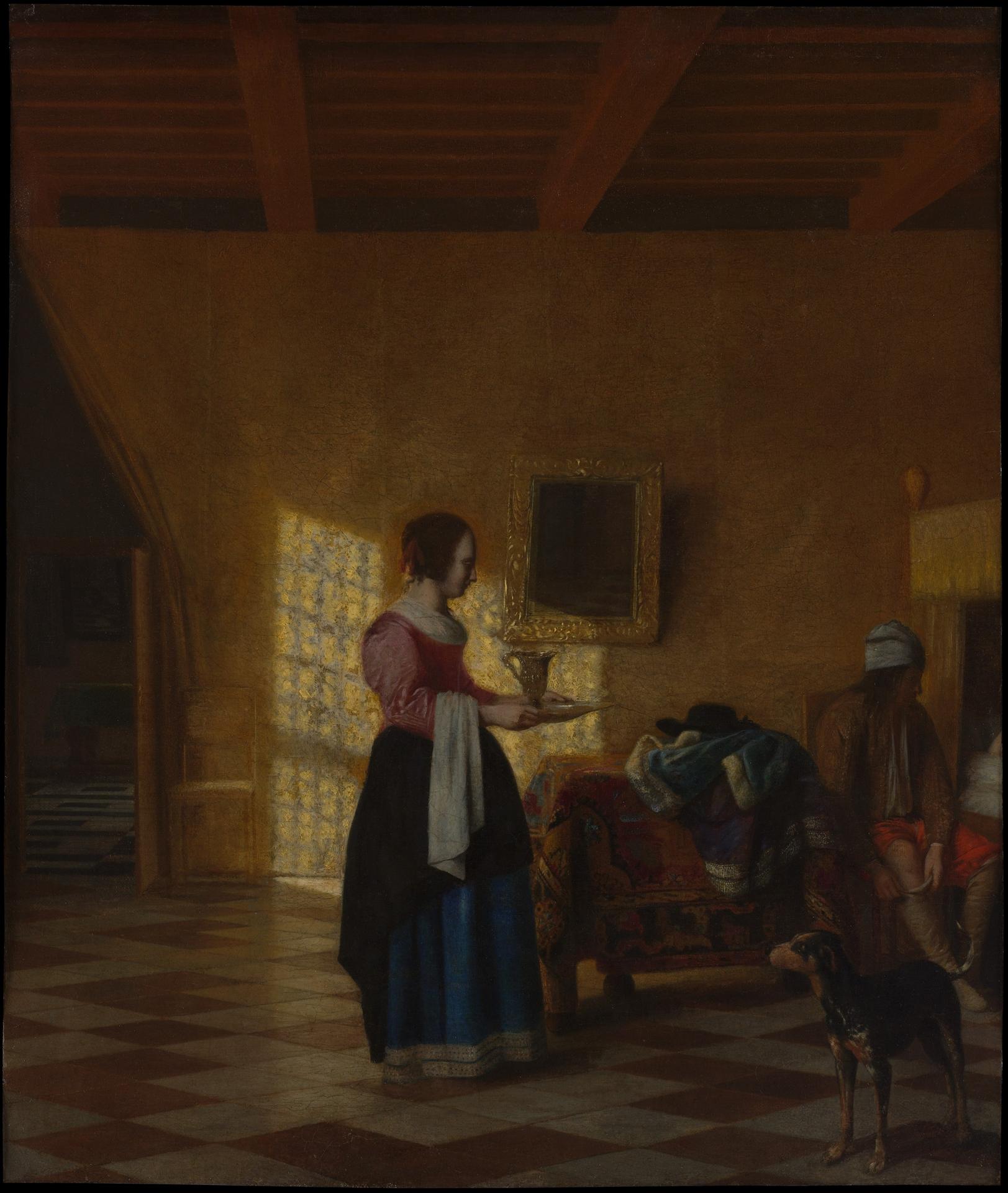
Woman with a Water Pitcher, and a Man by a Bed
Original title: Woman with a Water Pitcher, and a Man by a Bed
kurzbeschreibung
Pieter de Hooch painted this picture around 1667–70. A woman carrying a water jug stands in the foreground while a man lies on a bed behind her. Executed in oil on canvas, it measures 61.5 x 52.1 cm and ranks among the characteristic examples of seventeenth-century Dutch genre painting.
Description
A room with a beamed wooden ceiling and a broad window front on the left sets the stage. Up front stands a woman in traditional dress, red bodice, white apron and black skirt, holding a vessel on a tray. A dog beside her looks up at her. Toward the back a man rests under a blanket on a bed, wearing a head covering and a brown shirt. A picture in a gilded frame hangs on the wall, and the floor is laid with a pattern of red and white tiles.
Context
Pieter de Hooch was a contemporary of Jan Vermeer, active in Delft, where he specialised in interior scenes. This picture dates from his later period, when he was working in Amsterdam. Everyday scenes with moralising overtones were widespread in the art of the Dutch Golden Age. Nothing is documented about who commissioned the work; it belongs to a group of paintings with similar motifs.
Impact
Warm light falling through the window lends the scene a quiet, intimate mood. The muted palette and careful arrangement produce a still, everyday atmosphere that draws the viewer into the moment. Setting the woman in front against the man at the back creates a subtle narrative of closeness and distance.
Technique
Oil on canvas was typical for the period. De Hooch worked with fine brushstrokes and precise handling of light to render the textures of fabrics and tiles convincingly. Glazing allowed him to model the warm light effects and the depth of the room.
AI-generated description text
Source: Metropolitan Museum of Art · Public Domain (CC0 1.0)