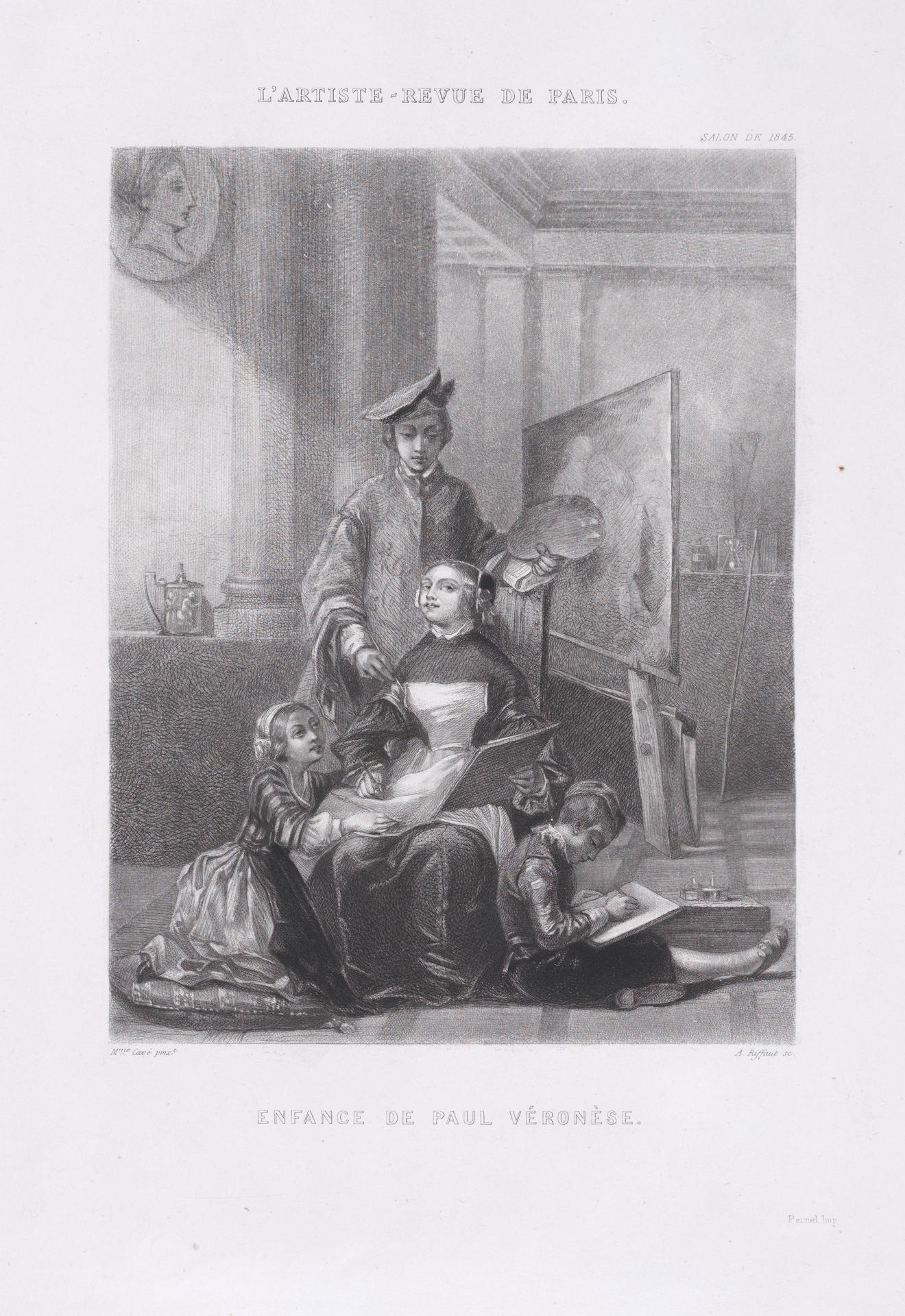
The Childhood of Paolo Veronese, from "L'Artiste"
Original title: The Childhood of Paolo Veronese, from "L'Artiste"
kurzbeschreibung
Adolphe Pierre Riffaut's lithograph "Die Kindheit von Paolo Veronese" (1845) belongs to the genre of artists' biographies, showing a group of children in a studio. Created as an illustration for the journal L'Artiste, the print focuses on the early years of the Renaissance painter Paolo Veronese.
Description
In a room set up as a workshop or study, several children have gathered. Daylight falls through a large window framed by curtains. On the right, an easel with a canvas indicates painterly activity. One child sits on the floor, drawing or writing in a book; another examines an object in his hand. A third stands upright, also occupied with an object, while a fourth looks up at the standing child from a cushion. The children's clothing follows 16th-century style. The rendering remains monochrome and realistic; subdued light creates an intimate atmosphere.
Context
The lithograph was made in 1845 for the French art journal L'Artiste – Revue de Paris. Riffaut thus worked in the orbit of Romantic history painting, which took an interest in the lives of great artists. By presenting Paolo Veronese as a child, the image emphasizes the idea of early artistic talent. L'Artiste regularly published such illustrated narratives to bring art closer to a wider audience.
Impact
The print feels quiet and intimate, inviting viewers to imagine themselves into childhood creativity. The subdued light and close observation of the children yield a nostalgic, idealized view of a famous painter's childhood. The layout directs attention to the various activities and underscores the atmosphere of concentrated making.
Technique
For this print Riffaut chose lithography, a planographic process in which a greasy crayon is drawn on limestone. This method allows fine lines and soft tonal gradations, giving the rendering a painterly quality. The artist used the monochrome of the print to bring out effects of light and shadow and to emphasize the intimate scene.
AI-generated description text
Source: Metropolitan Museum of Art · Public Domain (CC0 1.0)