Design for the Decoration of a Palace Wall (Veronese Palazzo?)
Original title: Design for the Decoration of a Palace Wall (Veronese Palazzo?)
kurzbeschreibung
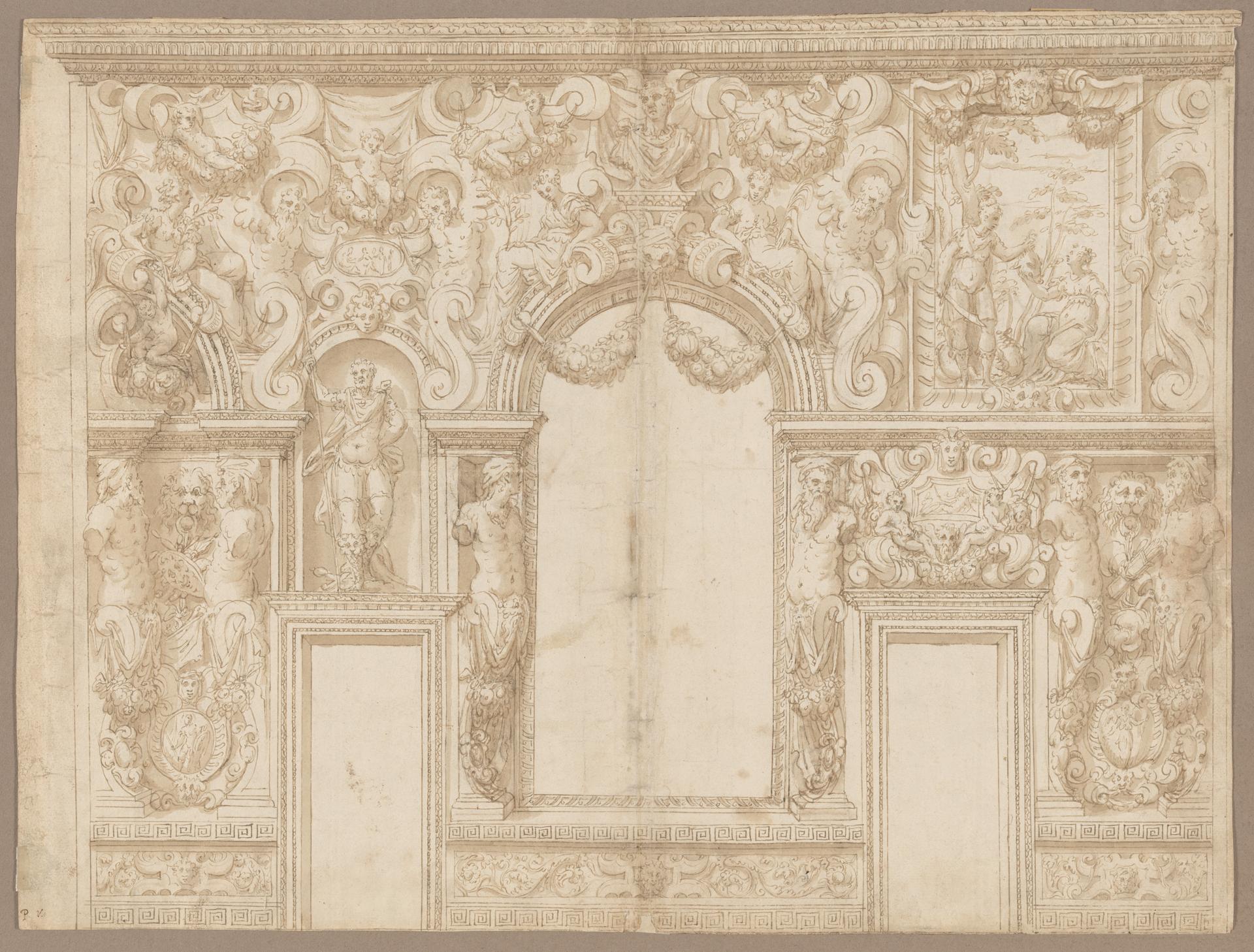
Columns, arches and scattered figures define this design by Alessandro Vittoria for a palace wall decoration, made around 1550–70. The sheet is executed in pen and brown ink, with brush and brown wash over black chalk. Its layout follows the Renaissance repertoire typical of elaborate interior schemes of the period.
Description
Two massive framing columns support an openwork arch at the top that recalls a triumphal arch. Between and below them, figures and masks are embedded in ornamental flourishes, suggesting mythological or allegorical characters. Flanking the central column, two further columns with similar decoration repeat, while the lower zone extends a grid-like pattern across the full width. The tonal values remain mostly gray and vary according to pen and brush technique; since this is a drawing, there are no directed light effects.
Context
Alessandro Vittoria, an Italian sculptor and architect, worked mainly in Venice. Around 1550–70, the decoration of palaces in northern Italy was of great importance, often with mythological and allegorical subjects. The attribution to a Veronese palace remains uncertain; the style, however, suggests a closeness to the Venetian art scene. Vittoria repeatedly took on decorative commissions for palaces and churches, and this design fits within his oeuvre.
Impact
Precisely drawn lines and dense ornamental detailing characterize the sheet and match Renaissance taste. The clear division into zones gives the design a monumental quality and foreshadows its later execution on the wall. The monochrome approach brings the graphic quality and structure of the design to the fore.
Technique
Pen and brown ink form the drawn foundation, while brush and brown wash create shading. Beneath lies an underdrawing in black chalk that establishes the layout. By combining drawing and wash techniques, details could be captured precisely and tonal values differentiated.
AI-generated description text
Source: Metropolitan Museum of Art · Public Domain (CC0 1.0)