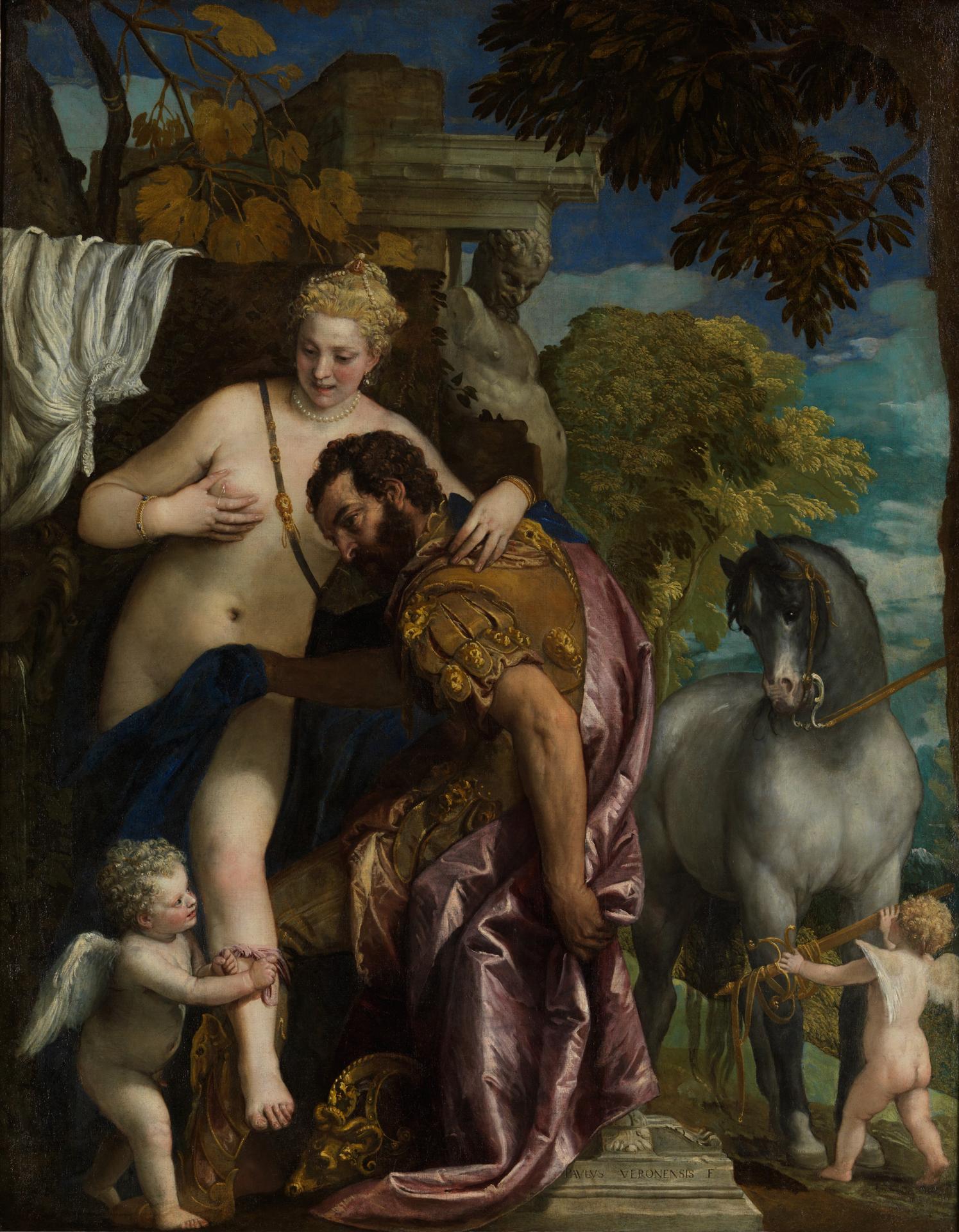
Mars and Venus United by Love
Original title: Mars and Venus United by Love
kurzbeschreibung
Paolo Veronese (Paolo Caliari) painted "Mars and Venus United by Love" in the 1570s in oil on canvas. Unlike many allegories of the period, the picture does not stress the opposition of war and love but their union through Cupid: Venus and Mars are brought together by the power of the love god.
Description
Venus sits in the foreground, half dressed and wearing a chain across her breast; Mars appears beside her in armor and cloak. Cupid, an angel, holds Venus's hand and touches her foot, while a second putto leads the reins of a white horse standing at the right. Trees, a fountain and a statue fill the background; light enters from the left and picks out the textures of the garments. The warm tones of the figures contrast with the cooler hues behind them.
Context
Veronese worked in the Venetian Renaissance, when mythological subjects were in demand among wealthy patrons. Mars and Venus were a familiar motif, standing for harmony between opposites such as war and love. The painting was probably made for a private collection, where it expressed humanist ideals. Veronese was known for his large, crowded compositions and for his skill in rendering sumptuous fabrics and precious materials.
Impact
The vivid colors and elegant arrangement create an atmosphere that is sensual and lofty at once. The interplay of the figures and the soft lighting give the picture an intimate yet theatrical effect, drawing the viewer into the allegorical scene.
Technique
Veronese used oil paint on canvas, a medium common in Venice that allowed fine gradations and luminous color. His handling is marked by loose brushwork and careful layering, which gives the figures volume and the fabrics their sheen.
AI-generated description text
Source: Metropolitan Museum of Art · Public Domain (CC0 1.0)